The Bombay Phenotype

ABO and H are the most important of the currently characterized blood group systems, since incompatibility between transfused red cells and recipient plasma leads to potentially devastating consequences. Those learning about this system spend lots of time memorizing biochemical details that can be overwhelming. In addition, exam-writers seem to enjoy asking questions about unusual entities in these systems that most blood bankers will never see in real life. Two very rare situations with altered red blood cell appearances (“phenotypes”), known as “Acquired B” and “Bombay,” are among those most frequently discussed on examinations. In a previous post, I discussed the Acquired B Phenotype (see my web page for further details and a video presentation). Today, let’s proceed with details about the very famous Bombay Phenotype.

In the 1950’s, a small group of people were identified in an area in India surrounding the city of Bombay (now called “Mumbai”) that appeared to be blood group O at first glance. As you should know from a basic understanding of the ABO system, group O individuals have antibodies against both A and B antigens, and as a result, can only receive red blood cells from donors who are also group O. The patients reported by Bhende et al (Lancet 1952;1:903-4), however, carried an extra antibody in their plasma that made them INCOMPATIBLE with others that were truly blood group O. These individuals (and others described since) lack a precursor antigen known as “H” both on their RBCs as well as in their secretions and plasma.

In brief, ABO antigens on red blood cells are made in a sequential manner. First, long sugar chains attached to either lipids or proteins (glycolipids or glycoproteins, respectively) on the surface of the RBC must be modified through the work of an enzyme encoded by the H (FUT1) gene (chromosome 19) to display H antigen activity. Only then can the chain be further modified by the action of a second enzyme that adds a single sugar to change that H antigen into either an A or a B antigen. The alleles inherited at the ABO gene site on chromosome 9 (A, B, and/or O) determine which ABO antigens will be expressed on the red cell surface, but again, such a change ONLY happens if the precursor antigen (H) is made first.

ABO antigens are unusual in that they are not only attached to RBCs, but are also present in free-floating forms throughout the body. The same manufacturing principle (first make H, then make A or B) applies to the formation of soluble ABO antigens found in virtually all bodily fluids, including plasma and saliva (and other secretions). The enzyme that is responsible for H antigen formation in these fluids is different than the one described above; it is encoded by the Se (FUT2) gene (also on chromosome 19).

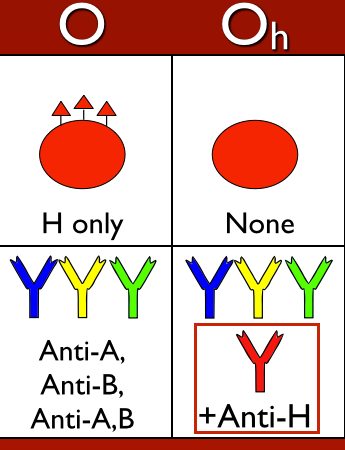
If a person lacks both active forms of both the H (FUT1) and Se (FUT2) alleles (described as having the genotype hh, sese), they are incapable of making H antigen either in secretions and plasma AND on the surface of the RBC (they are described as “H-deficient non-secretors”, and commonly with the shorthand Oh). The genetic mechanism of these changes is well described in the original cohort in India (a particular single nucleotide polymorphism in FUT1 accompanied by a total deletion of FUT2), and multiple additional mutations have been identified that could lead to someone lacking active forms of both alleles.
Bombay

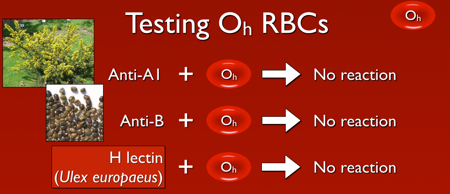
So, with that out of the way, what does this mean? Well, if a person lacks the ability to make H antigen in both RBC-based and free precursor chains, they will appear to be blood group O, just like someone who inherits two O alleles at the ABO site. However, unlike group O RBCs, which carry more H antigen than any other ABO group, H-deficient non-secretor RBCs have NO H antigen (this can be demonstrated easily in blood banks by showing no reaction when the RBCs are mixed with the H lectin Ulex europaeus). In keeping with the way other ABO system antibodies are formed, Bombay individuals make anti-A, anti-B, and anti-A,B, exactly like others that are group O. However, they also make a strong and very dangerous anti-H. The antibody is primarily IgM, but like most ABO-related antibodies, it reacts strongly at body temperatures, and generally is considered highly capable of giving rise to dangerous hemolytic transfusion reactions. As a result, Bombay patients can really receive blood only from others who completely lack the H antigen (which functionally means they should either get their own blood that has been stored for their future use or blood from another H-deficient non-secretor).
Bombay1

There are variants of Bombay, most notably the “Para-Bombay” phenotype in which the patient is H-deficient on RBCs, but IS capable of making ABO antibodies in secretions and plasma (these patients are H-deficient secretors). The key fact that must be evaluated in all of the Bombay-related phenotypes is whether or not an anti-H has been formed that is capable of reacting at body temperature. If so, Bombay variants must also receive only H-deficient red blood cells.

As mentioned, most workers will never see a patient with the Bombay Phenotype. This entity is seen mostly in examination world, but it is nonetheless very important for transfusion service personnel to be aware of this rare phenotype and prepared to take steps to diagnose it. I have seen reports of Bombay cases misdiagnosed as non-ABO high-frequency alloantibodies, and am aware of a case where the diagnosis became apparent when a child was born with an ABO type that seemed impossible based on the ABO types of the parents.
Chaffin

-Joe Chaffin, MD, is the new Vice President and Chief Medical Officer for LifeStream, a Southern California blood center headquartered in San Bernardino, CA. He has a long history of innovative educational efforts and is most widely known as the founder and chief author of “The Blood Bank Guy” website (www.bbguy.org).
CLSI and APHL to Co-Host 12th Annual AST Update Webinars

From the press release:

The Clinical and Laboratory Standards Institute (CLSI) and the Association of Public Health Laboratories (APHL) will co-host the 12th annual educational update webinars for antimicrobial susceptibility testing (AST).

Each January, CLSI updates standards for AST. It is important for clinical laboratories to incorporate the new recommendations into routine practice to optimize detection and reporting of antimicrobial resistance. In January 2015, the annual update of the M100 AST tables (CLSI document M100-S25) was published. In addition, the standards that describe performance of disk diffusion and minimal inhibitory concentration tests in versions M02-A12 and M07-A10, respectively, were updated. Some highlights for 2015 include introduction of the Carba NP test for carbapenemases and expanded recommendations for quality control testing.
These changes and several other new recommendations found in M100-S25, M02-A12, and M07-A10 will be discussed during the webinar. In addition to the webinar, an optional postprogram self-assessment will be provided that will allow individuals to assess their knowledge regarding the most important AST and reporting issues for 2015. Laboratories can use this feature to augment competency assessment requirements for their staff.
The webinar will be led by Janet A. Hindler, MCLS, MT(ASCP), Senior Specialist, Clinical Microbiology, at the UCLA Health System in Los Angeles, California, USA.
Webinar information is as follows:
CLSI 2015 AST Update
February 4, 2015 • 1:00–2:30 PM Eastern (US) Time
February 5, 2015 • 3:00–4:30 PM Eastern (US) Time (repeat session)
Learner Level: This intermediate-level program is appropriate for laboratory professionals working in clinical and academic settings.
At the conclusion of this program, participants will be able to:
    • Identify the major changes found in the new CLSI document M100-S25.
    • Design a strategy for implementing the new practice guidelines into their laboratory practices.
    • Develop a communication strategy for informing clinical staff of significant AST and reporting changes.

Register for the upcoming webinars at www.aphl.org/clsi.

How to Say “No”

Saying “no” to things is a learned skill that takes continuous practice, and a good amount of balance. The balance is because when you’re starting out in your career, I firmly believe that it’s important for you to agree to requests and to take on new tasks. It gets you out there, introduces you to new people and new skill sets, and teaches you so much you might not learn just performing your regular job. But then we get into a habit of saying ‘yes”, and we all know how hard habits are to break. We think things like, “if I don’t do it, no one will” or “if I do it, it will be done correctly.” Or more than just those things, we all like to please people, especially our friends and colleagues. So when a friend asks you to take on another research project or review a paper or look over some data or run a test or cover their call, we all readily agree to taking on just one more task.

As with every other aspect of life though, there is such a thing as too much of a good thing. Saying “no” occasionally is good for your overall health and sanity. It’s entirely possible to reach a stage where you’re so over-whelmed that you cannot do a good job at any of the tasks you have undertaken. Thus learning the art of saying “no” is also important, and is something I myself am just still struggling to learn.

Here are some points to remember that may help you when you need to say “no:”

  • Don’t give an immediate response, especially if you have any concerns about having time for this new task. Tell the person you will get back to them after some thought, and tell them when you will reply to them.
  • Give yourself time to consider whether the new task can be accommodated in your current workload, or whether you will have to short something else to accommodate it.
  • Be firm once you’ve decided. Don’t use phrases like “I don’t think I can.” Say “I cannot. ” And be persistent because you may have to turn down this opportunity more than once.
  • Always remember, you are turning down a request, not a person. It is especially hard when the request comes from a friend, but sometimes it is necessary.
  • Accepting a task that you don’t have time for is not doing any favors for yourself or the person asking. If the requestor has to then become a nagger to get you to complete their task, they will not thank you for it.

In conclusion, it’s important to maintain a balance at work without overloading yourself with too many tasks to allow you to accomplish any of them well. Learning to say no to requests is an important part of keeping that balance.

-Patti Jones PhD, DABCC, FACB, is the Clinical Director of the Chemistry and Metabolic Disease Laboratories at Children’s Medical Center in Dallas, TX and a Professor of Pathology at University of Texas Southwestern Medical Center in Dallas.

Final Thoughts from the Fellowship Application Process

And with the dawning of a new year, I’m another year closer to becoming a full-fledged pathologist. Exciting and yet daunting at the same time as I have only 1.5 years and my AP/CP boards left before I start my fellowships! So, I thought I’d leave some final words on what I learned during the fellowship application process for those who have yet to go through it.

The earlier you decide on your choice of fellowship(s), the better you can prepare by presenting and publishing research in your area of interest, spending extra rotation time and study in areas related to your interest, and networking within your academic subspecialty organizations. I would say for the first half of first year, concentrate on your rotations especially surgical pathology and grossing technique. But at the latest by the second half of your first year, start honing in on what you think you’d eventually like to do and working toward that goal. Most residency programs are amenable if you ask them to adjust your schedule so you can rotate early through subspecialties of possible interest during your second or early third year. Don’t forget to ask for lighter rotation months and less/no call duties during peak interview season (Oct-Jan).

If you can, do an elective during your second or early third year in your subspecialty of interest at your dream program(s) before fellowship decisions are made and fund it through grants such as the one offered by ASCP (1/16/14 deadline; application here). I found that often, positions were already promised or eventually went to internal candidates or external candidates who had done an elective prior to their interview. Scheduling for elective rotations takes foresight, time and effort (eg – state medical license can take months), and an available rotation spot during your desired month, so start the process early!

Research early to create your application list. Only you will know the number you feel comfortable applying to which depends on your personal situation (eg – subspecialty competitiveness). I found that attending conferences and listening to speakers in my content area of interest helped me to decide which programs I may like. I’m also very active in CAP and ASCP and the physicians I work with in these roles, pointed me toward programs where the culture might be a good fit for me as they were role models of the type of people that I would like to work with. Of course, I also applied to top programs that I knew or that my attendings advised me were good.

Then check with programs about the opening date for application submissions if it is not posted on their website. I found that frequently, these were not hard deadlines. Since we don’t have a match, decisions are rolling (eg – I got promised an offer during my interview day and have friends who also had similar experiences). Once again, the early bird may catch the worm, and not because they are necessarily the best bird, but the first bird that a program likes. While some programs have a schedule for decisions, I found that just as many made offers as soon as they found someone they liked.

Make sure that personal statements are no longer than one page, shorter is better. You can follow this format: 1) how and why you fell in love with that subspecialty, 2) what you bring to the table especially for the program, and 3) what you want out of your fellowship and why that program is the best to accomplish those goals. Ask multiple people in your subspecialty or more senior residents to give you feedback on your personal statement/CV and for letters of recommendations very early – give a deadline earlier than you need so that you can have them ready by the time you want to submit.

I applied mostly to programs that had both hematopathology and molecular pathology fellowships and stated in my cover letter that I wanted to do both consecutively at the same place (but that it wasn’t a deal breaker). I received invites at almost all but decided to interview at a select number. For the ones where I interviewed for both fellowships (ARUP, Hopkins, MD Anderson, UPMC, Houston Methodist), it was usually the program looking for the fellow first who made the arrangements with the other fellowship. ARUP had interviews over 2 days (paid expenses except airfare) but the others all worked it out so that half a day was interviewing for hematopathology and the other MGP. Receiving an offer from one did not necessarily mean that I would automatically get one from the other. Scheduling both on the same day, also made things a little more difficult.

Respond to invitations quickly because this process is truly rolling. I was often given a limited choice of date(s). One place gave me only one date for an interview that I couldn’t make. Rescheduling can result in losing an interview because programs interview less people over fewer dates than they did for residency and will schedule someone else if you can’t make it. Some programs told me they were interviewing 2-3 per position while others said 5-10.

Be courteous and prompt, send your “thank you” email/note early and no later than by the next day. You can have a basic “thank you” email template ready to go that you can personalize so that you can send it even while waiting at the airport to go to your next interview. And be honest. I found that being upfront made it easier for programs to extend me a counteroffer when I mentioned that I had to make a decision soon on another offer. Once you’ve accepted a position, keep in touch with your program to hit fellowship running! I hope to do a PGY4 research elective in order to submit abstracts for conferences that occur soon after I start my fellowship and to familiarize myself with the EMR and clinical workflow in both fellowship areas.

And finally, be true to yourself about your goals, realistic possibilities, and most importantly, the program characteristics that will make you most happy. When I was applying to college, academic prestige and idealism were important, and for medical school, proximity to my aging parents. But now, what I find most important is the fit of the program. I want to be happy and feel like it is my home. I want to be at a place that hires their alumni and goes out of their way to help them find jobs. I want to be around role models working in areas that I want to as an attending: advocacy, medical education, and research…and of course, foremost, clinical diagnostic excellence…and who I feel will continue to support me as colleagues in the future. For me, fellowship isn’t just the time to merely refine my clinical expertise or learn things that I didn’t get to during my residency. It was more like interviewing for a job rather than for school admissions, making decisions with a more immediate goal of what I want to accomplish after and no longer “down the road”, and most importantly, building toward my future.

And I’m happy to say that I did get multiple offers from great programs and accepted at the place I felt the best fit. It was my last interview in mid-December, so you never know. I can say that having served in positions with CAP actually helped me because I already felt at home with 2 of my interviewers with whom I serve on a CAP Council (we just had a meeting 4 days prior) and one of the current fellows who I also met through being involved with CAP. So, networking, even when it isn’t deliberate or conscious as it was in this case, can help. In case you’re wondering, I’ll be completing hematopathology (2016-2018) and molecular genetic pathology (2018-2019) fellowships at Houston Methodist and also hope to participate in research at the Houston Methodist Research Institute.


Chung

-Betty Chung, DO, MPH, MA is a third year resident physician at Rutgers – Robert Wood Johnson University Hospital in New Brunswick, NJ.

Microbiology Case Study

Patient History:

81 year old man with a history of systemic vasculitis (present for the past 10 years ANCA negative, ANA negative, Rheumatoid factor <20) on immunosuppression (plaquenil with prednisone 40mg for flares about every 6 months), type 2 diabetes, and hypertension presented to an outside hospital with weakness and dyspnea. He was found to have a widespread purpura, ulcerative lesions, acute kidney injury (creatinine 4.7), and 3 days of hematochezia. He was started on 7 days of levoquin and zosyn for a presumed pneumonia and with no improvement was transferred to our institution. On admission, a CT scan of the chest demonstrated bilateral multifocal pneumonia and multiple cavitary nodules within the lungs. A thoracentesis was performed and was transudative (wbc 1883, N 63%, protein 2.6).

Laboratory findings:

  • WBC 7000/cmm
  • Hemoglobin 9 g/dL
  • Platelet count 104 K/cmm
  • Bacterial culture blood, no growth
  • Cryptococcal antigen negative
  • Pleural fluid bacterial culture and smear negative
  • Pleural fluid AFB culture and smear – no acid fast bacilli, modified acid fast bacilli seen from bottle
  • Pleural fluid fungal culture and smear – no fungi seen, rare modified acid fast bacilli growing
  • Histoplasma urinary antigen positive
  • Histoplasma antibodies negative
  • Blastomyces urinary antigen negative
Gram stain of growth from the AFB bottle showing beaded, branch Gram positive bacilli.
Modified acid fast stain of growth from the AFB bottle showing modified acid fast bacilli.
Isolated growth on BCYE media.

Discussion:

Based on Gram stain and modified acid fast stain, modified acid fast bacilli suggestive of Nocardia species was reported. Nocardia are strict aerobic, gram positive, filamentous rods that stain partially acid fast. This is due to the mycolic acids in the cell wall which are shorter than those of mycobacteria. Nocardia species produce many virulence factors including Cord factor (prevents intracellular killing), catalase and superoxide dismutase (which inactivate reactive oxygen species that would otherwise prove toxic to the bacteria).

Nocardia grow well on buffered charcoal yeast extract agar and at 30oC. They produce aerial hyphae and can have a chalky colony appearance. Species level identification is best done with molecular methods. This isolate was identified as Nocardia farcinica at a reference laboratory.

Nocardia species are ubiquitous in the soil. They can cause infections in immunocompromised hosts usually after inhalation or direct inoculation. Infections include bronchopulmonary disease and cutaneous infections. With bronchopulmonary disease, cavitation and spread to the pleura is common, which fits with our patient. Dissemination is also seen with common sites being brain and subcutaneous tissue.

Our patient had a positive Histoplasma urinary antigen, but negative Histoplasma antibodies. The working diagnosis was disseminated Histoplasmosis and he was being treated with amphotericin B. He expired and no postmortem exam was performed. Fungal cultures from the pleural fluid were not growing fungus at the time of this post. Fungal cultures were not obtained from sputum and a BAL was not performed.

-Dan Olsen, MD is a 4th year anatomic and clinical pathology resident at the University of Vermont Medical Center.

Wojewoda-small

-Christi Wojewoda, MD, is the Director of Clinical Microbiology at the University of Vermont Medical Center and an Assistant Professor at the University of Vermont.

Significant, but Fragile, Gains In the Fight Against Malaria

Marie Levy

January 2015 Lablogatory post

In recent months it seems that the only news stories about sub-Saharan Africa presented by western media are about Ebola. There are some bright spots in that news, but in general it is scary and saddening. Lost in the Ebola shuffle, however, is some good news about the fight against malaria. A recently released report from the WHO Global Malaria Programme states that worldwide the malarial mortality rate fell by 47% between 2000 and 2013 and currently 55 countries are on track to reduce their malarial burden by 75% by 2015. Those are exciting numbers. The report attributes these improvements to increased use of insecticide treated bed nets, accurate diagnostic testing, and increasingly effective drug therapies.

Accurate diagnostic testing means that the lab is playing a crucial role in the fight against malaria. Data from 2013 shows an increase in the use of diagnostic tests in sub-Saharan Africa. This supports additional data that shows there has been a shift from presumptive treatment to diagnostic treatment.

As a public health community, however, we cannot become complacent. The WHO report states that, in Africa, over 43,000 children die from malaria each year, 15 million pregnant women do not have access to preventative treatment, and over 200 million people live in households without access to insecticide treated bed nets.   Drug and insecticide resistance is a serious concern (thus underscoring the importance of accurate diagnostic testing to prevent presumptive treatment that can contribute to drug resistance). In the West African countries hit by the Ebola outbreak, health care resources have all been directed towards the fight against Ebola leaving them vulnerable to increases in other disease occurrence. If nothing else, however, the Ebola outbreak has provided a reason and impetus for discussions surrounding the importance of health systems strengthening. Strengthening that will not only fight future outbreaks of diseases such as Ebola, but will improve health care networks for every day care and treatment.

Thus, in the spirit of the holidays, let’s celebrate this good news. But while doing so, let’s also continue the fight and keep up the good work.

Links for further reading:

http://apps.who.int/iris/bitstream/10665/144852/2/9789241564830_eng.pdf

http://www.nytimes.com/2014/12/14/opinion/sunday/fragile-gains-against-malaria.html?_r=0

http://kff.org/news-summary/significant-global-gains-made-against-malaria-but-ebola-threatens-progress-in-west-africa-who-report-says/

Levy

-Marie Levy spent over five years working at American Society for Clinical Pathology in the Global Outreach department.

Does Pathology Need a Modern Day Flexner Report?

Happy New Year! I hope that everyone has been having a great holiday season so far. I just wanted to share some brief musings I recently had as we start our new year…

Most of us have heard of the famous 1910 Flexner Report but for those who are unfamiliar, it is not exaggerating to state that it transformed and birthed the modern concept of biomedical education that we know today. Originally entitled “Medical Education in the United States and Canada”, it was study commissioned by the Carnegie Foundation for the Advancement of Teaching (CFAT), an American educational policy and research “think tank” founded in 1905. The report’s author, a former secondary school teacher and principal and not a physician, toured all the existing medical schools in both the U.S. and Canada and recommended reforms that would result in the standardization of the structure of medical curricula with Johns Hopkins as their ideal model. Medical education went from for-profit apprenticeships, varying in quality, to an academic model of basic science study followed by practical hands-on training in patient care. Eventually with standardized accreditation requirements, most medical school curricula, despite their differences in implementation, had their core foundation in common: didactic years to learn and clinical years to apply (under supervision).

Like the proprietary “medical” training institutions of yesteryear that existed prior to the Flexner report, do our pathology training programs need a global re-evaluation and an overhaul? Despite the existence of ACGME accreditation criteria and visits, do we have programs that need serious reform or termination to meet an ideal? Do our accreditation standards need to change to create a new ideal? And must we come together now to adapt our expectations and training objectives to meet the challenges of our rapidly evolving health care landscape? What is and should be the role of the pathologist on the interdisciplinary clinical health care team? And so the core question becomes, what are the most important things that we need to teach our trainees and how do we go best about it? I’d love to hear your thoughts…

And to encourage scholarship in the Flexner tradition that also emphasized the role of research in our education…for those who would like to submit an abstract for resident poster and platform presentations, submission periods for these conferences are currently open (except for CAP) with the following deadlines (I’ll try to update with more later but these are the most immediate in terms of deadlines in the next quarter):

Chung

-Betty Chung, DO, MPH, MA is a third year resident physician at Rutgers – Robert Wood Johnson University Hospital in New Brunswick, NJ.

Go Outside And Play in the Dirt

Researchers may have made some headway in the fight against antimicrobial resistance. A paper published online in Nature today (abstract only unless you’re a subscriber) discusses a new method to grow bacteria that have previously been uncultivable. In doing so, researchers have discovered a new antibiotic they’re calling teixobactin that is active against gram-positive organisms (specifically, a precursor of peptidoglycan present in the cell wall). Initial tests suggest bacteria can’t form a resistance to this mode of action.

Maybe there’s something to the expression “throw some dirt on it and get back in the game” after all.

NPR and the Washington Post discuss this paper and its findings today, as well. It’s too soon to be excited, but I admit I’m cautiously optimistic.

Swails

Kelly Swails, MT(ASCP), is a laboratory professional, recovering microbiologist, and web editor for Lab Medicine.

Clinical Laboratory Science Education

At a young age, children have an idea of what they want to be when they grow up. From lawyers, to doctors, to scientists, children believe they can do it all. However, clinical laboratory science is not for everyone. In fact, Courtney Lower, who graduated from the University of Illinois-Springfield in 2014 with a Bachelor of Science degree in CLS, would attest to that. She believes that for someone to succeed in this field, one “must have patience, a high level of problem solving skills, and a compassion for helping others.” Possessing all of those skills is necessary when providing laboratory information and services that are required for the diagnosis and treatment of disease.

A clinical laboratory scientist not only performs laboratory tests, but he or she must also be able to explain the significance of these tests to physicians and other health professionals. A CLS must also be able to evaluate new methods and determine the effectiveness of new laboratory tests. This intense problem solving, along with her love for science, was what attracted Lower to the degree in the first place – which has in turn opened up the door to several possibilities.

Receiving a CLS degree has the potential to set one up for a multitude of exciting careers. A graduate can work in laboratories in several different settings: hospital, clinic, reference, government, or commercial. Within those laboratories, one could work in areas such as microbiology, chemistry, blood bank, hematology, and virology. Opportunities also exist in stem cell laboratories and veterinary clinics. Graduates can also use the degree to propel themselves into graduate or medical school.

Typically, CLS students take several science courses—typically chemistry and biology—before starting their degree-specific coursework. Most students take a similar route of three years of undergraduate schooling followed by a year in a laboratory setting to finish out their degree. Students enjoy this short schooling because it means that they can get into laboratories sooner. In particular, Lower remarked that, “My favorite program was rotations. It prepared me for transitioning from the classroom to the laboratory and I was able to gain more hands-on knowledge.”

Receiving a clinical laboratory degree has never been better when it comes to the job search. Graduates are basically guaranteed a job, partly because the degree is so versatile and partly because of abundant vacancies in the field. Hopefully this will be a degree that inspires young students let their love for science grow and partake in this field, allowing them to truly be able to do it all. Children can grow up knowing that they can serve a wide variety of employment opportunities and that their dreams can grow right along with them.

-Shannon Little is from Stillwater, Minnesota and is currently a journalism student at the University of Missouri. She is the fundraising chairman for Autism Speaks U. and is active in her sorority. In her free time, she enjoys watching U of M football.

Letters of Recommendation

Have you ever been asked to write a letter of recommendation? One of my favorite tasks is to write such a letter for someone who I believe is totally worthy of the honor for which he/she is being considered, or completely suited to the position or new career for which they are headed. Conversely, one of my least favorite tasks is to write such a letter for someone I’m unconvinced fits either of those categories.

Writing a letter of recommendation for someone you know well and believe in is a joy. It’s easy to write, easy to find examples, easy to express concepts. It almost writes itself. Writing a letter for someone you don’t know well, or aren’t sure fits the reason for the recommendation, can be a painful, tedious project.

A colleague once told me that if I can’t write a glowing recommendation for someone, I should decline to write one at all. That’s good advice because the recipient of the letter can often tell when you’re enthusiastic, and when you’re not. I have also received letters of recommendation for applicants from people who actually write a bad recommendation – why not to hire the person or admit him/her to the program. I’m appalled that people would agree to write a letter if they are going to write a bad recommendation. Yes, it is hard to say no to someone who comes asking, but it is far better to say no than to write a bad letter of recommendation.

Occasionally you may not have any options, and may need to write a letter of recommendation. For example a person may need a letter from their boss and have only worked in the job they currently have. Or they need a letter from their most recent instructor, and that’s you! These are especially hard to write because you may feel obligated to write a reference, but not have enough personal experience with the person to write a glowing one. In these cases, all you can do is write about as many positive aspects of the person as you are aware of and leave it at that. Sometimes I have talked to the person’s immediate supervisor or work colleagues to gain some insight before writing the letter.

I have declined to write a letter of recommendation on occasion. In general, I decline because I have not had enough direct contact with the individual asking me to provide them with a good recommendation. Once in a while I decline because I truly can’t recommend the person.

From the opposite perspective, when asking someone to write a letter of recommendation for you, always ask for a GOOD recommendation. Also, try to always ask people who know you well and know your work and work ethic well. You’ll be doing both them and yourself a favor.

-Patti Jones PhD, DABCC, FACB, is the Clinical Director of the Chemistry and Metabolic Disease Laboratories at Children’s Medical Center in Dallas, TX and a Professor of Pathology at University of Texas Southwestern Medical Center in Dallas.