MERS Outbreak in the Republic of Korea

Lablogatory spoke to Kyung Jin Cho, PhD, from the Department of Health and Environmental Science at Korea University about the current outbreak of MERS in the Republic of Korea. This is what he had to say.

Lablogatory: What can you tell us about MERS in the Republic of Korea?

Dr. Cho: MERS is a viral respiratory infection caused by Middle East Respiratory Syndrome Coronavirus (MERS-CoV). The MERS-CoV belongs to the coronavirus family (beta coronavirus). Many MERS patients developed severe acute respiratory illness with symptoms of fever, cough, expectoration, and shortness of breath. The cause of MERS is not yet fully understood. Some infected people had mild symptoms or recovered. Incubation period is known as 2-14 days. The incubation periods are still under dispute since a few cases in Korea reported incubation periods longer than 14 days. Fortunately, the MERS outbreak appears to be subsiding with one or two new cases are reported daily. Many people under the house quarantine at the peak of MERS outbreak are now released.

STATISTICS
The Korean MERS portal reported that there are 27 deaths from 175 cases as of June 23, since the first MERS patient was confirmed on May 20, 2015 (Fatality rate: 15.4%). Most of the people who died had an underlying disease such as chronic lung and kidney disease, cancer, and diabetes mellitus. Of the 27 deaths, 74.1% were male and all were over the age of 40. Of the 175 confirmed cases, male 107 (61.1%), female 68 (38.9%); the Inpatient/outpatients 80 (45.7%), family members/visitors visiting sick persons 62 (35.4%), staff and other hospital employees 33 (18.9%). Most of the MERS cases were infected within the medical facilities. The cumulative number of released individuals from quarantine is 10,718. The current number of isolated is 2,805 (home 2,091 and institution 714).

Lablogatory: How fast is it traveling within Republic of Korea?

Dr. Cho: The major second place of MERS spread was a mammoth hospital which is a top-class institution in Seoul. Within a large hospital, the Hospital S, nearly half of the cases (82 of 166 cases, As of Jun 20, 2015) were exposed to the MERS during June 5th through June 10th. The hospital S admitted the 14th case of MERS and became the epicenter of the second generation of MERS cases. The health authority failed to carry out timely control measures against MERS. The authority and the hospital S were harshly blamed for the late response in the beginning of MERS outbreak.

During the MERS outbreak, a few doubtful MERS patients roamed about a few institutions. Some local hospitals had to refer their untreated cases to the tertiary hospitals located in big cities, like Seoul or Busan, which have excellent specialists and more resources. Unfortunately, some of the hospitals could not cope with the unexpected MERS outbreak. The triage systems in some medical institutions and the house quarantines were not operated successfully at the beginning, which contributed to the spread.

Lablogatory: Beyond the basic protocols, what other measures are being put in place, or SHOULD be put in place to stop the spread of this virus?

Dr. Cho: The Government’s rapid-response team (RST) should have activated much earlier. Government should have timely announced the list of hospitals in which MERS cases appeared and should have issued the compulsory order for the closure or partial closure of the few target hospitals much earlier. We realized that there are too few officials who are working for the government as experts in the epidemiology.

Also, the number of efficient Airborne Infection Isolation Room (AIIR) is largely insufficient. The possibility of MERS spread within the patients’ rooms and emergency room might be much higher than we would have expected.

Even though the government and some hospitals didn’t make timely responses, they disclosed the list of 84 hospitals (As of June 20th, 2015) that had MERS cases onset or MERS cases passed by. They also announced the list of 251 safe hospitals so that general citizens and respiratory patients can take the treatment under the safe conditions.

Seoul City authority asked citizens of Seoul to report MERS outbreak to Dasan Call Center (120) or official website of the Seoul metropolitan city. Citizens of other areas can report the outbreak to Korea government’s official website.

Through text messages or phone calls, the Hospital S tried to reach all the people who visited the Hospital S during the periods of high MERS exposure. Most of citizens are now well complying with the government measures.

Since some MERS patients in Korea exhibited symptoms beyond the two-week latency period, local health authorities will maintain a tent at the entrance of the town for more five days with staff to monitor if any villagers show symptoms.

The health authority is monitoring three hospitals intensively ( Hospital G in Seoul, Hospital A in Chungcheong province and Hospital G in Busan) that could possibly become new epicenters for the spread of MERS.

Lablogatory: How should institutions protect laboratory workers? What steps can clinical laboratory scientists take to protect themselves?


Dr. Cho: Information can be found here:“The Guidelines on Diagnostic Testing for MERS.” These guidelines include information about specimen collection, transport, and testing.


  Continue reading “MERS Outbreak in the Republic of Korea”

Serum Protein Electrophoresis in Children

Although most of the testing performed and the methodologies utilized in a clinical laboratory which serves a pediatric institution are very similar to those found in adult laboratories, a few differences stand out. Differences include devising ways to deal with small test volumes and different test menus than those found in laboratories that serve adult patients. One such test menu differences is the lack of serum protein electrophoresis (SPEP) testing in pediatric labs.

SPEP’s are essentially performed for the main purpose of helping to diagnose and then monitor the treatment of multiple myeloma. SPEPs provide this help by detecting, identifying by reflex immunofixation electrophoresis (IFE), and quantifying monoclonal gammopathies. Children don’t get multiple myeloma. After 20 years of signing out SPEP results at the county hospital next door, the youngest person with a diagnosis of multiple myeloma that I’ve seen was 24 years old. Thus in general SPEP’s are not ordered on children, nor performed in pediatric labs.

Recently however, I learned that although children don’t get multiple myeloma, they do in fact get monoclonal gammopathies. An SPEP ordered on a 7 month old patient in my institution came back with a very clear biclonal gammopathy, identified by IFE as an IgG kappa and an IgA kappa. This child has no bone marrow indication of abnormality, although she does have a deficiency of B-cells along with plasma cell infiltrates in the liver and duodenum.

A little searching determined that apparently, monoclonal spikes on SPEP’s in children are not at all unusual. A study published in 2014 (1) looked at 695 children who had SPEPs performed, and 11% of those children had a monoclonal gammopathy, although none of them had multiple myeloma. The most common associated diagnosis was ataxia-telangiectasia (22%), with a wide range of other diagnoses being found in these children, including some immunodeficiencies, autoimmune diseases, various hematological disorders and a few solid organ malignancies.

Thus it appears that monoclonal gammopathies are present in children and have an entirely different meaning than they do in adults. In addition, currently monoclonal gammopathies in children have no clear diagnostic utility. Perhaps that is the real reason we don’t routinely perform them in the pediatric population.

  • Karafin MS, Humphrey RL, Detrick B. Evaluation of monoclonal and oligoclonal gammopathies in a pediatric population in a major urban center. AJCP 141:482-487. 2014

-Patti Jones PhD, DABCC, FACB, is the Clinical Director of the Chemistry and Metabolic Disease Laboratories at Children’s Medical Center in Dallas, TX and a Professor of Pathology at University of Texas Southwestern Medical Center in Dallas.

Troubleshooting Complex Instrumentation

When we talk about technological advances in laboratory medicine, the discussion usually focuses on analyzers, methodology, or ancillary equipment that makes testing more accurate or efficient (hello conveyer belts and molecular testing; goodbye bleeding time). While all of those are valid conversations, one component that gets left out of the mix is troubleshooting. After all, an instrument that runs 600 tests an hour is nothing more than a place to put sticky notes if it’s not working properly.

When I first started in the laboratory, “troubleshooting” more often than not meant “put a ‘do not use’ note on the analyzer and call in the service rep.” Unless the fix was something simple (like removing a jammed cartridge), we left it to the professionals. That attitude gradually changed, however. When I left the bench, most of my coworkers thought nothing of “lifting the lid” to change tubing, observing the inner workings of an analyzer as it operated, and repairing an instrument with the assistance of a service rep over the phone. In fact, manufacturers trained us fairly extensively in troubleshooting each time we bought a new analyzer. Thanks to the ubiquity of the internet, it is commonplace for a service rep to remotely take control of an analyzer in order to diagnose and repair software (and even some hardware) issues while offsite.

So what’s next? Videoconferencing software so a service rep can see a malfunction in action, maybe, or virtual reality software that can assist a bench technologist with complex repairs. Maybe even analyzers that diagnose or repair themselves!

What do you think? What is the next innovation in clinical laboratory instrumentation in terms of troubleshooting?

Swails

Kelly Swails, MT(ASCP), is a laboratory professional, recovering microbiologist, and web editor for Lab Medicine.

Diagnostic Value of Viral History

Recently, the New York Times published an article about a study that appeared in Science. In the study, researchers developed a test called VirScan that detects antibodies to hundreds of species of viruses that infect humans. The research applications are broad (epidemiology studies, determining the best times to vaccinate children, disease etiology), but what about the diagnostic value of this sort of test? For starters, it could streamline tests for immune response to vaccinations (hepatitis B and measles, for example). It could also become a routine test in a “personalized medicine” setting.

What do you think? How do you see clinical laboratories using this technology?

Swails

Kelly Swails, MT(ASCP), is a laboratory professional, recovering microbiologist, and web editor for Lab Medicine.

Microbiology Case Study: 92-year-old with Itchy Rash

A 92 year old female nursing home resident presented to her primary care physician with an itchy rash between her fingers and at her waist. A skin scrape revealed the following:

Sarcoptes scabiei  (the itch mite) from skin scraping.
Sarcoptes scabiei (the itch mite) from skin scraping.

Laboratory identification:

It is critical that an appropriate specimen is collected for identification of the organism. A fresh unopened papule on the skin should be selected for skin scraping. A scalpel coated in mineral oil should be used to vigorously scrape the papule and transfer the scrapings to a glass slide. A well collected skin scraping draws blood.

Female mites are 330-450 microns long; males are slightly smaller at 200-240. The eggs are thin shelled and approximately 150 x 100 microns in size. It is also possible to see fecal pellets in scrape specimens.

Discussion:

Sarcoptes scabiei is transmitted by direct contact. The gravid female mite burrows into the epidermis leaving behind a trail of up to 40 eggs. The burrowing process is enhanced by the presence of suckers and specialized cutting surfaces on the organism. The larvae hatch in 3-4 days, leave the burrow, and reach adulthood in hair follicles. The typical patient presentation is intense pruritis, often in folds of skin, with possible secondary bacterial infection due to itching and excoriation.

Scabies is treated with aqueous solutions of malathion or permethrin.

-Lauren Pearson, D.O. is a 2nd year anatomic and clinical pathology resident at the University of Vermont Medical Center.

Wojewoda-small

-Christi Wojewoda, MD, is the Director of Clinical Microbiology at the University of Vermont Medical Center and an Assistant Professor at the University of Vermont.

Bad Press

Have you heard the expression “there’s no such thing as bad Press?” This saying makes the assumption that getting your name out there is the important thing, whether it’s something good you did or something bad you did that put you forward. I think there’s some truth to this saying because people’s memory tends to be short. They’ll remember a name but not necessarily a context for that name. This probably explains why crooked politicians, even when it’s known that they’re crooked, continue to be elected.

Thinking about this saying from a lab perspective, it means that even when a mistake is made, you may be able to capitalize on it to make contacts outside the lab, to effectively put your name out there. Even if it is a significant mistake, or is a situation you had no control over, using it as an opportunity to introduce lab personnel and lab concepts to the greater medical community is a good thing. Okay, it may take them a bit to forget the bad incident, but they will remember you and now have a lab contact for other lab-related issues.

I was considering this in the context of notifying physicians of a reagent recall, on a reagent we have been using for about 3 months. Luckily, I have a good rapport with the majority of the physicians involved, but even when fielding negative phone calls from those who do not know me, I used this event as an opportunity, an introduction and an offer of lab help on any other issues they may be having.

As a field, the laboratory tends not to blow its own horn very much outside of lab and pathology. Because that’s true, we need to learn to grab opportunities when they arise, even if they arise from less than ideal situations. It’s also an opportunity to suggest that a laboratory professional sitting on various committees may prevent future issues. Being this “forward” sometimes places people firmly outside their comfort zone, but in this day and age of decreasing test reimbursement, and decreasing money in the medical and laboratory fields overall, being an integral part of the healthcare team is more important than ever.

So, the next time you have to notify other healthcare professionals that test results that were reported may be less than accurate, try considering it as an opportunity to create new contacts and build cross-medical-field relationships. Quickly acting on every opportunity to become a well-recognized and needed part of healthcare is the best way to keep our profession alive and flourishing.

-Patti Jones PhD, DABCC, FACB, is the Clinical Director of the Chemistry and Metabolic Disease Laboratories at Children’s Medical Center in Dallas, TX and a Professor of Pathology at University of Texas Southwestern Medical Center in Dallas.

Dr. Frank Artress and FAME Africa

A couple of weeks ago I had the wonderful fortune of reconnecting with someone from my past. In 2007 I lived and worked in Tanzania and through that work had the pleasure to meet Dr. Frank Artress and his wife, Susan Gustafson. In rural Tanzania, Dr. Frank, as he is known, stands out. He is a tall white guy with an infectious laugh and booming voice. An American cardiac anesthesiologist, he spent the early part of his career building a successful practice in California. However, in 2002, after a near death experience as a tourist climbing Mt. Kilimanjaro, he and Susan changed paths. They sold everything, uprooted their lives, and moved to Tanzania where he has practiced medicine ever since.

They started by conducting mobile medical clinics in rural Tanzania out of a large red and white van reaching areas with no access to Western medical care. Today, Frank and Susan run a 24 bed hospital. The hospital, located in Karatu, Tanzania, continues to grow and recently began to offer not only maternity care but has a fully functioning surgical ward where they are now able to deliver babies via c-section. They have an outpatient clinic, a dispensary, and a laboratory and are almost entirely staffed by Tanzanian nurses, doctors, lab techs, and administrators. Their laboratory, operational since 2011, has a fully automated blood chemistry machine which makes them the only hospital within a 140 kilometer radius with the diagnostic capabilities it provides. The lab is also in the process of developing a telepathology program in conjunction with ASCP, the College of American Pathologists, and the American Society of Clinical Oncology.

As their reputation spreads throughout the region, their catchment area continues to expand. In a country where the average doctor to patient ratio is approximately 1/50,000 they are providing critical care to a large population of people.

Our recent interaction was while they were in town on a fundraising tour in the United States. Over 70% of their funding comes from grants and individual donations. They are always in need of more support. In addition, they have a small volunteer program for people with the skills that match their current needs.

They are wonderful people doing amazing work. I could sing their praises for hours, but Dr. Frank is the best at telling his story. Check out this video: https://www.youtube.com/watch?v=_-ud_cS6Mek and find their organization, FAME Africa, online: http://www.fameafrica.org/.

Levy

-Marie Levy spent over five years working at American Society for Clinical Pathology in the Global Outreach department.

Platelet-Rich Plasma: My View from the Transfusion Service

Platelets play a significant role in primary hemostasis, however they also serve as a reservoir of a number of important growth factors, including but not limited to platelet-derived growth factor (PDGF), vascular endothelial growth factor (VEGF), and epidermal growth factor (EGF). Thus, autologous platelets applied topically or injected into areas of recent surgical reconstruction or to wounds are thought to stimulate angiogenesis and aid in tissue repair/regeneration. Several instruments are available to harvest platelets, (re-suspended in plasma a.k.a. platelet-rich plasma, PRP), and this provides a vehicle for delivery as a topical or injectable product.

There is no doubt that basic science and in vitro studies substantiate the release of platelet-derived growth factors and their potential role in healing, however robust trials and in vivo studies are lacking and often show conflicting results. The lack of strong clinical evidence is due to the marked heterogeneity of PRP preparations, platelet counts, and growth factor yields or activity. Differences in the site of use, type of injury and tissue, and patient comorbidities likewise contribute to the broad range of study results. Dosing regimens for optimal use are also unknown. There are no evidence-based studies of head-to-head comparisons of these products or their relative efficacies on patient outcomes.  Current literature maintains that there is insufficient evidence to support the routine use of PRP in clinical practice. In spite of this, there continues to be extensive utilization of this product.

And I purposefully highlight the word product.

In my view, when allowing the use of instruments to acquire PRP, this represents manufacture of a blood product and constitutes a transfusion activity for which the Transfusion Service and specifically, the Transfusion Service Medical Director are ultimately responsible. All relevant transfusion activities fall under the auspice of the Transfusion Service and applicable standards would demand oversight of policies, processes and procedures. The AABB Standards for Blood Banks and Transfusion Services(1) clearly identify elements to be included such as equipment, suppliers, informed consent, document and record control, along with relevant quality and patient safety activities.

There are limited standards applicable to PRP specifically, such as storage temperature, expiration and conditions of use listed in the AABB Standards for Perioperative Autologous Blood Collection and Administration.(2) To this end, the International Cellular Medical Society(3), in 2011, noted a serious lack of guidelines surrounding the use of PRP and submitted a draft document which outlined elements for training, indications/contra-indications, informed consent processes, preparation, injection/application, safety issues and patient follow-up. A 2014 Cochrane Review called for standardization of PRP methods.(4)

Overall, I would venture to say that few hospital Transfusion Services are aware of the scope of use of PRP within their facility(ies). Regardless of one’s opinion of the current literature, I would urge all of us involved in transfusion practice to be informed of the use of PRP and to be vigilant in oversight of this activity. It is not merely a regulatory and accreditation issue, but our duty as laboratory physicians and clinical scientists to provide quality, safe and effective transfusion therapies to all patients. Often this requires educating our clinical colleagues and enabling them to understand our role in this critical process.

REFERENCES AND SUGGESTED READING:

  1. AABB Standards for Blood Banks and Transfusion Services, 29th edition, 2014
  2. AABB Standards for Perioperative Autologous Blood Collection and Administration, 5th edition, 2013
  3. cellmedicinesociety.org
  4. Morae VY et al. Platelet-rich therapies for musculoskeletal soft tissue injuries. The Cochrane Library 2014
  5. Griffin XL et al. Platelet-rich therapies for long bone healing in adults. The Cochrane Library 2012
  6. Leitner GC et al. Platelet content and growth factor release in platelet-rich plasma: A comparison of four different systems. Vox Sang 2006; 91: 135-138
  7. Everts PA et al. Platelet-rich plasma and platelet gel: A review. J Extra Corpor Technol 2006; 38: 174-187

Burns

-Dr. Burns was a private practice pathologist, and Medical Director for the Jewish Hospital Healthcare System in Louisville, KY. for 20 years. She has practiced both surgical and clinical pathology and has been an Assistant Clinical Professor at the University of Louisville. She is currently available for consulting in Patient Blood Management and Transfusion Medicine. You can reach her at cburnspbm@gmail.com.

You Never Know What You Might Find on Peripheral Smear Review

A 15 month patient was seen in the Pediatric Hematology-Oncology clinic in June 2014 for mild normocytic anemia.

Review of Systems

Negative 12 system review. No history of pallor, jaundice or high colored urine.

Ref. Range 6/14
WBC 6-17 K/uL 11.4
Hemoglobin 10.5-13.5 g/dL 8.9 (L)
Hematocrit 33-39 % 25.4 (L)
Platelets 150-400 K/uL 648 (H)
RBC 3.7-5.3 M/uL 3.57 (L)
MCV 70-86 fL 71.2
MCH 23-30 pg 24.9
MCHC 31-36 % 34.9
RDW 11.5-14.5 % 16.4 (H)

His serum iron profile was normal, serum lead levels were normal. Reticulocyte percentage and absolute reticulocyte count were also both not elevated.

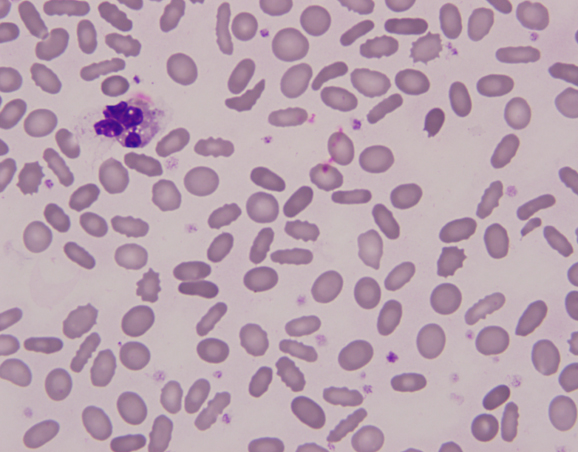
Review of peripheral smear revealed moderate anisopoikilocytosis with presence of numerous elliptocytes.

he1

he2

Molecular studies demonstrated a heterozygous mutation in the EPB41 gene associated with HE.

Patient was diagnosed with Hereditary Elliptocytosis (HE).

He has been followed up at the hematology clinic for a year now. His follow up CBC results are as follows. He has reached his age appropriate milestones and continues to grow well.

Ref. Range 7/14 10/14 12/14 4/15
WBC 6-17 K/uL 10.3 11.3 7.4 10.0
Hemoglobin 10.5-13.5 g/dL 9.3 (L) 9.9 (L) 9.7 (L) 11.0
Hematocrit 33-39 % 26.5 (L) 28.7 (L) 28.1 (L) 33.6
Platelets 150-400 K/uL 599 (H) 570 (H) 403 (H) 447 (H)
RBC 3.7-5.3 M/uL 3.74 3.91 3.87 4.58
MCV 70-86 fL 70.8 73.3 72.6 73.5
MCH 23-30 pg 24.8 25.4 25.1 23.9
MCHC 31-36 % 35.0 34.7 34.5 32.6
RDW 11.5-14.5 % 16.9 (H) 17.7 (H) 18.2 (H) 18.0 (H)

Hereditary elliptocytosis (HE) is an inherited hemolytic anemia, secondary to red cell membrane defect more commonly assembly of spectrin, spectrin-ankyrin binding, protein 4.1 and glycophorin C with a clinical severity ranging from asymptomatic carriers to a severe hemolytic anemia. It is more common in individuals from African and Mediterranean decent – neither applies to our patient.It is inherited in an autosomal dominant pattern, typically individual who are heterozygous are asymptomatic while those who are homozygous or compound heterozygous have a mild to severe anemia. Occasional patients with more severe hemolysis may require splenectomy.

Regardless of the underlying molecular abnormality, most circulating red cells are elliptical or oval. They still have an area of central pallor, since there is no loss of the lipid bilayer (as seen in Hereditary spherocytosis).

Vajpayee,Neerja2014_small

-Neerja Vajpayee, MD, is an Associate Professor of Pathology at the SUNY Upstate Medical University, Syracuse, NY. She enjoys teaching hematology to residents, fellows and laboratory technologists.