Jaffe vs. Enzymatic Method for Serum Creatinine Measurement

The Jaffe and enzymatic methods are the two most common methods for measuring serum creatinine. The Jaffe method is less expensive than the enzymatic assay ($0.30 vs $2.00 per test based on 2014 list prices) but is more susceptible to interferences. Although these tests are not expensive, they are high-volume tests and the savings could be substantial. We were using the enzymatic assay at the University of Utah and estimated that we could save about $50,000 per year by switching to the Jaffe assay; however, we were uncertain whether the Jaffe assay was safe to use due to the potential for interferences. For that reason, we decided to conduct a risk assessment to evaluate the suitability of the Jaffe assay.

Risk is defined as the expected cost of an action. The expected cost has two components: 1) the probability that an event will occur and 2) the consequences or cost of an event:

Risk = prob(event) x cost(event)

The event of interest was misclassification of a patient due to an error in serum creatinine measurement. Nephrologists classify kidney disease based on the estimated glomerular filtration rate which is based on the creatinine value. The distribution of eGFR for patients at our hospital is shown in Figure 1. The dashed lines show decision limits that nephrologists use to classify kidney disease. An eGFR is considered normal or healthy.

We spoke with the nephrologists and learned that they were relatively unconcerned about errors in eGFR in healthy patients (eGFR above 60 ml/min) because there was no potential for harm. Similarly, they felt there was relatively little risk of harm to patients with low eGFRs because these patients are routinely monitored and no major decision would be based solely on a single eGFR measurement. An error in creatinine measurement in a low eGFR patient would be detected by repeat measurements or be inconsistent with other measurements. From the nephrologists’ point of view, the only area of concern was in the region around 60 ml/min.  Patients about 60 ml/min are considered healthy whereas those below 60 ml/min are diagnosed with stage 3a chronic kidney disease. In this zone, an error in serum creatinine could result in a false negative (i.e. observed eGFR greater than 60 ml/min when the true eGFR was less than 60 ml/min). In such cases, a patient may go without care and their disease could progress.  The nephrologists believed that the potential for harm was relatively minor, but potential for harm did exist.

We compared the eGFRs provided by the enzymatic and Jaffee methods to estimate how often patients might be misclassified (Figure 2).1 Focusing on the 60 ml/min decision limit, we found that 17 of 500 (3.4%) of measurements were discordant. Some of these discordant results would be due to imprecision. Discordance due to imprecision would have small differences (bottom of Figure 2) and are unavoidable – they would occur using any method. Discordance due to interference would be expected to have larger differences (top of Figure 2) and could be avoided by using the enzymatic method. We used statistical techniques to estimate the proportion of discordances that were due to interference vs imprecision and found that about 60% of the discordance at the 60 ml/min limit was due to interference. In summary, our risk analysis showed that using the Jaffe method would pose about a 2% rate of avoidable misclassification which presented some potential risk to patients. The nephrologists felt the risk was low but, in theory, disease could unnecessarily progress in a patient with a false negative diagnosis.

Our risk analysis was based on analytical error. We compared magnitude of analytical error to the biological variation in eGFR and found that the analytical error was relatively small in comparison to biological variation (data not shown).  Biological variation was likely to be a more significant cause of misclassification than analytical error.

So, what to do? Was the potential savings of the Jaffe method worth the risk? Some experts recommend against using the Jaffe method. 2-4 On the other hand, most US laboratories use the Jaffe assay. A recent College of American Pathologists proficiency challenge found that 70% of the submitted results were based on the creatinine assay.5

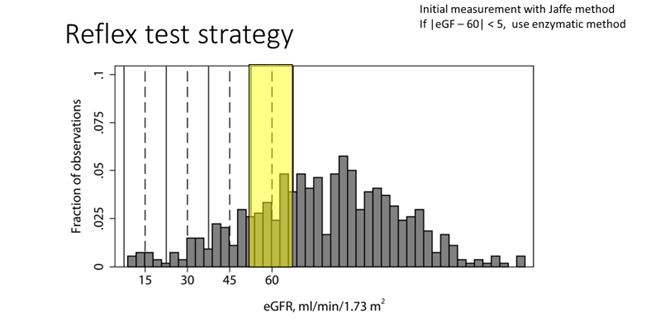
We decided to get the best of both worlds by using BOTH methods. We defined a zone of risk surrounding the 60 ml/min eGFR decision limit (Figure 3). Results in this zone would have some risk of misclassification whereas results outside of the zone would be unlikely to be misclassified using the Jaffee method. All creatinine measurements are initially performed using the Jaffe method. If the result is outside the risk zone, the result is reported. If results fell within the risk zone, they were repeated with the enzymatic method and the results of the enzymatic method are reported. This reflex procedure saves money while avoiding risk. The reflex rate is approximately 15%.

There are circumstances in which one would want to order the best possible test. To that end, we created a special orderable test, based on the enzymatic method, that the nephrologists could use to insure the most accurate results when required. For example, the enzymatic test may be indicated when making decisions regarding biopsies for renal transplant patients. The order volume for the special test has been less than 100 orders per year. 

creat1
Figure 1. Distribution of Estimated Glomerular Filtration rates (eGFR). The distribution is for outpatients at University of Utah for calendar year 2014. The dashed lines indicate decision limits used for classification of chronic kidney disease (15, 30, 45 and 60 ml/min). eGFRs greater than 60 ml/min are considered disease free.
creat2
Figure 2. Discordances in estimated glomerular filtration rate (eGFR) at the 60 ml/min decision limit. The length of each arrow, represents the difference between estimates based on the Jaffe (head) and enzymatic (tail) methods. The dashed line represents two standard deviations of expected imprecision of the difference. Differences greater than 2 standard deviations would most likely be due to analytical interference (loss of specificity).
creat3
Figure 3. Reflex test strategy. The figure shows the distribution of eGFR values for outpatients at the University of Utah.  The dashed lines represent clinical decision limits. The yellow zone represents the range of eGFR values where misclassification could pose a risk to patients. Creatinine is first measured by the Jaffe method. The Jaffe result is reported if the estimated eGFR is outside the yellow zone. If the eGFR is within the yellow zone, the measurement is repeated using the enzymatic method and the result based on the enzymatic method is reported.

References

  1. Schmidt RL, Straseski JA, Raphael KL, Adams AH, Lehman CM. A Risk Assessment of the Jaffe vs Enzymatic Method for Creatinine Measurement in an Outpatient Population. PloS one. 2015;10(11):e0143205.
  2. Cobbaert CM, Baadenhuijsen H, Weykamp CW. Prime time for enzymatic creatinine methods in pediatrics. Clinical Chemistry. 2009;55(3):549-558.
  3. Drion I, Cobbaert C, Groenier KH, et al. Clinical evaluation of analytical variations in serum creatinine measurements: Why laboratories should abandon Jaffe techniques. BMC Nephrology. 2012;13(1).
  4. Panteghini M. Enzymatic assays for creatinine: time for action. Scand J Clin Lab Invest Suppl. 2008;241:84-88.
  5. College of American Pathologists. Chemistry/Therapeutic Monitoring, Participant Survey. 2014.


Schmidt-small

-Robert Schmidt, MD, PhD, MBA, MS is currently an Associate Professor at the University of Utah where he is Medical Director of the clinical laboratory at the Huntsman Cancer Institute and Director of the Center for Effective Medical Testing at ARUP Laboratories.

Does Price Transparency Improve Lab Utilization?

Physicians often have poor awareness of costs. For that reason, many believe that providing cost information to physicians would increase awareness that, in turn, could improve laboratory utilization. For example, costs of lab tests could be displayed as a field in the computerized provider order entry system. Interventions of this type are attractive because they are relatively inexpensive to implement and do not disrupt workflow with popups. Further, unlike other interventions, cost display is sustainable. Some interventions require constant training and followup whereas cost display is a one-time intervention. For these reasons, organizations are experimenting to see the effect of cost display on laboratory utilization.

Does cost display reduce lab utilization? Studies have shown wide variation in impact. Most studies have focused on orders for laboratory testing and imaging; however, a few studies have looked a pharmaceuticals.  A recent systematic review concluded that cost display is associated with a modest reduction in laboratory utilization.(1) The review included twelve studies on lab utilization and all of these showed improvement.(2-13) However, a more recent study by Sedrak et al. found that cost-display had no impact on utilization.(14) Similarly, two imaging studies found that cost-display had no effect on orders.(4, 15). There was a wide variation in impact: test utilization reduction ranged from 0% to over 30% in some cases. Overall, it appears that cost display tends to reduce utilization; however, it sometimes has no effect as shown in the Sedrak study. So far, cost display has never been associated with an increase in utilization. We have experimented with cost display at University of Utah and, like the Sedrak study, found no effect.

Why is there such a range of effects? Can we predict which organizations are likely to benefit? The short answer is that nobody knows.  The twelve studies on lab utilization where conducted in a wide range of settings (community, academic and pediatric hospitals), included different numbers of tests, or had other differences that could affect results. The way in which costs are displayed also varies. Some sites use the Medicare Maximum Allowable Reimbursement Rate, some use a series of dollar signs to indicate cost categories, and others use charges. It is not clear whether these differences matter.

There are a number of factors that might affect the impact of cost display. For example, cost display might have less impact at an institution that has an effective utilization management program in place because there is less opportunity for improvement. Or, the number of tests with costs displayed may have an impact. For example, some studies have displayed costs for a relatively few number of tests whereas other studies showed costs for a large number of tests.  Cost display for a few tests may send a different signal to providers than providing costs for all tests. Also, we don’t know how long the intervention works. Is there an initial effect that wears off? If so, how long does it last? These questions will need to be resolved by future studies.

In the meantime, should you provide cost feedback at your institution? It is hard to predict what will happen but most evidence suggests that you will see some improvement in utilization. It is not expensive to implement and some organizations have seen a significant impact. At worst, the evidence suggests that you will see no effect on testing behavior.  On balance, cost-display seems like a low-risk intervention.


References

  1. Silvestri MT, Bongiovanni TR, Glover JG, Gross CP. Impact of price display on provider ordering: A systematic review. Journal of Hospital Medicine 2016;11:65-76.
  1. Fang DZ, Sran G, Gessner D, et al. Cost and turn-around time display decreases inpatient ordering of reference laboratory tests: A time series. BMJ Quality and Safety 2014;23:994-1000.
  1. Nougon G, Muschart X, Gérard V, et al. Does offering pricing information to resident physicians in the emergency department potentially reduce laboratory and radiology costs? European Journal of Emergency Medicine 2015;22:247-52.
  1. Durand DJ, Feldman LS, Lewin JS, Brotman DJ. Provider cost transparency alone has no impact on inpatient imaging utilization. Journal of the American College of Radiology 2013;10:108-13.
  1. Feldman LS, Shihab HM, Thiemann D, et al. Impact of providing fee data on laboratory test ordering: A controlled clinical trial. JAMA Internal Medicine 2013;173:903-8.
  1. Horn DM, Koplan KE, Senese MD, Orav EJ, Sequist TD. The impact of cost displays on primary care physician laboratory test ordering. J Gen Intern Med 2014;29:708-14.
  1. Ellemdin S, Rheeder P, Soma P. Providing clinicians with information on laboratory test costs leads to reduction in hospital expenditure. South African Medical Journal 2011;101:746-8.
  1. Schilling UM. Cutting costs: The impact of price lists on the cost development at the emergency department. European Journal of Emergency Medicine 2010;17:337-9.
  1. Seguin P, Bleichner J, Grolier J, Guillou Y, Mallédant Y. Effects of price information on test ordering in an intensive care unit. Intensive Care Medicine 2002;28:332-5.
  1. Hampers LC, Cha S, Gutglass DJ, Krug SE, Binns HJ. The effect of price information on test-ordering behavior and patient outcomes in a pediatric emergency department. Pediatrics 1999;103:877-82.
  1. Bates DW, Kuperman GJ, Jha A, et al. Does the computerized display of charges affect inpatient ancillary test utilization? Arch Intern Med 1997;157:2501-8.
  1. Tierney WM, Miller ME, McDonald CJ. The effect on test ordering of informing physicians of the charges for outpatient diagnostic tests. N Engl J Med 1990;322:1499-504.
  1. Everett GD, Deblois CS, Chang PF. Effect of Cost Education, Cost Audits, and Faculty Chart Review on the Use of Laboratory Services. Arch Intern Med 1983;143:942-4.
  1. Sedrak MS, Myers JS, Small DS, et al. Effect of a Price Transparency Intervention in the Electronic Health Record on Clinician Ordering of Inpatient Laboratory Tests: The PRICE Randomized Clinical Trial. JAMA Internal Medicine 2017.
  1. Chien AT, Ganeshan S, Schuster MA, et al. The effect of price information on the ordering of images and procedures. Pediatrics 2017;139.


Schmidt-small

-Robert Schmidt, MD, PhD, MBA, MS is a clinical pathologist who specializes in the economic evaluation of medical tests. He is currently an Associate Professor at the University of Utah where he is Medical Director of the clinical laboratory at the Huntsman Cancer Institute and Director of the Center for Effective Medical Testing at ARUP Laboratories.

Pathologist On Call: Fluctuating Parathyroid Hormone with Normal Calcium in an Elderly Man

Case:

A 75 year old Alzheimer’s dementia patient.  Parathyroid hormone (PTH) levels were ordered.

Analyte

(Reference

Range)

05/13 10/13 12/13 7/14 10/14 04/15 09/15 03/16 07/16
PTH

(10-65 pg/mL)

869 42 864 47 1180 48
Ca2+

(8.8-10.2 mg/mL)

10.3 10.5 10 10 9.6 10
Vit D

(2-100 ng/mL)

26 21 39 49 39 57 19


Why order PTH? 

PTH is ordered to assess for hyperparathyroidism.  There are two forms of hyperparathyroidism: primary and secondary.  Primary hyperparathyroidism can be caused by a parathyroid (PT) adenoma,  PT hyperplasia, or a non-PT malignancy such as squamous cell cancer or multiple myeloma.  Secondary hyperparathyroidism occurs in response to hypocalcemia which can arise from insufficient intake of vitamin D or chronic renal failure (which results in insufficient vitamin D).   There is weak evidence suggesting a positive correlation between PTH and cognitive decline.(1, 2)  Progression of cognitive decline is slowed when PTH and vit D levels are normalized.

Action of PTH: PTH is a peptide hormone that controls calcium levels in the blood. It is secreted as a prohormone and is cleaved in the blood.  The 34 residue N-terminal fragment is active and has a half-life of about 5 minutes.  The C-terminal end has a half-life or 2 hours and is diagnostically insignificant because it is physiologically inactive.  PTH activates receptors on osteoclasts which causes them to release bone calcium.  PTH also increases renal synthesis of 1,25 OH2 vitamin D which, in turn, increases intestinal absorption of calcium.

What would make the PTH level fluctuate so much?

This is most likely a case of incipient normocalcemic primary hyperparathyroidism (NPH).(3-5)  PTH levels are higher than normal but calcium levels are normal.  PTH levels tend to fluctuate. Calcium can also be sometimes elevated as well.   The disease is thought to be a mild or early form of hyperparathyroidism and 20 percent of patients go on to develop worsening hyperparathyroidism. How should NPH be managed?  Parathyroidectomy or monitoring are the primary alternatives; however, the best way to manage this disease is unknown.


References

  1. Lourida I, Thompson-Coon J, Dickens CM, et al. Parathyroid hormone, cognitive function and dementia: A systematic review. PLoS ONE 2015;10.
  1. Björkman MP, Sorva AJ, Tilvis RS. Does elevated parathyroid hormone concentration predict cognitive decline in older people? Aging Clinical and Experimental Research 2010;22:164-9.
  1. Shlapack MA, Rizvi AA. Normocalcemic primary hyperparathyroidism-characteristics and clinical significance of an emerging entity. Am J Med Sci 2012;343:163-6.
  1. Lowe H, McMahon DJ, Rubin MR, Bilezikian JP, Silverberg SJ. Normocalcemic primary hyperparathyroidism: Further characterization of a new clinical phenotype. Journal of Clinical Endocrinology and Metabolism 2007;92:3001-5.
  1. Crowley RK, Gittoes NJ. Elevated PTH with normal serum calcium level: A structured approach. Clinical Endocrinology 2016;84:809-13.


Schmidt-small

-Robert Schmidt, MD, PhD, MBA, MS is currently an Associate Professor at the University of Utah where he is Medical Director of the clinical laboratory at the Huntsman Cancer Institute and Director of the Center for Effective Medical Testing at ARUP Laboratories.


Forty Things Every Lab Professional Should know

Hello again everyone! Every few posts on Lablogatory I like to take a small departure from updates about my medical school experience and my Zika public health initiative. This time is more of a shameless plug: I am thrilled and honored to be considered one of ASCP’s Top 40 Under Forty for 2017!

40under40

Looking through the rest of the honorees, I can certainly say I’m in great company. Each person on that list is a prime example of the working values, lessons, and vision that ASCP recognizes in our dynamic field. So, to celebrate my and others’ place on this list, I’ve put together a few thoughts that truly reflect our hard work, talent, and potential as laboratory professionals and what that might mean for each of us. Here are what I consider the “Top 40” lessons that a career in medical laboratory science and laboratory medicine have taught me:

  1. The laboratory is the best melting pot –How many awesome pot-lucks have you had in your breakroom? How many words in new languages have you picked up? All that cultural exposure really contributes to a profound sense of community and humility.
  2. If everything is STAT, nothing is… – need I say more? We know the value of prioritizing and triaging what’s important for patients.
  3. You know a little about a lot of things, and sometimes a lot about a few things – To all my fellow generalists and specialists out there: how good does it feel to directly contribute to a patient’s positive outcome?
  4. Everyone’s got a different TAT – To turn a phrase, we’re all at various stages. Some laboratorians are just starting out and some can “smell” a tricky differential…
  5. Quality control protects everyone – If QC is good, instruments are good. If instruments report good values, results are good.
  6. Accountability is key – Owning up to failures and successes are both important!
  7. Record everything – This is how we protect patients and ourselves as well as improve.
  8. Teamwork is a necessity – It takes a village or, in this case, a full staff…
  9. Serotypes and Stereotypes – We’re not shy! We’re not afraid to jump in and collaborate!
  10. We’re not magicians, but sometimes we are – Impressing other clinicians with our ability to analyze and get results is just part of what we do.
  11. Nurses are our friends – Really, when you’ve got great relationships with the nursing staff you know just how that can make an enormous difference in your work.
  12. Doctors are our friends, too – The best doctors value the laboratory, and its staff!
  13. Ultimately, we’re here for our patients – That’s what it’s all about!
  14. We celebrate each other – How many of your labs have a ‘tech of the year’ award, or service awards? We make sure that we recognize each other’s talents.
  15. We share everything – Life events, stories, experiences, swapping shifts…
  16. Toxic techs are real, but they can be your friend too – All too real in many labs; often they’ve got lots of experience and can be a positive voice for change. Are we listening?
  17. What happens if everyone retires? – Staff turnover can be a challenge, but a combo of great training and communication are key.
  18. What happens if no one retires? Ever? – This occurs too, staff gridlock can be tough to manage and laboratory leadership is part of our role as well.
  19. We ALL have prior experiences – From brand new to near retirement, we’ve all had experience in healthcare; even as patients!
  20. Sometimes, QC just won’t come in range – That’s why relying on protocol and documentation can make all the difference.
  21. Sometimes, things happen even when QC was perfect – Bad days happen! Our drawing board is based on what we do best: analyzing, interpreting, and taking action.
  22. No one can tolerate as much as we can – How many of you have been blamed for hemolysis, or scrutinized for TAT statistics? Let’s call it “character-building experience.”
  23. Trust your training – It’s really your best resource.
  24. Taking initiative is a built-in perk – There will be times when it comes down to one lab tech on a night shift, or one pathologist who’s been paged, to take charge and make decisions.
  25. Watch something, do something, teach something – What better place than a clinical lab to see everything, learn it hands-on, and teach the next person?
  26. Never ending details – All those SOPs really make one appreciate the vast number of details that go into planning anything.
  27. We’re the best part of the hospital for metrics and progress – Diagnostic data comprises 70% of patient information, and 100% of laboratory performance.
  28. Lab week is the best – It feels great to be part of a large family of clinicians in this shared field. It’s also usually around my birthday, so that’s been a personal perk…
  29. Some teachers have years of experience on you – They’ve seen things you may never get the chance to!
  30. Some people will teach you something, even if you’re their supervisor – Everyone brings something to the table, or lab bench, or conference table, or shared microscope.
  31. We choose our words carefully – “These cells are suspicious and require pathology consult with further clinical correlation…” We know our scopes and practices.
  32. We word our choices carefully too – “This specimen was forwarded for pathology review because of our criteria…” We know we’ve got to back up our actions with evidence.
  33. We know office politics, just a little more intense than most people realize – Every hospital has a hierarchy, but laboratorians know we’re all on the same team.
  34. We’ve got an SOP for that – Literally, we have one for everything.
  35. We can come up with solutions with very limited information – Requisitions don’t always carry the highest level of clinically relevant guidance. (Test: Hgb A1c, Note: repeat from 1 hour ago).
  36. Sometimes we cannot find a solution, despite endless information – There are times when laboratory data is not enough to definitively make diagnoses, that’s just part of medicine.
  37. We all have the potential to be laboratory leaders – We’ll all have moments to take initiative and demonstrate our talents at one point or another.
  38. We are all real clinical scientists – The change to calling it “medical laboratory scientists” is one of the best changes ever. In my opinion, we are true clinical and critical scientists.
  39. It’s our job to promote our role and our field!
  40. Never stop learning!

I think the last two points need no explanation. Thank you for taking the time to read my “Top 40” Laboratory Lessons. If you have a great lesson you’ve learned, add it to the comments below! Don’t forget to check in next month for another update on my work and don’t forget to vote for ASCP’s Top Five! All the Top 40 Under Forty nominees are eligible to be in the Top Five based on your votes and comments!

Visit HERE, click on my face, and vote today!

Thanks, and see you next month!


ckanakisheadshot_small

Constantine E. Kanakis MSc, MLS (ASCP)CM graduated from Loyola University Chicago with a BS in Molecular Biology and Bioethics and then Rush University with an MS in Medical Laboratory Science. He is currently a medical student at the American University of the Caribbean and actively involved with local public health.


Safety Success in the Anatomic Pathology Laboratory

The pathologist walked into the histology laboratory every morning to say hello to the staff. As he did so, he drank from his cup of coffee.

The gross room was very small, and the eyewash station was placed on the faucet in the only sink in the room. One foot above the sink were the sharp ends of all of the cutting tools that hung on the wall. That was also the hand washing sink.

The morgue was the only space in the hospital where chemical waste could be stored before being picked up. The waste containers were not dated, and a funnel was left in the opening of one of them.

It can be difficult to oversee safety for a clinical laboratory, but often the people responsible for it have a clinical lab background, so the understanding of the regulations is clear. However, if you are responsible for the anatomic pathology (AP) areas as well, you may need to broaden the scope of your safety learning. Each of the lab safety situations mentioned above are real, and detecting and resolving those and other issues is important. Knowing the regulations for histology, cytology, and the morgue settings is a good place to start. Next, spend some time in those areas, and learn the processes that occur every day. Ask questions and look at procedures.

Bio-safety regulations in the AP lab are no different than for clinical laboratory staff. Many specimens, body parts and cadavers may be handled, and Standard Precautions should be used. That includes the use of gloves, lab coats, and face protection.

Chemical hygiene is also important in the AP lab, and since these areas tend to utilize many more chemicals than others, the management of them can seem daunting. Be sure to keep an updated chemical inventory which designates carcinogens, reproductive toxins and acute toxins. Ensure all staff have access to Safety Data Sheets (SDS) and that they have been trained to properly store chemicals. That means strong acids and bases should be stored near the floor, and they should never be stored together. Other incompatible chemicals should be separated as well. Ensure that proper spill supplies are available, and that staff can clean up various types of chemical spills. Conducting spill drills is a great way to keep staff ready for the real event.

Exposure monitoring should occur depending on what chemicals are used in the area. Managing chemical safety also includes ensuring proper labeling of all chemical containers. Primary container should have current Globally Harmonized System (GHS) compliant labels, and secondary containers also need adequate labeling. Secondary containers may be labeled using a GHS format or NFPA and HMIS conventions may be used.

Chemical or Hazardous waste handling must also be monitored closely in AP areas. If chemical waste is stored in the lab in a Satellite Accumulation Area, the containers should not be dated, and they should be stored at or near the point of waste generation. Central Accumulation Areas are areas where waste is stored before it is removed from the site. In these areas, containers must be dated, and a log should be kept for weekly checks of the areas. Weekly checks include looking for container leaks, dates on containers, and making sure containers remain closed. All chemical waste containers must remain closed unless someone is actively working with them. Never leave an open hazardous waste container open or with a funnel in it while unattended.

Special safety consideration should be given to tissue cutting in the histology area. Microtome and cryostat use presents specific sharps dangers because of the large sharp blades in use. If a blade guard is included with the equipment, train staff to always engage it before placing hands near the blade. Use magnet-tipped implements to remove the blades and rubber-tipped forceps to install new ones. Follow manufacturer guidelines for cryostat decontamination, but avoid using formaldehyde fumes for that purpose.

If laboratory staff is exposed to formaldehyde concentrations greater than 0.1 parts per million in their routine work, there is a safety training program that is required by OSHA. This formaldehyde training needs to be administered at the time of initial job assignment and whenever a new exposure to formaldehyde is introduced into the work area. The training must also be repeated annually.

As a lab safety officer, I learned over time how to work with and coach pathologists for safety. There is no more coffee consumed in the lab. The cramped gross room was remodeled to improve safety. Understanding the issues and reporting them was the key to getting this done. It took a difficult inspection by the EPA to teach me how to properly handle chemical waste. Today the representative from the state is my best reference, and she is willing to come to the labs and help us with waste regulation compliance. If your background is clinical, don’t ignore the special considerations in the anatomic pathology areas. Use your resources to learn what happens there, and understand the regulations so that employees in every area of the lab can work safely.


Scungio 1

Dan Scungio, MT(ASCP), SLS, CQA (ASQ) has over 25 years experience as a certified medical technologist. Today he is the Laboratory Safety Officer for Sentara Healthcare, a system of seven hospitals and over 20 laboratories and draw sites in the Tidewater area of Virginia. He is also known as Dan the Lab Safety Man, a lab safety consultant, educator, and trainer.

Applying the Flipped Classroom to Medical Laboratory Science

Our Medical Laboratory Science (MLS) program curricular model applies the “reverse-lecture-homework-paradigm” (more commonly known as “flipping the classroom”) to the majority of our didactic courses. For our MLS program, this model works best for those MLS courses that we are able to provide strong hands-on laboratory lessons in our classroom setting. For those courses that are not amenable to this (like clinical chemistry where the laboratory procedures are highly automated), we provide the learning content in a traditional lecture-based format with supplemental laboratory lessons. This combination of approaches to instruction and learning—whereby we provide both traditionally designed courses (live, synchronous, “face-to-face” learning) and online courses (virtual, asynchronous, distance learning)—ends up supporting all of our students’ varied learning styles.

As an example, in our course in bacteriology, we can teach hands-on laboratory lessons using manual procedures for identifying bacteria that can be readily instituted in our program classroom/teaching laboratory. Because we can easily reproduce these techniques for our students, we use the flipped-classroom approach in this course and provide all of the lecture material as online learning lessons that our students complete as homework before the next day’s laboratory session. By having our students complete the lecture material as homework, we can dedicate more classroom time to learning laboratory techniques that are more closely anchored in what our students are going to do for a living.

From the standpoint of education theory and Bloom’s cognitive domain of learning, lesson content that requires basic recall of information (knowledge and comprehension) is presented as homework in the online lesson. In the hands-on laboratories, more of the higher level cognitive domains of interpretation and problem solving are applied, and the lab techniques are performed in the presence of the instructor, allowing for greater instructor-student interaction, questions, and joint problem solving.

The instructor role radically changes in this model, and he/she is no longer put in the position of “expert at the lecture podium,” allowing for greater opportunity to partner with the students in the classroom as a facilitator or guide in their learning. The literature commonly refers to the redefining of the instructor’s role in educating the student as moving away from being the “sage on stage” to that of facilitator or “guide on the side.” Our instructors have more time to help the students hone their laboratory techniques and apply the learning material in context and also answer questions.

Our instructors have found the experience rewarding, and they have been very successful using this format. They are able to partner with our students more collaboratively, and they can assume more of a mentorship role. It should be noted that there is a substantial amount of front-end time required to build the courses. Each lesson plan includes learning objectives, an online lesson, a hands-on lab, and a self-assessment. Our courses also include online discussion boards, homework assignments, and study guides for exam preparation (both written tests and laboratory practicals). Once an online course is built, however, we have found that it is easier to update and maintain versus a lecture-based course that may need redevelopment when instructors change.

The students’ role in the classroom also changes. When they are presented with the lecture material as online homework, they gain a newfound control over the material that doesn’t exist in a face-to-face traditional lecture format. They have control over when they study the learning content and the length of time they study. They can go in and out of the online lecture content as often as they want. The lesson material can include links to additional resources that they can delve further into if they desire. This format places each student in the “driver’s seat,” and the student moves from being a passive learner to active.

As for our students, they consistently come to class prepared for each hands-on activity, ask questions, and perform well on their written and practical examinations. Our students tend to form study groups outside of the classroom, and they review and process the online content with their peers, which results in a classroom environment that is collegial, team-oriented, and mutually supportive.

Reference

Bloom, Benjamin S., (Ed.), Taxonomy of Education Objectives: Handbook I: Cognitive Domain, N.Y., David McKay Company, Inc. 1956.


Lehman_small

-Susan M. Lehman, MA, MT(ASCP)SM graduated from the University of Wisconsin-Madison in 1983 with a BS in medical technology. She is program director for the Medical Laboratory Science Program and course director for Clinical Microbiology I and II; her areas of interest include distance education and education methodology.

Leading Lab Safety

The number of medical laboratory scientists is dwindling. Baby Boomers have begun their retirement, and even before that started, there were more job openings than people to fill them. That means more opportunities in the lab world, and in some cases leadership roles are being obtained by less experienced people than in years past. Whether or not one has a long lab history, one aspect of any new leadership position that will be important to grasp is management of the lab safety program.

The first step for a new lab leader is to ensure the existence of a functional laboratory safety program. Do this by looking for specific components of the program, a laboratory safety manual, a safety committee, and lab safety indicators. If these items are in place and functioning as they should, you’re off to a good start.

The laboratory safety manual may be in paper or in an electronic format. It should be separate from the hospital or facility safety manual as there are many lab-specific safety policies and procedures that are required. Maintain document control of these safety policies, ensure they have medical director (or designee) approval, and review these policies in a timely fashion. It is important to remember that while some lab regulatory agencies (like CAP) allow bi-annual policy review, OSHA requires annual reviews. OSHA covers many safety policies in the lab such as the chemical hygiene plan, the exposure control plan and many more.

The laboratory should have a functioning safety committee, no matter the size. If the lab staff is very small, the leader may play a role in the larger hospital or facility safety committee. If the lab is larger, a committee composed of just lab staff is advised. If the hospital or lab is part of a system, the committee should include at least one member from each lab site. The safety committee should meet at least monthly. It is important not to skimp on meetings or cancel them on a regular basis. Let staff know this is a priority for the leadership in the lab. During the meetings provide education, review lab incidents, and raise safety awareness. Train committee members how to perform safety audits, how to develop “safety eyes,” and most especially how to coach each other and their peers in the department.

Another important component of a functioning lab safety program is the use of safety indicators. Much like quality indicators, this safety data can be used to help determine the overall safety culture in the department. A good example indicator includes monitoring the employee exposure and injury rate. By using the laboratory’s OSHA 300 log information, a lab can compare its reportable injury data to national benchmarks. Many safety indicators are typically reactive data (or lagging), but tracking safety meeting attendance can actually serve as a leading indicator for the lab.

Once you’ve assessed the lab’s safety program, the next step a new leader should take is to assess the overall lab safety culture. This can be performed in many ways. One part of performing the assessment is by using your “safety eyes” that was mentioned earlier. Scan the lab visually. What immediate safety issues are seen? What is on the walls of the department? What types of interactions are observed? What is the physical layout? With practice and experience, a leader may be able to do the visual portion of the culture assessment quickly.

Another safety culture indicator tool is a laboratory safety audit. The results of an audit can provide much information about safety practices in the lab such as PPE use, chemical storage, and awareness of fire safety issues. One good model safety audit that can be used is located in the appendix of CLSI’s document Safety in the Clinical Laboratory (GP17-A3). This is a very comprehensive laboratory assessment and it can tell you much about your overall safety culture. As stated before, audit results can be discussed at the lab safety committee meetings, and ideas for improvements can be considered.

Managing the overall lab safety program is a big job, and it is often only one task of many that belongs to a laboratory leader. Change occurs daily in the field of lab medicine, and new leaders are coming aboard. Whether you are new or experienced, however, utilizing these basic first steps will provide a leader with the information needed to identify the safety culture and to understand how the program is operating.


Scungio 1

Dan Scungio, MT(ASCP), SLS, CQA (ASQ) has over 25 years experience as a certified medical technologist. Today he is the Laboratory Safety Officer for Sentara Healthcare, a system of seven hospitals and over 20 laboratories and draw sites in the Tidewater area of Virginia. He is also known as Dan the Lab Safety Man, a lab safety consultant, educator, and trainer.

Myers-Briggs Type Indicator

Let me be honest and straightforward: this was not my favorite model when I first learned about it. Until, that is, I went through the certification to become a trainer and I fell head over heels in love, despite it being more complicated and intricate than the other models used and discussed in the Leadership Institute. The MBTI provides a deep understanding of your personality traits, natural skills, and tendencies while highlighting skills you have learned along the way. As an added bonus, this understanding isn’t tied to any life role (work, parent, child, friend, etc.). I, for instance, have a slight preference for extraversion with a lot of introversion tendencies. However, I usually come across as highly extraverted, as I learned to act more extraverted because my sister was very shy growing up and I wanted to balance it out.

The MBTI focuses on your innate personality preference, organized into four dichotomies:

  • Extraversion vs. Introversion (E –I)
  • Sensing vs. Intuition (S – N)
  • Thinking vs. Feeling (T – F)
  • Judging vs. Perceiving (J – P)

Your preferences in each category, when combined, are your type. For example, if I had a preference for Introversion (I), Sensing (S), Feeling (F), and Perceiving (P), my type would be ISFP. This type gives me insights into how I interact with others, process information, come to conclusions, and approach the outside world. Understanding this will allow me to know my strengths and weaknesses as well as those of others. As a leader, applying that knowledge effectively in different situations and with different people is essential.

lotte-small

-Lotte Mulder earned her Master’s of Education from the Harvard Graduate School of Education in 2013, where she focused on Leadership and Group Development. She’s currently working toward a PhD in Organizational Leadership. At ASCP, Lotte designs and facilitates the ASCP Leadership Institute, an online leadership certificate program. She has also built ASCP’s first patient ambassador program, called Patient Champions, which leverages patient stories as they relate to the value of the lab.

Yin and Yang

Who would have thought that our personality is made of contradicting elements?

I truly enjoyed the MBTI course, it was an eye opener of who I am and a trip inwards. Knowing who we really are, our talents, comfort zones and blind spots will help us become better leaders.

So now I know and after all these years (on a personal or professional level) that I am an “ENFP,” these four letters mean that I tend to be extraverted, intuitive, feeling and perceiving. I do agree with the assessment as it reflects who I am and decided after taking the course to put my Middle Eastern Ego aside and not challenge the blind spots.

ENFPs see new possibilities in people, situations, tasks and projects at hand. We tend to have high energy and flexibility. In my line of work, being the Chief Quality Officer at MedLabs Consultancy Group in Amman-Jordan, I find these personal traits very critical to our success as a company to ensure the highest compliance in implementing quality standards throughout our network of laboratories spanning four countries and exceeding 50 in total. Being a people’s person is a great asset in order to touch the hearts, minds and souls of our staff to sustain these quality standards, being 150% convinced rather than simply following the rules. We are trying to “personalize” Quality and Safety, this can only be accomplished through connecting with each staff member and it requires inspiration, a trait that is “built in” ENFPs.

Looking at the blind spots, I find that we tend to get overexcited about projects, juggling many at the same time and loosing track of priorities in the hope of making a difference. Guilty as charged.

I am learning to take one project at a time, see it through completion and start the next one in the pipeline, this gave me and my colleagues a breather and time to reflect if the road that we are taking is indeed the correct one.

So now I am asking myself, what if I did not have the great opportunity to be part of the ASCP Leadership Program and I have missed out on MBTI? What if I did not realize that I am an ENFP? What if I could not appreciate the blind spots?

The simple answer is: I will be a classical leader in it for the title, with little contributions and not much of a positive effect on those who are around me. My job will be stale, with no spirit and dull, so I guess Yin and Yang actually works.

Soudi

-Nael M. Soudi holds a bachelor degree in Microbiology from State University of New York at Plattsburgh (USA). He completed both his Master Degree in Molecular Biology and a postgraduate program in Cytotechnology at Johns Hopkins University (USA). Mr. Soudi is a certified Practitioner in Health Care Quality (CPHQ) and a certified consultant and inspector with the Healthcare Accreditation Council. He is also certified by the International Academy of Cytology (IAC) and the American Society of Clinical Pathologists (ASCP) – Cytology. Mr. Soudi is fully licensed by the American Society of Clinical Pathologists and the College of American Pathologist (CAP) as a Certified Inspector. He is a frequent presenter at regional and international conferences discussing topics in Cytology, leadership, accreditation and healthcare quality. 

Your Reaction to Safety

The toddler’s father let her hand go so he could pay for their dinner at the busy airport. The little girl quickly wandered away and suddenly found herself at the top of a long escalator that was going down. No one was watching.

Mrs. Anders was walking home as she did every day from the neighborhood pool. She was very hard of hearing, but she was as friendly as she could be. As she waved to you while crossing the street, you see the car speeding toward her at too fast a pace.

You may have encountered a situation similar to one of these, or you may have seen something like it in a suspenseful movie or television program. The scenario is something that can create a reaction in you, a feeling of sudden dread, and the urge to take quick action. That’s a good response, and it could save someone from a serious incident.

But is your reaction the same in the lab where you work?

Lisa processed some CSF samples at the front desk that were delivered from another lab. She later received a call from the sending lab alerting her that the patient was positive for CJD, a prion disease, and the specimens were sent in error. When she went to clean up the processing area and tell the other staff, Lisa saw her co-worker leaning on the counter and using the computer with no PPE.

In the morning, Ken dropped a glass bottle of hydrochloric acid on the lab floor, and it shattered and spilled. He went to get the spill clean-up kit, but before he returned, the pathologist walked into the department wearing open-toed shoes.

Now let’s try something a bit subtler:

Robert is working in the chemistry department and he uncaps the next batch of tubes to be analyzed behind the safety shield on the counter. He places the tubes in the rack and carries the rack over to the analyzer. He’s not wearing any face protection.

Sheila was the supervisor in hematology, and she was walking through the department as Dwayne was on the phone with a service representative about the broken analyzer. The rep asked to speak to Sheila. Dwayne hands her the phone with his gloved hands, Sheila is wearing no PPE.

As a lab safety professional, one of my goals is to help lab staff have that same urgent gut reaction- that feeling that something is wrong and needs immediate correction- in all of those lab scenarios above, particularly the subtle ones. In each of those moments, the risk of danger or infection is very high and needs to be mitigated. All too often, however, these events occur in labs and no one reacts. That’s a safety culture problem.

There are many possible reasons for that typical lack of response. People are busy, the unsafe practices are common, or safety is simply not a priority. Lab injuries and exposures continue to occur across the nation, so the issues need to be addressed, and there are ways to do that successfully.

One method I use in safety training (that I’ve written about before) is the development of “Safety Eyes.” I call that the latent super-power that everyone possesses, but it needs to be taught and honed. When you work in a particular environment every day, it can become difficult to see the safety problems without training and practice. Take pictures of unsafe lab practices or problems and show them to staff. Have them identify the issue. As they practice, they will begin to see issues more often. Take practice safety walks with staff and look for issues. These actions will help everyone’s “Safety Eyes” to develop and become powerful tools in the department.

Of course, just seeing the issue is not enough. The second important piece here is teaching staff to respond when they do spot a problem. That can take some training and empowerment that may be new ideas for many. Teach staff to coach their peers for safety. This behavior will show others that safety is a priority, and over time more and more staff will begin to follow suit.

To produce the reaction you want in your laboratory—the issue is noticed, there is a sudden sense of dread or a gut reaction, and then there is a correction made—takes consistency. The lab safety leader will need to provide education about the regulations. Next, develop the “Safety Eyes” of the staff through pictures and safety walks. Finally, teach them to respond to the problems. As people, we are aware of the immediate danger when we see a toddler at the top of the stairs. The possibility of harm is clear to us. If you can produce that clarity for your staff with lab safety issues, you can get those reactions that can only improve your safety culture, and you can drastically reduce those injuries and exposures.


Scungio 1

Dan Scungio, MT(ASCP), SLS, CQA (ASQ) has over 25 years experience as a certified medical technologist. Today he is the Laboratory Safety Officer for Sentara Healthcare, a system of seven hospitals and over 20 laboratories and draw sites in the Tidewater area of Virginia. He is also known as Dan the Lab Safety Man, a lab safety consultant, educator, and trainer.