The Rogue Suitcase, Part II

I’m sure you’re anxious to hear what happened to my little suitcase packed for two continents and extremes in weather—part of my “Adventures In Travel” as an ASCP Consultant. We left the little rogue somewhere in Amsterdam with several airline baggage officers giving chase in multiple languages. My hotel concierge in Kazakhstan was very sympathetic to my plight, and they sent me in a car to the city’s one shopping mall. Remember it’s about -30 degrees, and so they dropped me off to find what I needed and would pick me up in two hours. I have a very good friend I’ve worked with internationally who would call that “power shopping.”  I needed professional clothing and shoes to work in, a few essentials, and definitely a coat, hat and gloves. It should be noted that, with rare exceptions, body sizes differ across the globe….and the language of sizes is a challenge. One kind store clerk kept bringing me black pants to try on that would have fit Twiggy (and if you know who that is, well, you know the root cause of my problem!).  Finally in sign language, she convinced me that “these were the biggest sizes she had” and with no other choices available I set my goal for lighter breakfast in the weeks ahead. The coat was another matter. After looking in every store I found the ONLY one in the entire mall that actually fit me, and was warm enough, and was not a men’s musher’s parka. Of course, it was not on the bargain rack, but it was worth every KZT tenge!

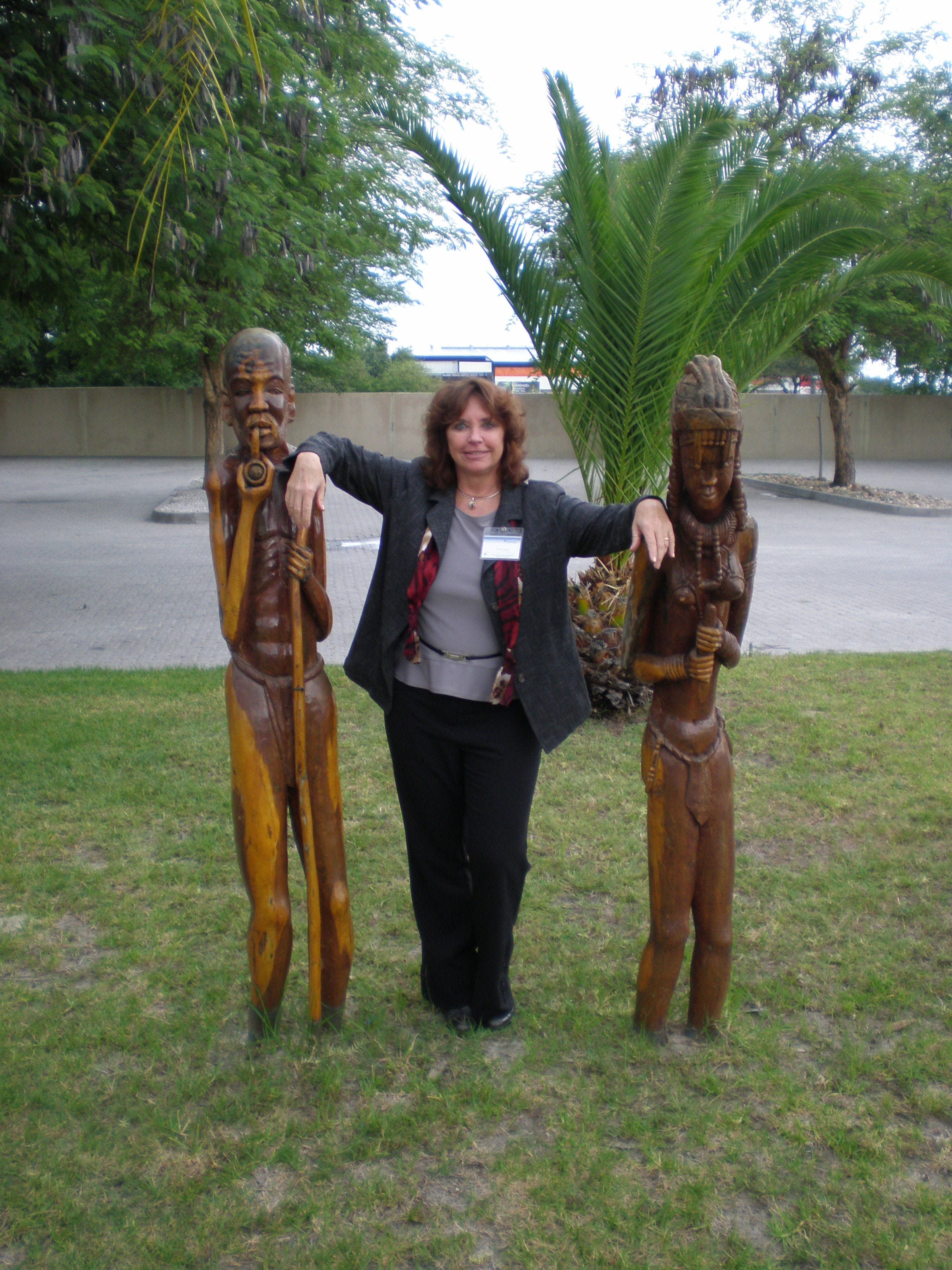
My suitcase caught up with me the last two days in northern Kazakhstan just in time to board the plane for our next few days in southern Kazakhstan. One of my travel companions shared a furry lambs’ wool hat with me and I had the rest of my travel wear for the next few days. At the end of our time in Kazakhstan I was headed for Namibia for another week of work in the summer sun with our colleagues there, and en route I had a 2 day layover in Frankfurt, Germany, where I celebrated my birthday! Armed with my coat and hat and gloves and boots on my body, I boarded the plane for Frankfurt. Due to the size of the plane they would not allow me to carry on my little rogue suitcase, but I figured what could possibly happen? We’re not stopping anywhere. I reluctantly gave it to the baggage handler. It made it to Frankfurt according to the computer, but was somewhere inside the Frankfurt air terminal and they “couldn’t exactly locate it just now.” Well … it caught up with me again just as I was leaving the hotel to board the plane to Namibia. By this time I’m having fun with this little game, and happily checked it at the airport wondering where in the world it would travel without me this time! Lo and behold, it didn’t make it to Namibia either … no surprise. It probably missed the last plane from Johannesburg to Windhoek (which I’ve almost done several times myself!) You can imagine that my new coat and hat and boots are a bit overdressed for the Namibia summer climate, so I was glad I had “layered” my working outfit in the bottom of my backpack—and I was good to go, but I had quite a story to share with my ASCP colleagues and Namibia classmates about lost luggage.

My little rogue suitcase finally caught up with me in Ondangwa the next day, so I was now well dressed for the remainder of my trip; I actually had too many clothes, and had to purchase a small duffle to get things home. Oddly enough, that little suitcase made it all the way back to San Diego without incident through intricate travel on the home stretch—I fully expected it to end up in Brazil, but it must have been tired of the game by then!

Lessons learned? 1) Never trust your luggage to make it to your destination—even if it’s your carry-on; 2) Always have one change of clothing with you at all times, even if you have to wear it; and 3) You can actually live and work for three weeks out of a backpack, on two continents and extremes in weather with both professional and casual attire—but you’ll have to trust me on that one!

Next time I’ll share a little about “Adventures in Travel” that involve passports … stay tuned. And, if you are ever in Frankfurt celebrating your birthday, I highly recommend the Marriott Hotel restaurant. They treated me like royalty and were very attentive since I was celebrating all by my self—and served me a very fine birthday dinner with a complimentary glass of champagne!  I had a lovely day actually, and if you would like to know how to spend your birthday in Frankfurt, contact me at bsumwalt@pacbell.net. I’ve got some ideas for you!

Cheers, Beverly Sumwalt
Cystic Fibrosis Related Diabetes

Cystic fibrosis-related diabetes (CFRD) is a type of diabetes that affects individuals who have Cystic Fibrosis. CFRD is an entity unto itself, having several aspects that make it different from other forms of diabetes.

Cystic Fibrosis (CF) is one of the most common genetic defects among the Caucasian population, and it is a devastating, systemic disease. When CF was first being diagnosed, children with this disorder rarely lived to reach their teens]; now the average life expectancy  of an individual with CF is around 36 years. Still horrifically short, but better. The fact that people with CF are living longer means they acquire other disorders, including a type of diabetes. It has been shown that with increasing age in the CF population there is increasing incidence of diabetes mellitus.  Roughly 20% of adolescents with CF have diabetes and about 50% of adults with CF have CFRD (1).

CFRD is not as straight-forward to diagnose as type 1 and type 2 diabetes, so it’s important for laboratory professionals to be aware of this disease. People with CF who have diabetes may not always have hyperglycemia. Also hemoglobin A1c (Hgb A1c) values, which is a test recommended by the ADA for diagnosing diabetes, may not be elevated in these patients. The oral glucose tolerance test (OGTT) is recommended for diagnosis of CFRD, and yet even these results may be equivocal in CFRD patients (2). Nonetheless, the ADA/CFF guidelines suggest that all CF patients over 10 years of age should be screened yearly for CFRD using the OGTT. In addition, at least one study in the literature has found that when performing an OGTT on CFRD patients, a glucose level at the 1 hr time point correlates best with the patient’s lung function (3). Thus, if your lab performs OGTT on individuals with suspected CFRD, the physician requesting the test may want the glucose value on a one hour time point as well as the standard 2 hour OGTT.

Individuals with CF who get CFRD tend to have weight loss, protein catabolism, worsened lung function and significantly increased mortality compared to CF individuals without diabetes. The increased mortality is directly related to decreased pulmonary function, rather than to the atherosclerotic vascular disease seen in other types of diabetes. Insulin therapy is the recommended therapy for CFRD.

-Patti Jones

References:

  1. Moran A, Brunzell C, Cohen RC, Katz M, Marshall BC, Onady G, Robinson KA, Sabadosa KA, Stecenko A, Slovis B. Clinical care guidelines for cystic fibrosis-related diabetes.  Diabetes care 33(12):2697-2708. 2010.
  2. Rana M, Munns CF, Selvadurai H, Donaghue KC, Craig ME. Cystic fibrosis-related diabetes in children – gaps in the evidence? Nature Reviews: Endocrinology, 6:371-378. July 2010.
  3. Brodsky J, Dougherty S, Makani R, Rubenstein RC, Kelly A. Elevation of 1-hour plasma glucose during oral glucose tolerance testing is associated with worse pulmonary function in cystic fibrosis. Diabetes Care, 34:292-205. 2011.

I’ll Have Pasteurized Milk, Please

Recently officials determined the cause of death of a young mother in Las Vegas: tuberculosis. The family Mycobacteriaceae contains several pathogenic species, including the most famous, M. tuberculosis. While none of the articles I read mention the species, they do mention the patient consumed unpasteurized dairy products, which leads me to believe she died of the zoonotic organism M. bovis.

Since these organisms are recovered infrequently, clinical microbiologists should brush up on the basics of these organisms on occasion. The CDC has some general information on Tuberculosis; the illustrious contributors at Wikipedia go a bit more in depth. The best sources for information are reference textbooks such as the Manual of Microbiology. It’s important to remember that mycobacteria can infect any region of the body, not just the respiratory system, so it’s important to keep an open mind. It’s also helpful to know that some species are rapid growers and may present on blood agar in a routine culture.

-Kelly Swails


“Light Bulb” Moments During Residency

After four months on CP rotations, I am now on a 2-month surgical pathology rotation at the VA hospital where we have a 2-day grossing schedule. While it is not as busy as the two community hospitals I will rotate in surgical pathology at in 2014, the time away from anatomic pathology brings some trepidation as I feel I’ve lost some expertise in this area. Use it or lose it. But again, it helps to have a great support staff that makes life easier by helping me out and providing me with daily laughs to make the day go by faster and almost feel like I’m not at work

While I remember being stressed when I started my 3-month “intro to surgical pathology” rotation last year as a PGY-1, a lot has changed in a short year. Last year, I felt as if there was so much that I did not know but eventually a time came, without my even realizing it, when I got most of my diagnoses correct. Clinical pathology rotations were inherently easier for me due to my research and grad school background and my comfort level in the lab setting. But since I am in an AP/CP track, its important to maintain perspective as well as skills in both disciplines.

To accomplish these goals, I approach service duties on each rotation with the same diligence. I don’t play favorites even with those rotations that I find easier, more comfortable, or more likely to be my future choice of subspecialty. There is always something I can learn and I give each rotation and every patient that same respect. Next, I learn by performing my duties with as close to the same responsibility level as my attending as I can. I find that I learn more by “doing” than by just studying. This is especially true if I interact with all members through the clinical care process – from technicians to attendings to primary care physicians and other subspecialists, not just to deliver diagnoses but to help influence healthcare decisions. This was especially true on my lab medicine rotations. But I understand that this learning style may not be the same for others.

For whatever reason, PGY-2 feels as if it has flown by more quickly, probably because I have more responsibilities and also cover night/weekend calls. But whatever what advice I or another senior gives their junior, people will only listen when they are ready to hear and have their “light bulb” moment. I know it took me a while to understand the significance of much of what I was told last year…Are you ready for your “light bulb” moment?

I will leave tomorrow to attend CAP HOD and to present a poster at the CAP conference (where I probably won’t get to visit Disneyworld). I’ll let you know how it goes in my blog post next week!

-Betty Chung


How the Government Shut Down Affects Your Health

The shutdown has far-reaching implications for your health.

The government-funded Centers for Disease Control employs detectives that investigate foodborne illnesses, infectious disease outbreaks, and influenza viral patterns.  They work hard to keep us healthy and productive. You know what happens when the government shuts down? They stop detecting. Development of next year’s flu vaccine gets delayed. Flu outbreaks aren’t tracked. Right now, there’s a Salmonella outbreak that isn’t being investigated as thoroughly as it would be if the CDC were open for business.  (If you’re interested in the CDC’s role in outbreak investigation, that link is here.)

The Superbug blog has a great post about the government shutdown and your health. 

-Kelly Swails


Under the Hood

I like to keep some humor in the lab so when I see a technologist with a panel off a machine trying to troubleshoot an issue I will say “Uh-Oh, why do you have the hood up?” It’s a little tension breaker, especially if they are stressing about having their instrument down. It also acts as a little reset button so I can go through the troubleshooting steps with them. As technologists, we are modern day mechanics. We use instruments much more than we perform manual testing, and we are expected to be able to troubleshoot instruments that are more complex than the current day automobile.

Acquiring new instrumentation can be a lab changing experience. Each instrument has its quirks and special requirements. The vendors usually offer on site or even off site training for staff once the instrument is purchased. Who you send to these training sessions is just as important as the quality of training they receive. These sessions are where your staff will learn maintenance, operation, and most importantly troubleshooting. When your shiny new analyzer goes down, and it will, the time it takes to get it back up and running affects productivity, turnaround time, and staff morale. Nothing is more detrimental to a staff’s morale then coming into work and the first thing they hear is that the instrument they are on that day is already down. Having experienced that exact thing I can tell you it takes the wind right out of you.If it happens consistently you will see a decreased engagement by staff.

Whom should you send for analyzer training? You should have a good mix of talent and maybe some of the lower performing staff. This assures that you are keeping your talented staff engaged and shows weaker performers that you are invested in building them into a top performer. The question becomes, how do I make sure that the people I send get the most out of their experience? Let them know they will be responsible for presenting the material they learned to the rest of the staff once they get back from training. If any of your staff have an issue with that they are not the ones you should send. These small presentations will help with team building as well as solidifying the information for the key operator.

As leaders we must pick our key operators very carefully. When these choices become important is most likely when we won’t be in the office. Observe the staff that likes to troubleshoot instruments or that keep a level head once instruments are down. You want to make sure that once the hood goes up you have the best mechanic for the job.

-Matthew Herasuta

Lab Product Friday-UniCel DxH800

The common maxim when buying laboratory equipment is “Fast, accurate, or cheap; pick two.” The perfect analyzer would have all three qualities, but as the saying suggests, it’s hard to find those instruments. Enter Beckman Coulter. Their website suggests the UniCel DxH800 is designed to meet these demands by improving productivity, decreasing turnaround time and reducing overall cost.

Recently Lab Medicine published a paper evaluating the performance of Beckman Coulter’s Unicel DxH800. The authors of the paper found the instrument to be accurate and efficient. They also commented that for larger facilities, this analyzer could improve productivity and turnaround times when compared to the older model (LH 750). Notably, the authors don’t mention cost, quality control, or maintenance concerns.

Does your laboratory have the DxH800? Is the maintenance easy to perform? Has this analyzer improved turnaround times in your lab? Let us know in the comments.


ASCP Annual Meeting: Training Residents in Genomics Workshop

I wanted to devote this blog to my experience at the recent Training Residents in Genomics (TRIG) one-day workshop at the ASCP Annual Meeting in Chicago. I admit that I am biased since I had ten years molecular and cell biology and transgenics research experience prior to medical school and enjoy all things molecular. But I really I do think that TRIG is an idea whose time has come.

TRIG is a group of molecular pathologists, medical educators, and geneticists who came together in 2010 with the goal to create a standardized, high quality genomics curriculum and to promote adoption at >90% of pathology residency programs by the end of their 5-year grant period. A 2010 survey of 42 pathology residency program directors found that only 93% confirmed molecular pathology as a part of their training and only 31% had established curricula on relevant topics. So, TRIG plans to provide online resources, lectures and workshops, and to assess the efficacy of genomic medicine curricula at residency programs through RISE performance. From speaking to other residents I’ve met over the past year, I know that the teaching of molecular pathology at each program can vary significantly.

The TRIG workshop had four sessions that followed the case of a woman with newly diagnosed breast cancer while applying specific hands-on skills related to the genomic related elements of her case. I missed the first session so I can’t say too much except that they discussed single gene testing and assessment of BRCA mutations of unknown clinical significance. Session two covered the assessment of prognostic gene panels (Oncotype DX) and compared them versus the standard breast IHC panel. We also learned to plot Kaplan-Meier survival curves based on a patient’s genomic profile on a publicly available website.

After lunch, session three dealt with the selection of genes to design a breast cancer multi-gene assay for this patient. Questions considered were the availability of targeted drug therapy for specific somatic mutations, the strength of association of selected genes with breast cancer, frequency of these variants, reimbursement, and choice of PCR based genotyping versus next-gen sequencing. The final session focused on the creation of a genomic pathology report for this patient after analyzing the clinical significance of each result from multi-gene mutational analysis using free web-based tools.

This workshop was a great introduction for the genomics neophyte (especially if one’s residency is weak in this subject or doesn’t have a molecular pathology rotation) and even someone with some experience like myself, learned how to use some new tools and applications even though the concepts were not new to me. As I mentioned in previous blogs, I learn more from having to tackle issues hands-on and being able to participate in a bidirectional discussion about a topic versus reading textbooks or attending lectures. The workshop was a good intro albeit too short to learn to apply these skills comfortably and effectively…but it is definitely a step in the right direction and I expect to see more great things coming out of the TRIG Working Group. More info about TRIG is at www.ascp.org/trig.

-Betty Chung