New National Strategy for Antibiotic Resistance

Last week, the White House published a National Strategy for Combating Antibiotic Resistant Bacteria and President Obama signed an executive order that orders the implementation of the strategy. The report covers a lot of information, but two goals stuck out as being especially pertinent for laboratory professionals.

By 2020:

  • 95 percent of hospitals report data on their antibiotic use to the CDC
  • create regional laboratory networks for testing resistant bacteria and make the data publicly, electronically, available.

Both of these goals require the cooperation of clinical laboratories including (but certainly not limited to)  infrastructure upgrades, data collection, and procedural changes. In an era when laboratories have less resources than ever before, will this stretch microbiology departments too far? Based on available resources, are these goals attainable?

If you’d like a comprehensive overview of the government’s strategy, check out Maryn McKenna’s excellent post on Wired’s Superbug blog.

Swails

Kelly Swails, MT(ASCP), is a laboratory professional, recovering microbiologist, and web editor for Lab Medicine.

Resident Concerns, Part 2: Fellowship Applications

So, continuing on with resident concerns I heard about during conversations at the 2014 CAP Residents Forum and Annual Meeting, let’s move on to the fellowship application process.

One nice offering by the Residents Forum for the past two years at the Annual Meeting is a mock fellowship interview. The process was simple in that I only needed to fill out a brief application prior to the meeting with my fellowship interests and I was matched up with a member of the CAP Board of Governors or another CAP national leader who either practiced or had experience in my area of interest (or as close to it as CAP could find out of the available pool of mock interviewers). Once matched, I emailed my personal statement and CV to my mock interviewer (who turned out to be someone I already knew from my work on a CAP Council). I also participated in the mock interviews last year with a pathologist who I didn’t know beforehand. Both times, I received valuable feedback on my submitted materials and advice for the actual interview as well as an open invitation to contact them in the future if I had questions or needed more advice. I highly recommend these mock interviews if you are attending a future CAP Annual Meeting.

Obtaining fellowships can be even more competitive than getting into a residency. There are far fewer spots in that some may only offer one position per year in that subspecialty, programs may have already filled their positions with internal candidates, and the majority of residents (96%) apply for at least one fellowship (85% of third and fourth year residents according to the 2014 ASCP Fellowship and Job Market Survey had already accepted fellowship positions by the time of this survey during the RISE).

The trend these days is to complete at least one fellowship (56% answered yes to this question on the ASCP survey) and many often complete two (39% on the ASCP survey indicated that they would pursue two fellowships). I personally also know individuals who completed three although they are in the minority.

And it’s currently fellowship application season. Even though the suggested deadline is December 1st, we all know that most programs start accepting applications in September. I called some programs in August with questions and they had received applications already! Suffice it to say, from totally anecdotal evidence that I’ve heard, it seems that there are two periods for interviews: Oct/Nov for those accepting applications early and Jan/Feb for those who wait until December 1st to look at their applications. Even from friends in other specialties also going through this process, it seems that the process actually begins the year prior to application.

For those who want to be ahead of the game, at least start getting your CV and personal statements together. Since I’ve been updating my CV whenever something new came up since college, the CV was no problem. But I can tell you that I wished that I had started on the personal statement as a second year. I thought that I was being a semi-early bird to write my initial draft in August. But it took about a month of back-and-forth feedback from people who I asked to read it for me to whittle it down to less than one page. Turns out that most programs want something short and sweet (one page or <500 words). One program even wanted <250 words so I gave them a super abridged version of what I submitted to other programs. So, second years, start now so that you can submit everything in complete form on September 1st. The other part of applications are letters of recommendation. I’ve only heard residents from one program tell me that their letter writers will give them a letter within a day after being asked. If you’re like me, you’ll probably need to ask your letter writers way in advance and sometimes, give quiet reminders. So start early if you want letters ready by the time you submit.

The controversial issue that I always hear whispers about at the three Residents Forums I have attended is that of a standardized fellowship match like we had when we applied for residency. There are pros and cons for and against a standardized match. I was speaking with someone from the Association of Pathology Chairs (APC) and he supported a match. I would agree that it would deter residents from being subjected to undue pressure from programs to decide quickly once an offer is made (most 4th year residents who I spoke with said that they had up to 1 week at most to decide). It would also eliminate the situation that many of them found themselves in where they had accepted a position but later interviewing programs encouraged them to still interview and disregard their previous acceptances (which I think is unethical and I’d politely decline to interview at that program). But I can understand the conundrum that the later interviewing programs that follow the suggested CAP deadlines are subject to when many of their desirable candidates have already signed by the time they interview.

Unlike when the NRMP decided to go a match system for residencies, and later on, to bar pre-matching from participating institutions, the incentives and ability to leverage are very different when it comes to fellowships. Most fellowship programs offer a small number of single digit positions which they can usually easily fill without a centralized application service. And fellowships are a quasi-limbo state between school and our first “real” job. The job market does not cater to regulation and it is hoped that free competition is enough to ensure that everyone ends up where they are meant to be (although we know that connections and word of mouth still matter, especially in the small world of pathology). Programs (supposedly 51% from one study) will also often fill their spots with internal candidates and residents often feel the need to apply earlier and undertake audition rotations for the most competitive fellowships (eg – 2nd year for dermatopathology). While a standardized match may alleviate some of the aforementioned pressures, it does provide some of its own. Residents often have to spend more money to interview at a larger number of programs to feel secure that they will match somewhere and they also need to wait until later in the year to learn their fate. They also would likely have difficulty if they are trying to match for two successive fellowships which is not that unheard of, especially when those fellowships are related.

So, in terms of a standardized match, even though I usually have an opinion on most topics, I’m not sure which is better and the jury is still out. But I do know that the ability to incentivize programs into such a match process is much more difficult than it was for residency programs. It does seem though that residents do prefer a standardized application timeline according to multiple ASCP surveys even if they don’t support a match process. APC and PRODS (program directors section) tend to support a pan-pathology fellowship match while other organized groups within pathology and most residents remain skeptical that one would solve all the issues on both the resident and institution sides of the equation.

Well, for my compadres who are wading in these murky waters this interview season as I will also be, it’s a moot point. So I leave you with this: CAP had a great webinar last year by two pathologists-in-training who had survived this process as well as a program director. The webinar can be accessed here as well as a Q&A FAQ PDF from that webinar.

References:

  1. KD Bernacki, BJ McKenna, and JL Myers. Challenges and Opportunities in the Application Process for Fellowship Training in Pathology. AJCP, 2012; 137: 543-552. Accessed at http://ajcp.ascpjournals.org/content/137/4/543.full.pdf+html
  2. WS Black-Schaffer and JM Crawford. The Evolving Landscape for Pathology Subspecialty Fellowship Applications. AJCP, 2012; 137: 513-515. Accessed at http://ajcp.ascpjournals.org/content/137/4/513.full.pdf+html
  3. JM Crawford, RD Hoffman, WS Black-Schaffer.Pathology Subspecialty Fellowship Application Reform, 2007-2010. AJCP, 2011; 135: 338-356. Accessed at http://ajcp.ascpjournals.org/content/135/3/338.full.pdf+html
  4. RE Domen and A Brehm Wehler. An examination of professional and ethical issues in the fellowship application process in pathology. Hum Path, Apr 2008; 39(4): 484-488.
  5. N Lagwinski and JL Hunt. Fellowship Trends of Pathology Residents. Arch Path Lab Med, Sept 2009; 133(9): 1431-1436. Accessed at http://www.archivesofpathology.org/doi/pdf/10.1043/1543-2165-133.9.1431
  6. JL Myers, SA Yousem, BR DeYoung, ML Cibull (on behalf of ADASP). Matching Residents to Pathology Fellowships: The Road Less Traveled? AJCP, 2011; 135: 335-337. Accessed at http://ajcp.ascpjournals.org/content/135/3/335.full.pdf+html

Chung

-Betty Chung, DO, MPH, MA is a third year resident physician at Rutgers – Robert Wood Johnson University Hospital in New Brunswick, NJ.

Pandora’s Box

Archived in the ever-rich and exotic mythologies of the Greeks is the story of Pandora’s Box. It was actually a “jar”—which is strangely close to a “test tube” in my opinion. Pandora was given a wedding gift, a beautiful jar, with instructions not to open it under any circumstances. Curiosity killed the cat, so to speak, and she finally couldn’t resist. When she opened it, all the evil contained in the jar escaped and spread over the earth. She tried to close it but too late—the contents had already escaped. Only one thing remained in the jar at the very bottom—the Spirit of Hope.

I’m not sure the World Health Organization would agree with me, but “Pandemic” is very close to “Pandora.” In a world where international travel is commonplace the spread of contagious disease is a major concern. Rats on ships carrying plague may be a thing of the past, but viral-loaded passengers on an international flight happen every hour of every day. Think of all the headlines in the past decade that have highlighted international health risk issues. It seems that Pandora has unleashed a few additional mutated “evils,” and I doubt we’re through with all her mischief.

As laboratory professionals, we are essential to solving the public health issues confronting our world today. Rapid diagnosis, evidence-based research, viral load monitoring, susceptibility and pharmacological validation, managing toxicity—familiar territory for us, and just think of how much relies on our expertise? We are called on daily to be the platform and framework for “pandemic control” measures. Sitting in our clean, efficient, well-lit, safe and busy laboratories throughout our country it’s easy to forget there are bacterial and viral war zones not far from our shores…all it takes is a small rat on a creaky ship (or a young child on a red-eye international flight) to initiate a modern day plague world-wide.

Next time you hear “pandemic”, remember Pandora. Wash your hands, put on a mask, and peer inside that jar of hers and shake out some Spirit of Hope. Sprinkle it liberally around our laboratories and colleagues, and let’s roll up our lab coat sleeves—we have a lot of work to do!


???????????????????????????????

Beverly Sumwalt, MA, DLM, CLS, MT(ASCP) is an ASCP Global Outreach Volunteer Consultant.


Dried Blood Spots – Sample Extraordinaire

When you mention dried blood spot samples (DBS), most people think of newborn screening. That’s natural because the most common usage for DBS is newborn screening. However, DBS samples are actually one of the most versatile, stable and easily stored samples that it’s possible to collect from a human. And did I mention useful?

To create a DBS sample, whole blood, often from a finger or heelstick, is spotted onto a very specific weight of filter paper. The weight and type of filter paper is important so that all DBS are created equally, and so that differences in testing are not introduced due to filter paper differences. Enough blood is used to thoroughly saturate the paper (in most case roughly 50 uL will saturate the marked dot) and then the blood spot is allowed to dry completely.

DBS are ideal samples for population based testing. The list of positive attributes is long. They are easily obtainable (fingerstick). They use very little blood (50-60 uL). Once dried they are not subject to the sample degradation effects that plague liquid samples. They are simple to transport with no possibility of spilling or breaking. They store easily, taking up very little space, and studies suggest that once dried, the sample is stable for years, whether at room temperature, refrigerated or frozen.

In addition to these obvious benefits, a truly remarkable number of analytes can be measured from one or two 6 mm punches out of a dried blood spot, with a punch containing roughly 10 uL of blood. Protein enzymes are generally stable in a dried blood spot, allowing enzyme activity to be measured from DBS. Viruses such as HIV can be measured in DBS. Even RNA and DNA is stable in these spots, as evidenced by the PCR assays that are being performed using them. These assays include such things are Cystic Fibrosis (CF) mutation testing and screening for severe combined immunodeficiency (SCID).

Besides the PCR testing for CF and SCID, the newborn screen itself uses the DBS sample to measure some or all of the following: either T4 or TSH for hypo- or hyperthyroidism, hemoglobin variants for sickle cell anemia, 17-hydroxyprogesterone for congenital adrenal hyperplasia, immunoreactive trypsinogen for CF, amino acids and acylcarnitines for amino acid, fatty acid and organic acid disorders, and an enzyme for galactosemia. Each one of these assays is performed using the single punch from a DBS. The DBS is an almost overlooked sample type. However it has the potential to be used for a huge variety of testing.


???????????????????????????????????????????????????????????????????????????????????

-Patti Jones PhD, DABCC, FACB, is the Clinical Director of the Chemistry and Metabolic Disease Laboratories at Children’s Medical Center in Dallas, TX and a Professor of Pathology at University of Texas Southwestern Medical Center in Dallas.

Perfection

When I was in school I learned a lot about science and the laboratory science body of knowledge. The one thing that was emphasized over and over was accuracy and precision. It wasn’t until I secured my first position and started training did I realize just how important those two words were. Not only are we counted on for our accuracy, we are counted on for the repeated accuracy of everything we report to physicians. I have heard some statistics reported that up to 80% of physician decisions on courses of treatment are based on lab results. I really do not get caught up in that number because if you think about it every single value we report is going into a patient’s clinical picture and can affect a decision on a treatment one way or another. So the question always comes up, how do we deal with errors? This question is multifaceted and as a supervisor/administrator we are responsible for much more than just the correction of the error.

I wrote this in my 5 year progress report article but I think it deserves repeating. Everyone makes mistakes, but, it is how you recover and learn from your mistake that is most important. Everyone has had that sinking feeling in their stomach when they learned they have either reported out an incorrect result or have mislabeled a specimen. As a laboratory professional it is our biggest fear and each and every day we sit down at the bench and are expected to be absolutely perfect. Zero errors are a standard that not even the most efficient manufacturers know is possible yet we are expected to perform on this level each and every day. Errors happen to everyone, and when they do it is what happens afterwards that is key to inhibiting that error to occur again. Especially with newer technologists it is important to teach them so that they are able to recover and not make the mistakes again.

The first thing I do when an error is discovered is address it with the technologist. Ask them, “do you remember this sample or this patient? Do you remember what you were doing at the time this error happened?” One thing to watch is how much the technologist can remember. If they cannot remember too many details, were they trying to do too much at once? If they mislabeled did they have a pile of tube and labels while also trying to result specimens? With mislabels I found it helpful for myself to read the name in my head as I was labeling the tube. That way if what I was reading in my head did not match the label underneath I would stop to look. If it is a procedural error why did the technologist deviate from the actual process? Did they learn a shortcut but that shortcut actually increases the chances of error? Going over this with the technologist also will help them with their problem solving skills. Especially with new technologists building problem solving skills is vital to the success or failure of a young technologist. We know humans are not perfect, but when you work in an industry that accepts nothing less, each error made is amplified but also that much more important.


Herasuta

Matthew Herasuta, MBA, MLS(ASCP)CM is a medical laboratory scientist who works as a generalist and serves as the Blood Bank and General Supervisor for the regional Euclid Hospital in Cleveland, OH.

Acquired B Phenotype

Students learning about the ABO blood group system commonly get confused about two unique situations: The Acquired B phenotype and the Bombay phenotype.

These two entities are VERY different, but they are similar in this way: people are asked about both on exams all the time, but hardly anyone every actually SEES either one in real life! It is essential for students of blood banking to understand Acquired B clearly, as it remains a real possibility in everyday practice. I’ll cover Acquired B in this month’s blog, and next month I will discuss Bombay.

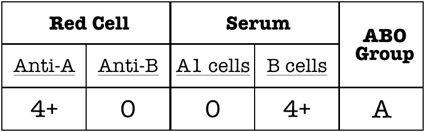
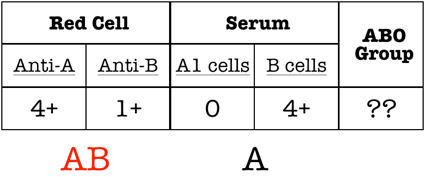
Routine ABO testing is performed in two distinct (but usually simultaneous) stages, known as “red cell grouping” (forward grouping or “front type”) and “serum grouping” (reverse grouping or “back type”). Here’s an example of how it works: If a person’s red blood cells (RBCs) react strongly with reagent anti-A but not anti-B, we would interpret their red cell grouping as blood group A. If there is no ABO discrepancy, that same person’s serum should have no reaction with reagent group A1 RBCs and strong reaction with reagent group B RBCs (demonstrating the expected presence of anti-B in the serum). Thus, the serum grouping interpretation would also be blood group A, and no ABO discrepancy would exist (see this illustrated in the figure below).

aboexample

ABO discrepancies occur any time the interpretations of a person’s red cell and serum grouping do not agree. ABO discrepancy takes on many forms, and acquired B is a great, if not terribly common, example.

Students learning about the ABO blood group system commonly get confused about two unique situations: The Acquired B phenotype and the Bombay phenotype.

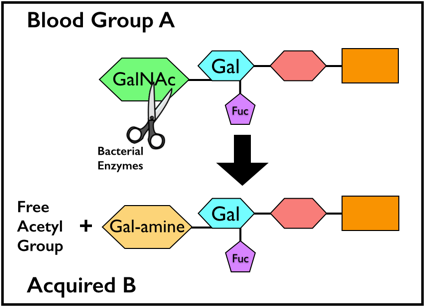
Usually, Acquired B occurs when the RBCs from a blood group A patient come in contact with bacterial enzymes known as “deacetylases.” These enzymes, commonly carried by bacteria that live in the colon, catalyze the removal of the acetyl group from the residue that gives the A antigen its specificity, N-acetylgalactosamine (GalNAc). This modification leaves the A-specific sugar as galactosamine (N-acetylgalactosamine with the acetyl group removed = galactosamine). Recall that normally, the group B-specific sugar is galactose.

acqb

As a result of this modification, anti-B in both human group A serum and especially certain monoclonal reagents will weakly agglutinate the group A RBCs carrying the acquired B antigen. This means that the patient’s RBCs may have a weakly positive reaction with anti-B in serum grouping tests instead of the expected negative (see image below). The serum grouping for these patients is no different from that expected for a group A individual (negative with group A reagent RBCs, strong positive with group B RBCs).

acqbabotesting

So, what does this actually mean? How do these patients actually get transfused? This is where the recognition of the entity in a transfusion service or reference laboratory is essential. Several simple strategies can be employed to prove that this patient is really NOT group AB. First, I always advise people to check the patient history! The rare cases of acquired B that are still seen will often be associated with colorectal malignancy, gastrointestinal obstruction, or gram-negative sepsis (where those bacteria can contact the RBCs). Second, adding the patient’s own serum to his RBCs (autoincubation) reveals no incompatibility. In other words, this patient’s own very strong anti-B does not recognize the acquired B antigen (which is really just a partially modified group A antigen) as being an actual group B antigen. We already know that this patient has anti-B in his serum from his serum grouping results (see above), but the patient’s own anti-B completely ignores the acquired B antigen on his RBCs (even though human anti-B from other people will react). Third, the technologist can use a different form of monoclonal anti-B in the patient’s red cell grouping test. Certain clones are known to react with acquired B, while others are not (normally specified in the package insert), and choosing a different clone (often easier in reference lab settings) will render the forward grouping consistent with that of a group A person. Also, incubating the Acquired B RBCs with acetic anhydride will lead to “re-acetylation” of the modified A antigen and loss of the B-like activity. Finally, acidifying the reaction mixture of the patient’s RBCs with human anti-B (non-self) can eliminate the incompatibility with that source of anti-B.

In the end, Acquired B is a serologic problem that is fairly easy to recognize, especially on examinations (I always tell my students that when they see a problem that starts with words like, “A 73 year old male with colon cancer…”, check the answer for Acquired B!). In real life, experienced blood bankers can diagnose and confirm Acquired B fairly easily in the rare times that it is seen. These patients can receive group A blood without a problem, and the ABO discrepancy will disappear as the infection or other situation causing causing contact with bacterial enzymes clears. Thanks for your time and attention. See you next month when I will discuss the Bombay Phenotype!


Chaffin

-Joe Chaffin, MD, is the new Vice President and Chief Medical Officer for LifeStream, a Southern California blood center headquartered in San Bernardino, CA. He has a long history of innovative educational efforts and is most widely known as the founder and chief author of “The Blood Bank Guy” website (www.bbguy.org).

Resident Concerns, Part 1: Boards Prep

So I’m writing this blog while taking a break from the 2014 CAP Annual Meeting (I hate high heels and my feet are killing me from standing by my poster). As a resident, one of the most enjoyable parts of every conference that I attend is meeting and speaking with other residents. It’s even better if the conference planners organize specific events, networking receptions, or a resident lounge where residents can meet and socialize with each other and other trainees and pathologists. The CAP Annual Meeting is always good in terms of providing residents such outlets.

The best part for me is hearing stories of other resident experiences different than my own in addition to making new friends and colleagues. So my next couple blog posts will be about some of the topics that came up as the most important from the residents I spoke with: boards preparation, the fellowship application process, and networking/engagement opportunities for residents.

So, in terms of the boards, two themes seemed to emerge. First, many felt that the Resident-In-Service-Exam (RISE) does not correlate well with what we need to know to prepare for boards. For instance, this example was given to me: a decent percentage of questions on the RISE focused on forensics while most had heard that the boards have very questions dealing with forensics. My opinion on this topic is that it depends on what your expectations are concerning the RISE. If you are hoping that the breakdown of the RISE is a simulation of the boards in mini-form, then you might be disappointed. But if you like to advocate change for a different focus for the RISE, then I’d encourage you to bring your concerns to the RISE committee at rise@ascp.org and provide a cogent argument for your views…my motto is always, “you never know, the worse that they can say is no, so it’s better to try.” It certainly is not irrational to want our in-service exam to reflect what we need to know most for the boards and for real-world practice so let the RISE committee know.

Secondly, the topic came up of what is tested on the boards in terms of breakdown. I also wondered the same thing since I need to prepare chemistry and molecular pathology podcasts for for ASCP’s Lab Medicine Podcast Series and had no clue what would be high-yield topics that I could focus on (if you have a specific topic or test in these areas that you’d like a podcast on, please feel free to let email me and I’ll try my best).

So, I asked someone I know at the American Board of Pathology (ABP) about this issue. She directed me to the APCP Exam Blueprints which outlines the overall breakdown of number of questions in specific topic areas on the most recent board exam. I’ve also been told that they will post category codes for the various exams (ie – something like a “table of contents”) to the ABP website soon.

Looking at the blueprints, I have a better idea of some of the board topic areas that I will need to concentrate on (although there is nothing listed for molecular pathology but maybe there isn’t that much yet on the boards or it’s included within other AP/CP areas like soft tissue or hematology). And apparently, this is much more info than has been previously provided. But again, if you want a more detailed breakdown or other information that you can’t find on the ABP website, I also encourage you to communicate your concerns to Dr. Rebecca Johnson, the CEO of the ABP. Remember, positive change only occurs if there is a stimulus for change, and that stimulus can be you! As attendings, we need to be pro-active in questioning and changing the status quo for the better, so why not start practicing or acquiring those skills while a resident.


Chung

-Betty Chung, DO, MPH, MA is a third year resident physician at Rutgers – Robert Wood Johnson University Hospital in New Brunswick, NJ.


Enterovirus D68

Over the past few weeks, hospitals around the country have seen a sharp uptick in cases of respiratory distress in children. The majority of patients test positive for Enterovirus D68, and most seem to have a history of asthma.

Only select laboratories test for this strain of enterovirus. If a suspected case comes to your facility, contact the CDC or your local health department for information about specimen collection and shipping.


What’s Your Number?

When I ask “what is your number,” I mean “what is the percentage of time you spend on the bench versus time in the office doing administrative work.” In my laboratory we currently have a chemistry supervisor on extended leave so myself and the hematology supervisor are 90/10 bench/office. I know what you’re thinking, how do you do the administrative portion while working the bench that much? The answer is simply, we can’t. Unless I work 60 hour work weeks there is no humanly possible way to be able to work on the bench and get done what I need to in the office. Prioritizing the administrative duties and taking advantage of slow days on the bench is the number one reason why I am somewhat successful at getting things done.

The biggest challenge I face is competency. One of CLIA’s six competency guidelines is physically watching each technologist/technician perform each test that is on our test menu. So let me break this down. I have 15 employees that need to complete competencies. We perform gel testing in blood bank as well as LISS, PEG, and Pre-warm screens in tube if necessary. Let’s round all of those tests to 45 minutes. 15 employees times 4 different methods is 60, times the 45 minutes is 2700 minutes, or 45 hours. Now don’t forget that I am in the hospital setting which is 24/7 so I have to be available for second and third shift if I want to make sure those employees are competent. So for simplicity sake I’m going to round those hours up to 48 which makes six 8 hour days of competency. If I get two office days a month, competency will take me four months to accomplish and that isn’t counting my other duties. This is also assumes uninterrupted time which we all know happens once a millennia. These are just four tests as well; we perform many others such as antigen testing, long crossmatching, etc. When looking at this it can be overwhelming but there are ways to accomplish the impossible without killing yourself.

One way to help yourself out is to look at the CLIA definitions of who can be a technical supervisor for competency testing. Chances are you have more than one employee who qualifies and as long as you sign them off as competent they can sign off other employees. This can drastically cut down the amount of time you need to spend individually with each employee. Another way is to have the employee’s videotape themselves performing the tests while explaining out loud what they are doing. This not only confirms their competency but you can watch back the tape at your leisure as well as show inspectors if they ask how you satisfy the observation portion of the competency. I now ask you in the comment section below write down your numbers and let me know what your biggest challenges are and some possible solutions. We can help each other out, and share in the continuous struggle. So, what’s your number?


Herasuta

Matthew Herasuta, MBA, MLS(ASCP)CM is a medical laboratory scientist who works as a generalist and serves as the Blood Bank and General Supervisor for the regional Euclid Hospital in Cleveland, OH.

Generation Gap from a Resident’s POV

I was talking with my attending and fellow this week and was struck by the generation gap in terms of how we were/are trained. When my attending was in residency, he had to handle over 100+ CP calls in a week – he even keeps one of his call sheets to back up his stories. In some ways, we are spoiled because we can just say that there is an APP to do many of the calculations he had to do then and so we’re not even paged on these types of calls. These days, I may average 10+ CP calls/week at the same institution where he trained at. He also said that they didn’t have PAs back then and it wasn’t unusual to gross until close to midnight…and the grossing resident also covered all frozen sections at the same time, too. His is not the first attending story that I’ve heard like this. Obviously, this was before we had work hour reform. But I wonder what we’ve lost in training since his time?

I’ve often heard residents complain that we have too many service duties and that they feel that service duties supersede our education. Most of the time these complaints revolve around not having enough time to read and too much “scutwork” including grossing routine specimens. I’m no expert by any means but I feel that for me, I’ve learned more when I’ve had to do things as opposed to reading textbooks. And by doing things, I mean performing those duties that are required of my attending as close as possible to the real experience. And yes, that does include lots of reading, not just textbooks but also journal articles and other resources, but is not limited mainly to reading.

Gone are the days where I could skip (or attend) my medical school classes and watch a video of the lecture and read the textbook and do well on exams. The more important difference is that now the consequences of my actions can more directly harm patients so it’s vitally important to gain “attending skills” as well and as soon as I can. And even after graduation, I know that it will still take a few years before I am comfortable in my clinical competency. I know that I’ll be more stressed and OCD about details because it will be my name at the end of the report that is responsible for patient care decisions and also liable for medico-legal action. But I want to be as prepared as possible when that time comes.

Residency is the time when we should transition from passive learning (ie – learning mostly by reading textbooks) to active “on the job” learning. Sure, if no one at your program wants to teach you, then you may be stuck with textbooks and online resources. But I’ll take a bet that even at the most “malignant” programs, there is always at least one golden mentor (including non-attendings) who wants to teach. And remember, that during fellowship, your attendings will expect that you have most of these skills in your portfolio and that you have good time management skills. No one expects that we have knowledge of everything (even our attendings don’t have that), but they will expect that we know how to approach that situation if we find ourselves unsure.

Anyway, that’s not my most important point. I find that complaining just wastes my energy that can be directed to a more useful endeavor. Yes, if I feel something is truly unjust, I will be one of the first to say something. But I realize that the patient is the center of my training and not me, their needs supersede mine, and yes, there will always be scut but it depends on how I approach it what I get out of it. Plus, I realize that compared to other specialties, I didn’t have an intern year and don’t have to do overnights, so I’m thankful that my residency experience is not as bad as it could be.

A generation gap exists where our attendings can’t understand why we complain and where we don’t feel our attendings understand us. But I think that there is a middle ground. I don’t think that we should go back to unregulated work hours where we are dangerously fatigued and never get to see our family and friends. But I also don’t believe that residency training is there to spoon-feed me. It is the time for me to spread my wings (with supervision, of course) and learn how I’d navigate my clinical duties as a future independent attending.

For those going into surgical pathology, you may still end up working at a hospital where you may need to gross or at least, look at specimens or teach how to gross. The end of residency doesn’t necessarily mean the end of grossing (or insert you least favorite aspect of residency here). A friend was telling me that he overheard attendings at a networking reception complaining about a new hire they had who didn’t know how to gross. If that was at a private practice, I would expect that after a short time allowed for remediation, that if that new hire didn’t improve, s/he would be fired. There may be more leniency at an academic or VA institution, but I also believe that if a better replacement could be found, that person would still be fired.

So residency is the time to make sure we gain competency in skills like grossing, lab management, billing, CLIA regulations…even if these are usually the things that we find to be boring. Sign-out is not even half of what will be required of us when we are full-fledged attendings, especially if you want to work in private practice, which is where most of us end up since the compensation is greater.

Getting involved in leadership positions, whether at your hospital, state society, or within a national advocacy organization in my experience opens doors to many practical opportunities as well. For instance, I’ll be going with my hospital’s CAP lab accreditation inspection team this month to help inspect the hematology section of a lab in another state. Because my department chair knows I have an interest in hematopathology and because I performed well on my first CP rotation here, I was given this great opportunity. I’m now certified as a CAP inspector and will have a better idea of lab management issues after this experience. Due to my involvement as the junior member on CAP’s Council on Education, I’ve also been given the opportunity to serve as the ACCME/AMA compliance monitor at a joint CME activity of CAP and a state pathology society in the near future. I see this as active learning and a step toward gaining the competencies that I will need.

Right now, we are buffered from much more than we realize. Probably as a fellow, we will understand the end game better, just how much our attendings’ days are filled with more than just sign-out. I suggest reading the article, “Adequacy of Pathology Resident Training for Employment: A Survey Report from the Future of Pathology Task Group” that outlines specific competencies that employers wanted and that residents did not possess adequate competencies in. It goes on to state that 50% of employers felt that new graduates that they hired needed more support and guidance than was required 10 years ago. So what can we do now during training to ensure that we are not those new graduates who are perceived as needing “more” supervision at our first job?

 

Chung

-Betty Chung, DO, MPH, MA is a third year resident physician at Rutgers – Robert Wood Johnson University Hospital in New Brunswick, NJ.