Modern Radiation Safety in the Laboratory

In the “old days” in the clinical laboratory, the main sources of potential radioactive substances were found in the Radioimmunoassay (RIA) department. Techs who worked in this specialized testing area handled reagents which often were radioactive isotopes. The materials were used to label specific antigens which would compete with unlabeled antigen from patient samples. This method would allow the determination of high-quality quantitative diagnostic values. In the early 1990s, radio-immunoassays were commonly used to perform thyroid testing, narcotics assays, and a variety of hormone level analyses. Unfortunately, the use of such isotopes for testing was costly, difficult to automate, and their use was potentially hazardous to staff. Eventually this major testing method was replaced by ELISA testing, chemiluminescence, and other techniques, but some labs still do utilize RIA analysis today.

In the Anatomical Pathology areas, there has been potential radiation exposure from certain specimens in the past, and newer techniques have introduced other sources into the lab as well. Tissues (such as thyroid gland sections) are not typically removed from patients when treated with radioactive dyes, but it can occur. Good communication to the lab from surgery staff is important so that no one is unnecessarily exposed. Sentinel lymph node biopsies are sometimes infused with radioactive tracer dyes. Pathology staff may also receive radioactive seeds used to treat prostate cancer. Usually these seeds have decayed sufficiently and are inert, but that may not always be true. Again, clear communication about these samples is important. Other radioactive seeds are now used for breast tumor localization, and these do arrive in the lab while radioactive, and they must be handled and stored with care.

The best protection from radiation exposure is distance, duration, and barriers. Being away from a radiation sources isn’t always possible, but working with them for short periods and using some form of barrier protection will help. The types of radioactive material handled in labs today generally emit low levels of energy, and the use of Standard Precautions offers sufficient protection. Gloves, lab coats and face protection will provide the necessary protective barriers when handling these standard materials (Note: items like thyroid tissue that have been infused with Iodine-125 contain above-normal levels of energy and should be treated with extra care).

The College of American Pathologists (CAP) updated its regulations last year regarding radiation safety in the laboratory. Some of the standards were moved from the Anatomic Pathology checklist, and some are new. When asked, the CAP has stated that these standards do not apply to laboratories that handle low-level radiation samples such as sentinel lymph node biopsies.

First, the regulations require radiation safety handling policies and procedures which are maintained in a radiation safety manual. This manual can be paper or electronic, and it does not need to be separate from other lab safety policies. The policies should need to spell out who in the lab is authorized and restricted from handling radionuclides. Specific procedures should also be maintained to describe what actions to follow in the event of a radionuclide leak or damage to radioactive seeds. All radioactive materials and supplies should be inspected to ensure that there is no leakage or compromise that could expose staff unnecessarily.

The updated standards also require workplace radiation decontamination procedures, and labs that perform this type of work must keep records that document the effectiveness of the decontamination processes. Laboratories that handle radioactive substances must post radiation warning signs to communicate to others the potential dangers present, and all laboratory and medical staff must have comprehensive training prior to handling radioactive substances. Lastly, the CAP checklist now requires that if radioactive substances are handled in the lab, a laboratory representative must participate as a member of an institutional radiation safety committee.

Many things have changed in the laboratory setting over the past decades, and the regulations keep changing in an effort to stay current. The bottom line for radiation safety regulations in the lab is that staff need to be aware of what radioactive substances they may become exposed to, so they need to know safe handling processes as well as emergency response procedures. In the real world of lab medicine, radioactive substances do not glow, so lab staff may not be aware of the dangers when they enter the department. If the proper communication and practices are in place, however, everyone can maintain the minimum radiation exposure levels needed to live long and safe lives.

 

Scungio 1

Dan Scungio, MT(ASCP), SLS, CQA (ASQ) has over 25 years experience as a certified medical technologist. Today he is the Laboratory Safety Officer for Sentara Healthcare, a system of seven hospitals and over 20 laboratories and draw sites in the Tidewater area of Virginia. He is also known as Dan the Lab Safety Man, a lab safety consultant, educator, and trainer.

Essential Diagnostics List

A propos of Lab Week 2018, the WHO announced the development of an Essential Diagnostic List (EDL). The first Strategic Advisory Group of Experts on In Vitro Diagnostics (SAGE IVD) met in Geneva in April. The role of the SAGE-IVD is to act as an advisory body to matters of global policy and strategies related to in vitro diagnostics (IVDs) – to guide the development of the EDL.

The EDL is, as it sounds, a catalog of IVDs that are essential for diagnosis, treatment, and management of diseases. An EDL was called for in 2016 by Dr. Tim Amukele, a clinical pathologist at Johns Hopkins and President of the non-profit organization Pathologists Oveseas, and Dr. Lee Schroeder, a clinical pathologist at University of Michigan Ann Arbor (N Engl J Med 2016; 374:2511-4). Amukele and Schroeder suggested the EDL to complement the WHO’s Essential Medicines List (EML). They suggested 19 categories of IVDs that are essential for 10 of the medicines appearing on the EML. As it stands, the initial EDL focuses on 4 disease areas: HIV, TB, Malaria, and Hepatitis B & C. The following categories are provided for each disease area: analyte, intended use, level of facility that should have the IVD, assay format, specimen type, and links to WHO guidelines and any WHO prequalified or endorsed products.

For example, in the disease area “Malaria”, the analyte P. falciparum has the intended use of diagnosis of P. falciparum. The rapid diagnostic assay format is recommended for all level facilities. The specimen type is capillary whole blood, and the corresponding WHO guideline is “Good practices for selecting and procuring rapid diagnostic tests for malaria, 2011”.

The EDL will provide countries a way to focus attention on which tests are most appropriate, which can have a huge impact on the cost-effectiveness of the health care system, and also improve the quality of the laboratory results. Cost-effectiveness can be achieved by 1) focusing on evidence-based IVDs appropriate for a specific disease burden and 2) facilitating proper utilization of medicines and other clinical supplies necessary for treatment/management. In my experience, many laboratories in resource-limited areas are developed seemingly on a whim; testing might reflect a pet project of an absentee lab director, or donated equipment. Focusing on more appropriate testing, as Dr. Amukele told Clinical Laboratory News, give a lab more bang for their buck. Dr. Schroeder indicated that “lab testing develop ad hoc is more prone to quality issues”. The hope is that providing more direction for development of lab testing will encourage greater quality control programs. One way I can see that playing out is, if more labs in a specific area adopt the same testing, a shared sample program for cost-effective proficiency testing might be developed.

The WHO hopes that countries will use the EDL to develop country-specific EDLs, based on the disease burden specific to the country. National EMLs have been successful. Personally, I am very excited about the EDL! The WHO efforts to control HIV, Malaria, and TB have highlighted the need for laboratory diagnostics. I think it’s about time that labs got a chance to show their worth! The EDL is an important step in bringing the lab out of the basement and onto the global health stage.


Sarah Brown Headshot_small

Sarah Riley, PhD, DABCC, is an Assistant Professor of Pediatrics and Pathology and Immunology at Washington University in St. Louis School of Medicine. She is passionate about bringing the lab out of the basement and into the forefront of global health.  

Call for Editor in Chief for American Journal of Clinical Pathology (AJCP)

American Journal for Clinical Pathology is in need of an Editor in Chief.

Job Description

  • The Editor-in-Chief will have responsibility for the overall strategic direction of AJCP, one of ASCP’s most visible and important benefits for all Society members.
  • The Editor-in-Chief should have a national and international reputation, with publications in top echelon journals in the field and extensive contacts throughout the pathology community.
  • The Editor-in-Chief will have responsibility for actuating the editorial direction of AJCP and proactively soliciting and presenting timely significant research findings relating to both anatomic and clinical pathology.
  • This is a volunteer, term-limited, contracted position. A monthly stipend is provided. The work of the Editor-in Chief is reviewed annually.
  • The Editor-in-Chief will be expected to devote time daily to AJCP work, totaling approximately 10-15 hours per week.
  • The Editor-in-Chief will be expected to travel to major pathology and laboratory medicine meetings to solicit content and authors.

Qualifications & Requirements

  • Have a medical degree with a specialization in pathology (boarding in both AP and CP is particularly useful), or a doctorate in a laboratory discipline (eg, clinical chemistry).
  • A strong preference will be given to those with clinical experience, combined with research or academic experience.
  • Must have experience working with scientific, peer-reviewed journals; as a peer reviewer, and as an editor or editorial board member.

Application Content and Submission

  • Submissions will only be accepted prior to 4 July 2018
  • Please submit your full CV with “Personal Statement” that explains (in a summary paragraph for each point):
    • Your motivation and interest in pursuing this position
    • Your previous experience with peer-reviewed publications
  • Please prepare and submit a “Vision Statement” that explains (in 2 pages):
    • Your vision for the direction of the journal’s future content
    • Your view of the journal’s content strengths and weaknesses currently
    • Your understanding of the unmet needs for new types of journal content
    • A summary of the editorial agenda you would pursue to enact the vision
  • Please submit your full CV and statements to: AJCPsearch@ascp.org

Equal Opportunity Employer: /Individuals with Disabilities/Protected Veteran


Microbiology Case Study: 42 Year Old Female with HPV

Case History

A 42 y/o female G2P2002 patient presented to her Ob/Gyn for Colposcopy for monitoring of persistent High-Risk HPV. She was originally found positive for HPV in 2015, but has had never had a Pap with a squamous intraepithelial lesion, abnormalities on colposcopy, or dysplasia seen on endocervical curettage. Additionally, she endorsed a complaint of vague diffuse pelvic/lower abdominal pain for approximately the last 2 months. She states that the pain is mild and comes and goes and is not associated with anything in particular. She has noticed some clear to gray-white discharge now and then since she first noticed the pain, but nothing that really worried her. Pt denies changes in bowel or bladder habits, denies nausea, fever, or chills. Pt has been in a monogamous relationship with her partner for the last 12 years. She had a Mirana IUD placed 4 years prior, without complication, and has not had menses since placement. Prior to that, the patient had normal, regular cycles. She has 2 children with the same father, both were delivered by spontaneous vaginal delivery without complications. She has mild anxiety and depression for which she is treated, but no other medical problems. There is no surgical history. She has 1-2 glasses of red wine every week, denies tobacco use, and denies illicit drug use.

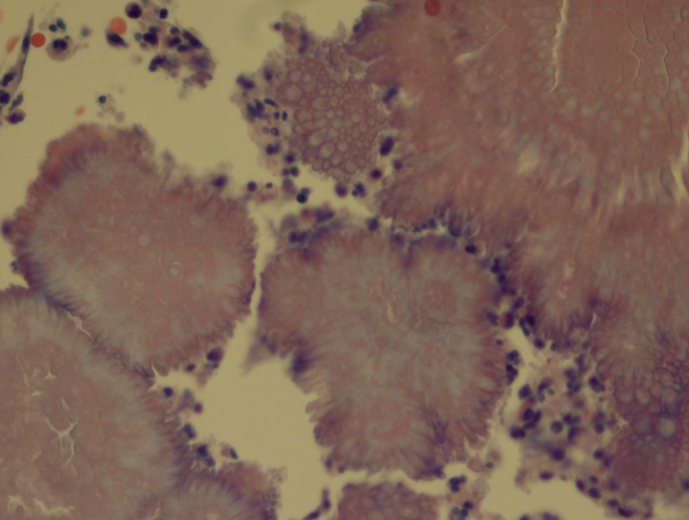
Pelvic exam revealed a benign appearing cervix that was not painful to touch or motion. There was a clear to white mild discharge that was suspected to be normal vaginal secretions. IUD strings were noted. Colposcopy revealed an easily appreciated transformational zone without any obvious lesions. A routine endocervical curettage (ECC) was performed followed by observed increased clear discharge from the cervical os. ECC was sent for routine pathology:

actinomyces1
Actinomyces, H&E, 20x
actinomyces2
Actinomyces, H&E, 40x

Discussion

Actinomycosis is an infection by a species within the Actinomyces genus, generally seen in dental and other oropharyngeal abscess formations. However, rare occurrences of pelvic Actinomycosis can be seen in women with intrauterine devices in place. Pelvic infections can result in cervicitis and endometritis and progress into abscess formation within the fallopian tubes and the ovaries along with salphigitis. The more profound disease consisting of abscess formation generally presents with fever, specific lower abdominal tenderness, and elevated WBCs, thus can mimic acute appendicitis, ovarian torsion, or ectopic pregnancy (1). The first case reported in the literature was in 1967 (2).

Three main species of Actinomyces have been found to be associated with IUD-associated pelvic infection: A. naeslundii, A. odontolyticus (3), and A. hongkongensis (4). All of these species are obligate to facultative anaerobes, catalase negative, and nitrate reducing. A sub-species group of A. naeslundii, however, can be catalase positive and is CAMP test-positive. All members of A. naeslundii are urease positive while A. odontolyticus and A. hongkongensis are urease negative.

References

  1. Joshi et al. Pelvic Actinomycosis: a Rare Entity Presenting as Tubo-ovarian Abscess. Arch Gynecol Obstet. 2010, 281:305-306.
  2. Brenner et al. Pelvic Actinomycosis in the Presence of an Endocervical Contraceptive Device. Obstet Gynecol. 1967, 29: 71-73.
  3. Woo et al. Diagnosis of Pelvic Actinomycosis by 16S ribosomal RNA Gene Sequencing and its Clinical Significance. Diagnostic Microbiology and Infectious Disease. 2002; 43: 113-118.
  4. Flynn et al. Identification by 16S rRNA Gene Sequencing of an Actinomyces hogkongensis Isolate Recovered from a Patient with Pelvic Actinomycosis. J. Clin. Microbiol. 2013, 51(8):2721. DOI: 10.1128/JCM.00509-13.


-Jeff Covington, MD, PhD, is a 1st year anatomic and clinical pathology resident at the University of Vermont Medical Center.

Wojewoda-small

-Christi Wojewoda, MD, is the Director of Clinical Microbiology at the University of Vermont Medical Center and an Associate Professor at the University of Vermont.