Regulating Your Lab Medical Waste

In general, there are two reasons employees in the laboratory should care about proper waste disposal. Improper disposal is expensive. Laboratorians like raises, bonuses, and updated equipment, but there is less money for those things when paper items are tossed into sharps containers or when used gloves go into red bag trash containers. Labs in many states also risk large fines if items with biohazard symbols are disposed of into regular trash containers. The other reason to care about trash disposal involves the environment. Regulated Medical Waste (red bag trash and sharps) has to be treated, and some of it is incinerated while some ends up in special biohazard landfills. Both of those are things we want less of in our environment.

As a lab safety professional, you may know of several other reasons to implement and maintain proper lab waste segregation, but in my years of safety training, money and the environment are the two that tend to hit home with staff. There are multiple waste streams generated in the lab setting, and while management in some departments may choose to offer only biohazard waste receptacles for everything, the safety savvy professional knows this is wasteful and perhaps a bit lazy. With proper education and training, laboratorians are capable of goo trash segregation that meets the regulations and meets best practice standards.

Appropriate trash segregation in the lab requires knowledge about what waste goes into what type of container, and it requires availability and proper placement of those containers. If a processing department only uses red bag trash cans, for example, then much of the non-hazardous waste will end up there. Assess the laboratory areas for proper placement of all necessary types of waste receptacles.   

In one lab, it was discovered that staff was throwing out urine containers with embedded needles into red bag trash containers. Why? There simply were no sharps containers in the area. It was a simple fix to move containers nearby, but no one was paying attention, and there could have been an unnecessary needle stick exposure. In another lab staff emptied urine sample cups into the sink and tossed them into regular trash bins. From a waste standpoint, that was fine, but because there was patient information on the container labels, HIPAA violations occurred.

Many venipuncture sample tubes used today are plastic, and they cannot be broken to create sharp edges. Given that, those items could be disposed of into biohazard trash bags. That can save a lab some money by reducing the volume of sharps containers used (they are more expensive to handle). However, glass specimen tubes are still available for purchase. Be sure to check for these in your racks before throwing out all lab tubes into a plastic bag. A broken tube can cause a very unfortunate exposure event.

Place patient information and extra labels into bins for shredding if available. Teach staff that in most cases it is acceptable to place used disposable lab coats and gloves into regular trash receptacles provided they are not visibly bloody. Other items can go into the regular waste stream such as plastic transfer pipettes, gauze pads, and paper towels (again, provided there is no blood visible on them).

If items can be broken to create a sharp edge, they should be disposed of into a sharps container. That includes specimen cups made of hard plastic, sharp pipette tips, and any glass item. Agar plates and wooden applicator sticks should also go into a sharps container. Remember, if the item breaks while a trash bag is handled, an employee may become exposed, and the incident would need to be treated as an unknown source exposure, something that should always be avoided.

Make sure staff know the proper disposal of chemical waste as well. Never pour chemical waste down the drain unless your facility has a permit to do so. Place chemical waste containers in appropriate locations and label them according to EPA regulations. Provide proper training for employees who sign waste manifests when hazardous waste is hauled away from the lab. If you take the easy route and combine all of your laboratory waste, you would be responsible for both increased departmental expenses and for unnecessarily adding bio-waste to the environment. Talk regularly to your group of trained lab scientists about proper waste segregation, use signage as reminders, and assess their lab waste knowledge regularly. Proper waste management takes work. Mistakes can be made easily, and some of them can cause injury and invoke heavy fines. Invest in a robust laboratory waste management program to avoid those issues and to create a safety savvy example for others.

Dan Scungio, MT(ASCP), SLS, CQA (ASQ) has over 25 years experience as a certified medical technologist. Today he is the Laboratory Safety Officer for Sentara Healthcare, a system of seven hospitals and over 20 laboratories and draw sites in the Tidewater area of Virginia. He is also known as Dan the Lab Safety Man, a lab safety consultant, educator, and trainer.

Hormone Blockers = Blood Letting for Female Athlete with high T?

Caster Semenya celebrates as she wins gold in the women’s 800 meters in the Commonwealth Games on April 13, 2018, on Australia’s Gold Coast (1). Jason O’Brien/Getty Images

I will continue this month along the thread of last month’s post, which addressed the controversy surrounding South African female mid-distance runner Caster Semenya. Caster has won many international mid-distance races (400-800m), but she has been suspected of naturally producing higher levels of testosterone.

Since last month, I’ve learned the reason for the higher testosterone is uncertain: it could be due to natural production (hyperandrogenism) or rumors of her being intersex1. Regardless, what I will discuss here is how the proposed actions of the International Olympic Committee would be expected to affect Semenya’s performance. Specifically, how would lowering testosterone levels affect her athletic performance?

Last month, we saw that muscle mass might be expected to decrease, but this may not affect athletic performance significantly.

Another important effect of testosterone is on red blood cell levels including hemoglobin, which by carrying oxygen to muscle is a central part of calculating VO2max. VO2max is maximal oxygen consumption. This is strongly linked to performance in cardiovascular athletic events.

Mid-distance running requires a large cardiovascular capacity. Maybe not the same level of Tour-de-France long distance bikers in the Alps, but still substantial. As a runner that feels pretty proud at having run a sub-3 minute 800m, I can say Caster’s feat of running it in less than 2 minutes is incomprehensible. From the burning feeling in my lungs and thudding, maximum heart rate at the end of the half-mile, I can attest that this event requires substantial cardiovascular efficiency.

Maximal oxygen consumption (VO2max) by exercising skeletal muscle is principally limited most by cardiac output and oxygen-carrying hemoglobin levels. This has been shown quite convincingly in a series of experiments in the 1950’s-70’s2,3 that probably wouldn’t be approved by the IRBs of today charged to protect research subject rights.

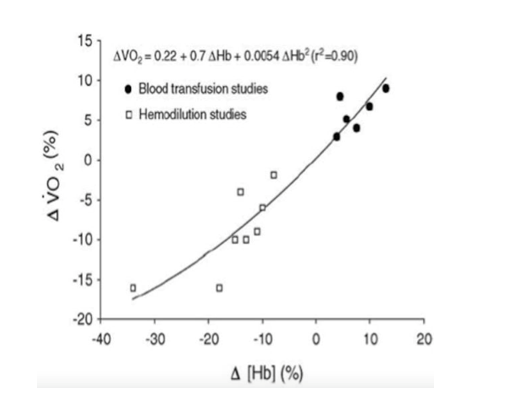
First, transfusing blood increased hemoglobin concentration and similarly the VO2max and exercise endurance of participants.  (This practice was exploited most notably later on in the Tour de France).  In other studies3, blood was removed from participants before assessing their exercise tolerance (10% loss of hemoglobin à 13% reduction in VO2max). Another study removed 400mL, 800mL and 1,200mL over several days, which decreased hemoglobin by 10%, 15%, and 18% respectively. There was a concomitant decrease in endurance time (-13%, -21%, -30%) and VO2max as well (-6%, -10%, -16%)3.  A summary of blood transfusion and hemodilution studies is shown in Figure 1 from Otto JM et al4.

Figure 1. Reproduced from Otto JM et al (4)

In transgender women (gender incongruent with sex assigned male at birth), hormone therapy to increase estrogen levels (oral estradiol) and block testosterone (anti-androgen: spironolactone) reduces hemoglobin by 9% on average (from 15.2 g/dL to 13.9 g/dL)5. I would expect a smaller decrease for Semenya as she will likely not get a full dose hormone regimen used for transgender transition and because her testosterone levels wouldn’t be as high as biologic males’.  However, she would still be expected to have lower hemoglobin- similar to donating a half or whole unit of blood. If hemoglobin decreased even just 5%, that could affect her performance substantially when the difference between competitors boils down to seconds in mid-distance races.

Arguably, forced blood donation could produce the same effects as testosterone-lowering therapy. But it would be far too dramatic to suggest something like bloodletting by the International Olympic Committee.

In the end, I don’t feel qualified to say what should be done in this case. All I can say is that I don’t think lowering Caster Semanya’s testosterone levels will have the intended effect of decreasing muscle mass. On the other hand, it would decrease hemoglobin levels tempering her performance. But who should determine the point where her hormone levels should be? There is such a strong biologic connection between hormone levels and physiology that manipulating them for athletic fairness could be akin to playing puppeteer.

References

  1. North, Anna. ““I am a woman and I am fast”: what Caster Semenya’s story says about gender and race in sports” Vox. May 3, 2019
  2. BALKE B, GRILLO GP, KONECCI EB, LUFT UC. Work capacity after blood donation. J Appl Physiol. 1954 Nov; 7(3):231-8.
  3. Ekblom B, Goldbarg AN, Gullbring B. Response to exercise after blood loss and reinfusion. J Appl Physiol. 1972 Aug; 33(2):175-80.
  4. Otto JM, Montgomery HE, Richards T. Haemoglobin concentration and mass as determinants of exercise performance and of surgical outcome. Extrem Physiol Med. 2013; 2: 33.
  5. SoRelle JA, Jiao R, Gao E et al. Impact of Hormone Therapy on Laboratory Values in Transgender Patients. Clin Chem. 2019; 65(1): 170-179.

-Jeff SoRelle, MD is a Molecular Genetic Pathology fellow at the University of Texas Southwestern Medical Center in Dallas, TX. His clinical research interests include understanding how the lab intersects with transgender healthcare and advancing quality in molecular diagnostics.

Microbiology Case Study: A 75 Year Old Female with Breast Erythema and Drainage

Clinical History

A 75 year old female with a past medical history of breast cancer presented to the Emergency Department with chills 3 weeks status-post bilateral breast reconstruction due to ruptured silicone breast implants. Her white blood cell count was 13,440/cmm and her temperature was 39.4ºC. Physical examination revealed erythema of the right breast incision and purulent drainage from the Jackson-Pratt (JP) drain. Two blood cultures were drawn and a specimen was collected from the JP drain fluid and sent for gram smear and culture.

Laboratory Findings

Blood cultures were negative for growth. Gram stain of the drain fluid was significant for many polymophonuclear neutrophils, however no bacteria were seen. Aerobic cultures grew gram positive cocci. Matrix assisted laser desorption ionization-time of flight mass spectrometry (MALDI-TOF) analysis identified Streptococcus gordonii. The patient was started on doxycycline and amoxicillin-clavulanate. Antibiotic susceptibility testing subsequently showed susceptibility to ceftriaxone and penicillin.

Image 1. Blood agar showing alpha-hemolytic colonies.
Image 2. Gram stain from media showing gram positive cocci.

Discussion

Streptococcus gordonii is a gram positive, non-motile, facultative anaerobic cocci that is part of the Streptococcus sanguinis group of viridans group streptococci (VGS). It is a common oral bacteria that has been implicated in invasive infections such as endocarditis and septic arthritis. It is less frequently a cause of soft-tissue infections such as orbital cellulitis, osteomyelitis, and subcutaneous abscesses. There are case reports of joint prosthesis infections, however breast implant infections have not been reported. Breast implant infections are most commonly caused by Staphylococcus aureus, Pseudomonas aeruginosa, and Staphylococcus epidermidis. There are reports of different VGS species causing breast implant infections. As the bacteria primarily resides in the mouth, infections are usually caused by oral trauma. Although symptoms may often be minor, in cases caused by VGS, systemic symptoms can occur including a toxic shock-like syndrome. In these cases there is a case fatality rate as high as 80%. S. gordonii has been reported as susceptible to clindamycin, ceftriaxone, erythromycin, and levofloxacin. Prompt treatment is important to prevent progression to systemic illness and mortality.

References

  1. Seng P, Bayle, S, Alliez, A, et al. The microbial epidemiology of breast implant infections in a regional referral centre for plastic and reconstructive surgery in the south of France. Int J Infect Dis. June 2015;35:62-66.
  2. Fenelon C, Galbraith JG, Dalton DM, Masterson E. Streptococcus gordonii—a rare cause of prosthetic joint infection in a total hip replacement. J Surg Case Rep. 2017 Jan;1:235.
  3. Liao CY, Su KJ, Lin CH, et al. Planta purpura as the initial presentation of viridans streptococcal shock syndrome secondary to Streptococcus gordonii bacteremia. Can J Infect Dis Med Microbiol. 2016:946385.
  4. Dadon Z, Cohen A, Szterenlicht YM, et al. Spondylodiskitis and endocarditis due to Streptococcus gordonii. Ann Clin Microbiol Antimicrob. 2017:16:68.
  5. Krantz AM, Ratnaraj F, Velagapudi M et al. Streptococcus gordonii empyema: a case report and review of empyema. Cureus. 2017 Apr;9(4):e1159.

-Jonathan Wilcock, MD is a 1st year anatomic and clinical pathology resident at the University of Vermont Medical Center.

-Christi Wojewoda, MD, is the Director of Clinical Microbiology at the University of Vermont Medical Center and an Associate Professor at the University of Vermont.