Tumor Boards and Multidisciplinary Conferences (MDC)

Even if we are not as visible to the patients that we care for as other physicians, pathologists are amazing! Of course, I admit that I’m biased since I am a pathology resident but, this does not make this fact any less true. Others may not always realize that pathologists often have to make life altering diagnoses on the most miniscule of tissue samples. Or that we need to incorporate clinical histories, imaging, and previous clinical test and pathology results just as much as the primary clinician, I’ll dare say, sometimes, even more so, since we often do not have the opportunity to talk with the patient face-to-face. And that in the future, especially as precision medicine develops an increasing foothold in the treatment decision making process, we should, and will be, taking more active leadership roles within multidisciplinary teams.

One of the places where I feel that pathologists can show their value to the patient care team is in the multidisciplinary conference (MDC) setting. These can include tumor boards where we discuss specific patient cancer cases or other interdepartmental conferences where we explore an area of common interest that doesn’t necessarily have to be neoplastic. “Doctor” is derived from the Latin word, docere, which means “to teach” and it is within MDC’s that we can shine as teachers. It is impossible to learn about you need to know in medical school in terms of patient care. Not only is the fount of knowledge ever increasing but also our training directs us toward subspecialization since the volume knowledge is so vast, we have to choose which areas we will spend more time mastering.

Way back in the day, surgery residents had to spend significant time (often at least six months) rotating on the surgical pathology service. I find that these more experienced attendings are often the ones who scrub out and sit with our pathologists at the multi-headed scope during frozen sections. And they are also the ones who can make the surgical pathology diagnosis and know the staging summaries even better than junior, and even some senior, pathology residents. But training requirements change. Most of the other clinical physicians we will interact with as colleagues were not trained in this manner.

One of the reasons I chose hematopathology was because I enjoy the daily increased face-to-face interaction I experienced while on this rotation. At most of the hospital sites I’ve trained (four at my previous program and two at my current program), hem/onc physicians and fellows often make the trek to the pathology department to discuss patient cases with the hematopathologist, especially over the microscope. They had some idea of what they were looking at, too. In fact, at a couple of the programs I interviewed (Hopkins and UW), hem/onc physicians are, or were in past in the case of UW, responsible for reading the liquid specimens (peripheral blood smears and aspirates). They also often had multiple interdisciplinary conferences – leukemia, lymphoma, coagulation/benign heme.

But, since I’m on a surgical pathology rotation right now, I was thinking about when we interact most with our surgeons – and I think that is during tumor board. A few of the “old school” surgeons will scrub out and come to the department to look over a frozen with us but most often than not, this is not the case. But during tumor boards, there is always active discussion which includes the pathology in order to come to a treatment decision on not-so-straightforward cases. And these are opportunities to demonstrate just how important the pathologist is to the process. At least in the difficult cases, we do not merely write out diagnoses for other doctors to read and move on without us to treat the patient. It is in these moments when we not only educate but can also actively participate in helping to direct care. But in order to do so, we need to be able to integrate the clinical, epidemiologic, morphologic, radiologic, ancillary diagnostic, and prognostic (lots of “-ogics” there) factors along with know the potential treatment alternatives. We don’t just deal with the morphologic and leave everything else to the referring physicians…at least, if you want to be the best pathologist that you can be. This is also the time when we can leave a lasting impression on other trainees (medical students, residents, and fellows) about how a pathologist can contribute when added to the team mix so that they will be more apt to seek out and work together with pathologists when they become attending physicians.

We are the physicians who understand the intricacies and implications of many of the ancillary tests if we understand well how they are performed and why and also what can cause erroneous or false positive/negative results. I think that I learned a lot of those types of things through serving as an accredited lab inspector (or you can help with your department’s lab self-inspections) and also by being more pro-active during my CP rotations to work with the lab staff and not just sit at my desk and read a book (or study for boards). And we can help guide other physicians regarding which tests are useful for specific situations and which tests really won’t impact prognosis or treatment management. So, be deliberate during your rotations! Try to understand the “big picture” and how important we can be (and really are) in the patient safety and care process! I think that tumor boards and interdepartment MDC’s are a great venue for us to showcase the “true” contributory potential of what pathologists to the patient care team.
Chung

-Betty Chung, DO, MPH, MA is a third year resident physician at Rutgers – Robert Wood Johnson University Hospital in New Brunswick, NJ.

Can You Identify This Structure?

What is this dark structure in the center of this biopsy of a thyroid nodule?

thyroid

A. Foreign body
B. Artifact
C. Psammoma body
D. Area of necrosis
E. Collection of fungal organisms

The structure at the center of this image is a psammoma body. Psammoma bodies are lamellated, calcific structures commonly seen in papillary carcinomas, such as this papillary carcinoma of the thyroid. The exact underlying cause or mechanism of psammoma bodies is not well understood. However, some studies have shown that in papillary thyroid carcinoma, psammoma bodies are associated with a lower disease-free survival and an overall worse prognosis.

Krafts

-Kristine Krafts, MD, is an Assistant Professor of Pathology at the University of Minnesota School of Medicine and School of Dentistry and the founder of the educational website Pathology Student.

Next Steps in Cytotechnology

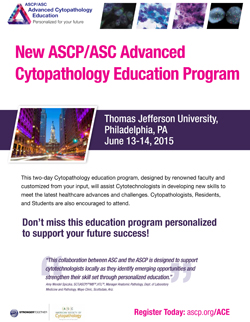
ASCP and ASC have put together a program to enable cytotechnologists to grow their skills and advance their careers. During this workshop, attendees will learn how to engage as a part of the clinical team and broaden their skill set to include fluorescent in-situ hybridization and interpretation of applied molecular tests.

AJCP_ACE

If you’d like to attend this program, you can register before April 30 to get a discount.

Pancytopenia in a 67-Year-Old Female

A 67-year-old female presents with pancytopenia, a markedly enlarged spleen, and extramedullary hematopoiesis. Her blood smear is shown here. She is found to have a JAK-2 mutation. What is the diagnosis?

myeloprolif

  1. Chronic myelofibrosis
  2. Chronic myeloid leukemia
  3. Hairy cell leukemia
  4. Metastatic breast carcinoma
  5. Renal cell carcinoma

The diagnosis in this case is chronic myelofibrosis. Chronic myelofibrosis is one of the four main chronic myeloproliferative disorders (the others are chronic myeloid leukemia, essential thrombocythemia, and polycythemia vera). In this disorder, the bone marrow is initially hypercellular, with proliferation of all of the myeloid cell lines (neutrophils, red cells, and megakaryoblasts). Over time, however, the marrow becomes progressively fibrotic. Eventually, there is not enough room for normal hematopoiesis, and the body starts making hematopoietic cells elsewhere (most notably in the spleen, which becomes markedly enlarged).

In these later stages of chronic myelofibrosis, the blood is characterized by pancytopenia (a decrease in white cells, red cells and platelets). Teardrop-shaped red cells (dacryocytes) may also be seen as a result of the red cells wending their way through a fibrotic marrow. Red cell precursors, such as the normoblast present in this image, are also commonly present, as there is less and less room for red cells to mature fully before leaving the marrow.

These blood smear findings are not specific for chronic myelofibrosis. Teardrop-shaped red cells may be seen when the marrow is fibrotic for other reasons, such as metastatic cancer, and pancytopenia and normoblasts may be seen in many other conditions. The JAK-2 mutation, however, is seen most frequently in three of the four chronic myeloproliferative disorders: polycythemia vera, essential thrombocythemia, and chronic myelofibrosis.

Krafts

-Kristine Krafts, MD, is an Assistant Professor of Pathology at the University of Minnesota School of Medicine and School of Dentistry and the founder of the educational website Pathology Student.

Final Thoughts from the Fellowship Application Process

And with the dawning of a new year, I’m another year closer to becoming a full-fledged pathologist. Exciting and yet daunting at the same time as I have only 1.5 years and my AP/CP boards left before I start my fellowships! So, I thought I’d leave some final words on what I learned during the fellowship application process for those who have yet to go through it.

The earlier you decide on your choice of fellowship(s), the better you can prepare by presenting and publishing research in your area of interest, spending extra rotation time and study in areas related to your interest, and networking within your academic subspecialty organizations. I would say for the first half of first year, concentrate on your rotations especially surgical pathology and grossing technique. But at the latest by the second half of your first year, start honing in on what you think you’d eventually like to do and working toward that goal. Most residency programs are amenable if you ask them to adjust your schedule so you can rotate early through subspecialties of possible interest during your second or early third year. Don’t forget to ask for lighter rotation months and less/no call duties during peak interview season (Oct-Jan).

If you can, do an elective during your second or early third year in your subspecialty of interest at your dream program(s) before fellowship decisions are made and fund it through grants such as the one offered by ASCP (1/16/14 deadline; application here). I found that often, positions were already promised or eventually went to internal candidates or external candidates who had done an elective prior to their interview. Scheduling for elective rotations takes foresight, time and effort (eg – state medical license can take months), and an available rotation spot during your desired month, so start the process early!

Research early to create your application list. Only you will know the number you feel comfortable applying to which depends on your personal situation (eg – subspecialty competitiveness). I found that attending conferences and listening to speakers in my content area of interest helped me to decide which programs I may like. I’m also very active in CAP and ASCP and the physicians I work with in these roles, pointed me toward programs where the culture might be a good fit for me as they were role models of the type of people that I would like to work with. Of course, I also applied to top programs that I knew or that my attendings advised me were good.

Then check with programs about the opening date for application submissions if it is not posted on their website. I found that frequently, these were not hard deadlines. Since we don’t have a match, decisions are rolling (eg – I got promised an offer during my interview day and have friends who also had similar experiences). Once again, the early bird may catch the worm, and not because they are necessarily the best bird, but the first bird that a program likes. While some programs have a schedule for decisions, I found that just as many made offers as soon as they found someone they liked.

Make sure that personal statements are no longer than one page, shorter is better. You can follow this format: 1) how and why you fell in love with that subspecialty, 2) what you bring to the table especially for the program, and 3) what you want out of your fellowship and why that program is the best to accomplish those goals. Ask multiple people in your subspecialty or more senior residents to give you feedback on your personal statement/CV and for letters of recommendations very early – give a deadline earlier than you need so that you can have them ready by the time you want to submit.

I applied mostly to programs that had both hematopathology and molecular pathology fellowships and stated in my cover letter that I wanted to do both consecutively at the same place (but that it wasn’t a deal breaker). I received invites at almost all but decided to interview at a select number. For the ones where I interviewed for both fellowships (ARUP, Hopkins, MD Anderson, UPMC, Houston Methodist), it was usually the program looking for the fellow first who made the arrangements with the other fellowship. ARUP had interviews over 2 days (paid expenses except airfare) but the others all worked it out so that half a day was interviewing for hematopathology and the other MGP. Receiving an offer from one did not necessarily mean that I would automatically get one from the other. Scheduling both on the same day, also made things a little more difficult.

Respond to invitations quickly because this process is truly rolling. I was often given a limited choice of date(s). One place gave me only one date for an interview that I couldn’t make. Rescheduling can result in losing an interview because programs interview less people over fewer dates than they did for residency and will schedule someone else if you can’t make it. Some programs told me they were interviewing 2-3 per position while others said 5-10.

Be courteous and prompt, send your “thank you” email/note early and no later than by the next day. You can have a basic “thank you” email template ready to go that you can personalize so that you can send it even while waiting at the airport to go to your next interview. And be honest. I found that being upfront made it easier for programs to extend me a counteroffer when I mentioned that I had to make a decision soon on another offer. Once you’ve accepted a position, keep in touch with your program to hit fellowship running! I hope to do a PGY4 research elective in order to submit abstracts for conferences that occur soon after I start my fellowship and to familiarize myself with the EMR and clinical workflow in both fellowship areas.

And finally, be true to yourself about your goals, realistic possibilities, and most importantly, the program characteristics that will make you most happy. When I was applying to college, academic prestige and idealism were important, and for medical school, proximity to my aging parents. But now, what I find most important is the fit of the program. I want to be happy and feel like it is my home. I want to be at a place that hires their alumni and goes out of their way to help them find jobs. I want to be around role models working in areas that I want to as an attending: advocacy, medical education, and research…and of course, foremost, clinical diagnostic excellence…and who I feel will continue to support me as colleagues in the future. For me, fellowship isn’t just the time to merely refine my clinical expertise or learn things that I didn’t get to during my residency. It was more like interviewing for a job rather than for school admissions, making decisions with a more immediate goal of what I want to accomplish after and no longer “down the road”, and most importantly, building toward my future.

And I’m happy to say that I did get multiple offers from great programs and accepted at the place I felt the best fit. It was my last interview in mid-December, so you never know. I can say that having served in positions with CAP actually helped me because I already felt at home with 2 of my interviewers with whom I serve on a CAP Council (we just had a meeting 4 days prior) and one of the current fellows who I also met through being involved with CAP. So, networking, even when it isn’t deliberate or conscious as it was in this case, can help. In case you’re wondering, I’ll be completing hematopathology (2016-2018) and molecular genetic pathology (2018-2019) fellowships at Houston Methodist and also hope to participate in research at the Houston Methodist Research Institute.


Chung

-Betty Chung, DO, MPH, MA is a third year resident physician at Rutgers – Robert Wood Johnson University Hospital in New Brunswick, NJ.
Does Pathology Need a Modern Day Flexner Report?

Happy New Year! I hope that everyone has been having a great holiday season so far. I just wanted to share some brief musings I recently had as we start our new year…

Most of us have heard of the famous 1910 Flexner Report but for those who are unfamiliar, it is not exaggerating to state that it transformed and birthed the modern concept of biomedical education that we know today. Originally entitled “Medical Education in the United States and Canada”, it was study commissioned by the Carnegie Foundation for the Advancement of Teaching (CFAT), an American educational policy and research “think tank” founded in 1905. The report’s author, a former secondary school teacher and principal and not a physician, toured all the existing medical schools in both the U.S. and Canada and recommended reforms that would result in the standardization of the structure of medical curricula with Johns Hopkins as their ideal model. Medical education went from for-profit apprenticeships, varying in quality, to an academic model of basic science study followed by practical hands-on training in patient care. Eventually with standardized accreditation requirements, most medical school curricula, despite their differences in implementation, had their core foundation in common: didactic years to learn and clinical years to apply (under supervision).

Like the proprietary “medical” training institutions of yesteryear that existed prior to the Flexner report, do our pathology training programs need a global re-evaluation and an overhaul? Despite the existence of ACGME accreditation criteria and visits, do we have programs that need serious reform or termination to meet an ideal? Do our accreditation standards need to change to create a new ideal? And must we come together now to adapt our expectations and training objectives to meet the challenges of our rapidly evolving health care landscape? What is and should be the role of the pathologist on the interdisciplinary clinical health care team? And so the core question becomes, what are the most important things that we need to teach our trainees and how do we go best about it? I’d love to hear your thoughts…

And to encourage scholarship in the Flexner tradition that also emphasized the role of research in our education…for those who would like to submit an abstract for resident poster and platform presentations, submission periods for these conferences are currently open (except for CAP) with the following deadlines (I’ll try to update with more later but these are the most immediate in terms of deadlines in the next quarter):

Chung

-Betty Chung, DO, MPH, MA is a third year resident physician at Rutgers – Robert Wood Johnson University Hospital in New Brunswick, NJ.

A Rare Myeloproliferative Disorder

hypereosinophilic

A 59-year-old male presents with skin lesions, hepatosplenomegaly and cardiomyopathy. A representative field of his blood smear is shown here. Of the following, what is the most likely diagnosis?

  • A. Chronic myeloid leukemia
  • B. Multiple myeloma
  • C. Metastatic prostate carcinoma
  • D. Hypereosinophilic syndrome
  • E. Bacterial sepsis

The diagnosis in this case is hypereosinophilic syndrome, a rare myeloproliferative disorder characterized by a marked and persistent elevation in the eosinophil count. Although this disease is primarily a hematopoietic disorder, it usually affects many other organ systems, such as the cardiovascular, nervous, respiratory, and gastrointestinal systems. Typical presenting symptoms include cardiomyopathy, skin lesions, thromboembolic disease, neuropathy, hepatosplenomegaly, and pulmonary disease. The pathophysiology behind the damage in these organs isn’t well understood, but it probably has something to do with the release of eosinophil granules in those tissues.

You need to have three things in order to make the diagnosis:
1. Persistent eosinophilia (absolute eosinophil count >1500/μL)
2. No other cause for the eosinophilia
3. Signs and symptoms of organ involvement

Other more common causes of eosinophilia, such as drug reactions, allergic reactions and autoimmune disease, must be ruled out before making the diagnosis.

Usually, patients aren’t treated unless or until they have symptoms (because the treatment itself has its risks). These patients are monitored closely with serum troponin levels (to monitor for MI), echocardiograms and pulmonary function tests.

Some patients with hypereosinophilic syndrome have a tiny deletion in 4q12, which ends up producing a fusion transcript called FIP1LI-PDGFRA (which is also present in some cases of systemic mastocytosis). Imatinib works very well in the majority of these patients.

Patients who have symptoms (but not FIP1LI-PDGFRA) are generally treated with steroids first. If those don’t work, interferon alpha and hydroxyurea are used. If those don’t work either, then imatinib is the treatment of choice (it doesn’t work as well as it does in patients withFIP1LI-PDGFRA, but it does seem to work in at least some of these patients).

Here are the reasons the other answers are incorrect.

  1. Myeloma is a monoclonal disease of plasma cells which manifests mainly in the bone marrow. In the blood, the main thing you see is rouleaux (red cells stacking up on top of each other). This blood smear just has a lot of eosinophils – so it’s not consistent at all with myeloma. The clinical history also doesn’t fit. In myeloma, patients usually have bone pain, signs of anemia (fatigue, palpitations), and maybe signs of renal failure. Hepatosplenomegaly, skin lesions, and cardiomyopathy aren’t generally seen in myeloma.
  2. In CML, you see a massive leukocytosis which is composed of neutrophils and precursors. There is a big left shift and a basophilia. This smear just has a ton of eosinophils, which is not consistent with CML. The patient’s hepatosplenomegaly would be consistent with CML (especially the splenomegaly part) – but the skin lesions and cardiomyopathy don’t go along with that diagnosis.
  3. In metastatic prostate cancer, it’s possible that you might see a rare tumor cell in the blood; you might also see a monocytosis (you occasionally can see that with solid tumors). Eosinophilia, however, is not consistent with prostate cancer. The history is also unsupportive. Patients with advanced prostate cancer may have urinary symptoms (trouble urinating, blood in the urine), abdominal or pelvic pain, or signs of metastasis (bone pain, particularly in the spine).
  4. The characteristic blood finding in bacterial sepsis is a neutrophilia, with or without a left shift. You may also see toxic changes in the neutrophils: toxic granulation, Döhle bodies, and/or cytoplasmic vacuolization. Bacterial infections generally don’t produce an eosinophilia – but some parasitic infections can.

Krafts

-Kristine Krafts, MD, is an Assistant Professor of Pathology at the University of Minnesota School of Medicine and School of Dentistry and the founder of the educational website Pathology Student.

The Future Cost of Antimicrobial Resistance

Over on Superbug, Maryn McKenna (are you following her yet? No? If you’re into infectious disease, you should) discusses a recent report on the global ramifications of antimicrobial resistance. In it, the authors project by 2050, 10 million deaths a year will be attributed to infections caused by six resistant organisms. (Those are: Klebsiella pneumoniae, E. coli, MRSA; HIV, TB and malaria.) These deaths will cause an estimated loss of 100 trillion dollars of lost gross national product.

So what can laboratory professionals and pathologists do to help stop these predictions from coming true? For starters:

  • Advocate for and implement antibiotic stewardship programs.
  • Educate the public about proper antibiotic use.
  • Practice good laboratory safety practices.

What else can labs, microbiologists, and pathologists do to stem the tide of antibiotic resistance?

Swails

Kelly Swails, MT(ASCP), is a laboratory professional, recovering microbiologist, and web editor for Lab Medicine.

The Importance of Continuing Medical Education, at Least in Theory…

Hello again residents. It’s the wee hours of the morning and I am in Chicago O’Hare International Airport waiting for my connecting flight to Columbus, Ohio, where I will serve as an ACCME/AMA monitor for the College of American Pathologists (CAP) at the Ohio Society of Pathologists (OSP) meeting. I wasn’t allowed on my flight because I was just beyond the cutoff time even though I had rushed out of the hospital, still in my scrubs. And so I got re-routed through Chicago and spent a couple hours at a hotel in order to sleep before catching an early flight the next day.

As the junior (trainee) member on CAP’s Council on Education (COE), I was given this opportunity to monitor this CME meeting for compliance to ACCME/AMA standards and CAP representation as a joint CME partner. I’ve served on the COE since January 2014. We have four meetings a year with two of them in Chicago. I was just approved for a second term that runs until December 2015. We oversee and approve proposed projects from all the educational committees of the CAP: publications, GME, CP education, and the curriculum committee as well as some of the educational aspects of the Annual Meeting.

Despite the airport snafus (which I’m pretty good at getting myself into), it was interesting to serve as a monitor. I met an attending from the Cleveland Clinic who I remembered from my residency interviews. I also met other residents and fellow who were in attendance. The OSP had taken great care to preclude commercial bias from their meeting. They did have a few exhibitors but they were in a separate room from the lecture sessions. I heard a very informative talk on the clinical oncology applications of next generation sequencing (NGS) as well as an engaging case-based session on dermatopathology cases.

The meeting was held in a hotel in Dublin, OH, which I strongly suspect must have Irish and German roots from the names of the town, streets, and types of restaurants (Irish pubs and German-Austrian) that are common here. The hotel restaurant which had an Irish name served a buffet of Irish food (no surprise) for the participants at a discounted rate. Overall, it was a good meeting with a good balance of germane topics covered. Having been a co-chair of a national medical conference when I was in medical school, I totally can appreciate all the pre-planning that goes on behind the scenes to organize meetings such as this. I was also able to have dinner with and catch up with a friend who is a non-pathology resident at the local Ohio State University.

I know that we, as doctors, would like to believe that once we’ve passed through the gauntlet of medical school and graduate medical education training, that we know everything that we need to know and shouldn’t necessarily have to be retested or do CME, but I believe that it only makes us better doctors if do. We should be life-long learners, especially in a technology-driven specialty such as pathology (that is, if we want to remain in control of lab testing). As a scientist in my life prior to medical school, I intimately understand how even dogmas can change (at one time, people thought that protein was the genetic material of the cell!). We can always learn something new and new disruptive technologies like NGS will always arise that will transform how we diagnose, prosnosticate, and treat our patients. We may not always see patients physically but must remain present within the process and that requires us to continue to test our knowledge base. Since I haven’t graduated yet, I don’t really have the experience to say whether the current mix of CME, SAM, and MOC requirements is the way to do it but in some form, we need regulations to help push us as a profession (not necessarily as an individual if we are self-directed and pro-active) in the right direction to be the best physicians for our patients.


Chung

-Betty Chung, DO, MPH, MA is a third year resident physician at Rutgers – Robert Wood Johnson University Hospital in New Brunswick, NJ.


Decisions That Will Impact the Direction of My Pathology Career

So, I’m in Midway Airport in Chicago with a 2.5 hour layover back to the East Coast from my West Coast tour of fellowship programs and interviews. I flew on 5 separate flights and interviewed at 5 programs in 4 cities in 3 states over the past week. Quite a whirlwind schedule to keep even if it wasn’t exacerbated by the fact that I’ve had a wicked flu the entire time (and still am sick as I type). But I look forward to getting at least one night’s comfortable sleep in my own bed and spending some time with my kitties before I start with my first East Coast interviews (2 in 1 day) on Monday. I’m very fortunate that my program director, program coordinator, and fellow co-residents have been supportive, especially when I’ve had to switch multiple days on-call.

On the left coast, I interviewed at 3 hematopathology and 2 molecular genetic pathology programs with overlap at one program where I interviewed for both hemepath and MGP. All of the people that I met at each program were people who I felt that I would like to become colleagues with (and who will be my colleagues in the future). But despite this fact, each program was vastly different from the other and I am reminded that these next decisions about where I’ll spend my fellowship years will probably impact the direction of my career more so than any other decision thus far. The people who will touch my life will help shape the pathologist I will be!

I thought that I had adequately prepared my list of questions that I carried around to each interview but I found that each interaction spurred additional new questions that I had not thought of prior to the interview. Many times, my interviewers had anticipated some of my questions and had answered them as we talked even before I asked. The current fellows I went to lunch with were very helpful in answering my questions and telling me about their lives within their fellowship programs. For me, the “fit” and culture of my working environment is important – finding colleagues who treat each other with respect and notice when others might be struggling and help each other out. I value a strong teamwork mentality as much as I appreciate a rigorous academic environment that will push me to be the best that I can be.

Having come from a graduate research training environment in what I might call some of my formative years, I also value an environment that spurs creativity. I enjoy being able to have open door policy discussions where we bounce ideas off each other and challenge each other in a positive manner to “think out of the box.” I know that research will be an integral part of my future career, hopefully along with hematopathology sign-out and molecular genetic lab directorship (even if it is not for the entire lab but possibly just the molecular hematopathology portion of it). The question for me is whether that research will be more basic science (which means I’d probably be committing to more like 80% research, 20% clinical in terms of my service duties) and on a K-R01 grant track as a physician scientist or will be more toward translational research where I can apply some of the knowledge and skills I gained during my graduate and MPH training. I was very flattered that at my first interview, the fellowship director told me that I could come back after my fellowships to do a post-doc with him and one of his mouse models of hematopoietic disease.

Mentorship for me is really big. I really want to find a program where the faculty take an interest in my career. I want mentors who look out for my future career and who will guide me toward opportunities that will enhance it. Mentors who will support me and make those all-so-important phone calls to help me get my first job, or better yet, offer me my first job. It is not far-fetched to think ahead that I might want to lay down roots where I complete my fellowships so that is an additional factor to consider when it comes time to make the final decisions.

Each program varied with respect to educational philosophy and resources. More so than I previously realized that they would even though I’ve been in two residency programs that I can compare. But right now, I compartmentalize everything I see and learn from each interview and just try to soak everything in like a sponge without assumptions or judgment. I’m placing those observations aside in my head until the time comes that I will need to think about them (which will probably be the end of this month or the very beginning of the next).

It has become very clear to me that being self-motivated and proactive to make opportunities for myself when they did not necessarily exist within the formal structure of my residency program has been a pivotal aspect of getting me this far in interviews. If your program does not have a resource available (eg – NGS for a MGP-minded person like me), then find one and gain access to it (eg – I will go to Rutgers for my last molecular pathology rotation to help with NGS clinical testing validation, and hopefully, a hematopathology elective rotation at an institution with a higher volume and diversity of cases than I can see at my own program)! If you are interested in a particular subspecialty, get involved in research, tumor board presentations, and sign-outs in that area (eg – look at hemepath cases on your free time or on the weekends if that’s what you like) from your first year as much as you can. Whining is not allowed nor is a quality that will help anyone so don’t waste time complaining about aspects of your programs you cannot change. Make your destiny happen rather than be a mere participant in it by accepting the status quo! Good luck to my fellow residents who are also on the interview trail! May we all find our future homes for the next phase of our careers very soon!


Chung

-Betty Chung, DO, MPH, MA is a third year resident physician at Rutgers – Robert Wood Johnson University Hospital in New Brunswick, NJ.