
Microbiology Case Study: A 14 Year Old Female with Neck Swelling

Case History

A previously healthy 14-year-old female presents to the emergency department with three days of progressive facial and neck swelling. The swelling started on the left side. Two days ago she visited her primary care physician where she had negative monospot and mumps IgM testing.  She is fully vaccinated, but was exposed to a mumps outbreak at school.

Discussion

Our patient was diagnosed with mumps by positive RT-PCR from a buccal swab. The mumps virus is a member of the Paramyxoviridae family which includes notable human pathogens parainfluenza, Hendra, and Nipah viruses. Members of this family are enveloped, helical viruses with single-stranded, non-segmented RNA genomes with negative polarity. Mumps is an obligate human pathogen that replicates in the epithelial cells of the upper respiratory tract and subsequently moves to regional lymph nodes. It is spread from person to person via direct contact with respiratory secretions or contact with contaminated fomites. Mumps is a highly contagious disease with as high as 85% of naïve individuals becoming infected after contact with a mumps infected individual. It spreads most efficiently in areas where there is close contact among individuals for prolonged periods of time such as college campuses and close-knit religious communities.

Prior to vaccination for mumps in the 1960s, greater than 150,000 cases of mumps occurred each year in the US. The incubation period for infection is 16-18 days, with the majority of infected persons being asymptomatic or having mild respiratory symptoms. Orchitis causing sterility in post-pubescent males is the main concern of mumps infection but other rare but serious complications include mastitis and oophoritis in females, meningoencephalitis, pancreatitis, and deafness.

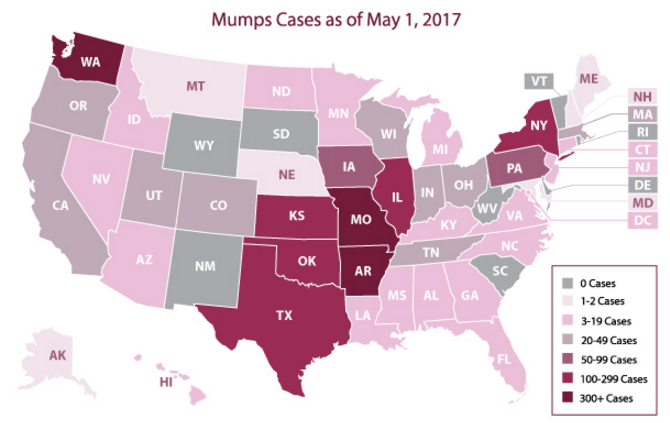
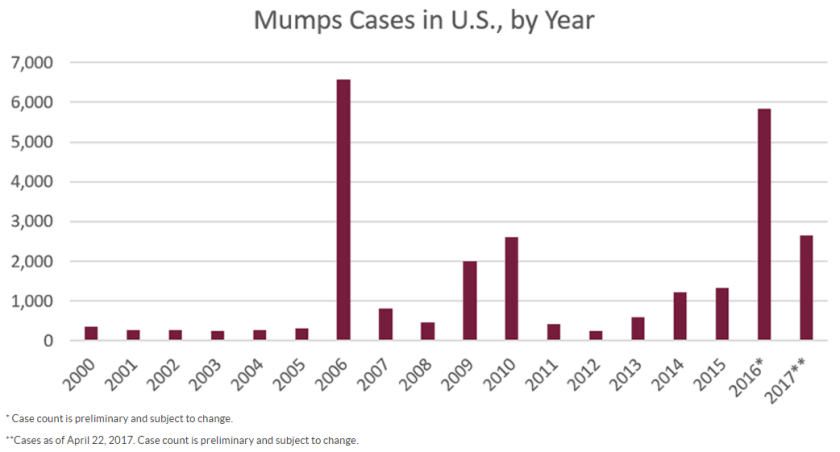
Due to sporadic outbreaks of measles since the introduction of the vaccine, the vaccine schedule has been revised from one dose of the MMR (measles, mumps, and rubella) vaccine at age 12-15 months to include another MMR booster at age 4-6 years. We are currently in the middle of yet another outbreak with nearly 6,000 cases of mumps reported to the CDC in 2016 and a high rate of infections reported thus far in 2017 (Figures 1 and 2).
mumps1
Figure 1. Number of cases identified by the CDC in 2017 by state. (Figure courtesy of the CDC Mumps website at https://www.cdc.gov/mumps/outbreaks.html. Content source: National Center for Immunization and Respiratory Diseases [NCIRD], Division of Viral Diseases)
mumps2
Figure 2. Number of cases of mumps per year identified by the CDC.
(Figure courtesy of the CDC Mumps website at https://www.cdc.gov/mumps/outbreaks.html. Content source: National Center for Immunization and Respiratory Diseases [NCIRD], Division of Viral Diseases)


Diagnostic Testing for Mumps

Serological testing for IgM and RT-PCR from a buccal swabs are the mainstay of mumps diagnosis. IgM becomes positive in the first 3-4 days after symptom onset and will remain positive for 8-12 weeks. IgG becomes positive 7-10 days following symptom onset and will remain at high levels for many years and detectable for life. In a vaccinated individuals, IgM testing has less utility as it may be non-reactive or weakly positive following a secondary immune response.

RT-PCR from a buccal swab specimen is the most sensitive test for diagnosis of mumps. It should be performed as soon as a patient is symptomatic, as testing by this method is the most sensitive in the first few days following symptom onset and becomes less sensitive as time goes on.

Urine specimens can be used to isolate mumps in viral culture. Urine is not positive for mumps until greater than 4 days post symptom onset and is less sensitive than PCR performed on the bucal swab. For these reasons, viral isolation from urine is no longer a commonly used test for diagnosis of mumps, although viral culture is still considered the gold standard for mumps conformation.

Resolution

The patient and her family were counseled on the infectious nature of mumps. She was instructed to remain in isolation at home for 6 days after resolution of swelling.


References

  1. Manual of Clinical Microbiology, 11th edition
  2. CDC Mumps Website (www.cdc.gov/mumps/index.html)

 

Erin McElvania TeKippe, PhD, D(ABMM), is the Director of Clinical Microbiology at Children’s Medical Center in Dallas Texas and an Assistant Professor of Pathology and Pediatrics at University of Texas Southwestern Medical Center.


Leading Lab Safety

The number of medical laboratory scientists is dwindling. Baby Boomers have begun their retirement, and even before that started, there were more job openings than people to fill them. That means more opportunities in the lab world, and in some cases leadership roles are being obtained by less experienced people than in years past. Whether or not one has a long lab history, one aspect of any new leadership position that will be important to grasp is management of the lab safety program.

The first step for a new lab leader is to ensure the existence of a functional laboratory safety program. Do this by looking for specific components of the program, a laboratory safety manual, a safety committee, and lab safety indicators. If these items are in place and functioning as they should, you’re off to a good start.

The laboratory safety manual may be in paper or in an electronic format. It should be separate from the hospital or facility safety manual as there are many lab-specific safety policies and procedures that are required. Maintain document control of these safety policies, ensure they have medical director (or designee) approval, and review these policies in a timely fashion. It is important to remember that while some lab regulatory agencies (like CAP) allow bi-annual policy review, OSHA requires annual reviews. OSHA covers many safety policies in the lab such as the chemical hygiene plan, the exposure control plan and many more.

The laboratory should have a functioning safety committee, no matter the size. If the lab staff is very small, the leader may play a role in the larger hospital or facility safety committee. If the lab is larger, a committee composed of just lab staff is advised. If the hospital or lab is part of a system, the committee should include at least one member from each lab site. The safety committee should meet at least monthly. It is important not to skimp on meetings or cancel them on a regular basis. Let staff know this is a priority for the leadership in the lab. During the meetings provide education, review lab incidents, and raise safety awareness. Train committee members how to perform safety audits, how to develop “safety eyes,” and most especially how to coach each other and their peers in the department.

Another important component of a functioning lab safety program is the use of safety indicators. Much like quality indicators, this safety data can be used to help determine the overall safety culture in the department. A good example indicator includes monitoring the employee exposure and injury rate. By using the laboratory’s OSHA 300 log information, a lab can compare its reportable injury data to national benchmarks. Many safety indicators are typically reactive data (or lagging), but tracking safety meeting attendance can actually serve as a leading indicator for the lab.

Once you’ve assessed the lab’s safety program, the next step a new leader should take is to assess the overall lab safety culture. This can be performed in many ways. One part of performing the assessment is by using your “safety eyes” that was mentioned earlier. Scan the lab visually. What immediate safety issues are seen? What is on the walls of the department? What types of interactions are observed? What is the physical layout? With practice and experience, a leader may be able to do the visual portion of the culture assessment quickly.

Another safety culture indicator tool is a laboratory safety audit. The results of an audit can provide much information about safety practices in the lab such as PPE use, chemical storage, and awareness of fire safety issues. One good model safety audit that can be used is located in the appendix of CLSI’s document Safety in the Clinical Laboratory (GP17-A3). This is a very comprehensive laboratory assessment and it can tell you much about your overall safety culture. As stated before, audit results can be discussed at the lab safety committee meetings, and ideas for improvements can be considered.

Managing the overall lab safety program is a big job, and it is often only one task of many that belongs to a laboratory leader. Change occurs daily in the field of lab medicine, and new leaders are coming aboard. Whether you are new or experienced, however, utilizing these basic first steps will provide a leader with the information needed to identify the safety culture and to understand how the program is operating.


Scungio 1

Dan Scungio, MT(ASCP), SLS, CQA (ASQ) has over 25 years experience as a certified medical technologist. Today he is the Laboratory Safety Officer for Sentara Healthcare, a system of seven hospitals and over 20 laboratories and draw sites in the Tidewater area of Virginia. He is also known as Dan the Lab Safety Man, a lab safety consultant, educator, and trainer.

Diagnostics for Displaced Populations

A few months ago, Sarah Riley discussed diagnosing disease in displaced populations. She says, “… being aware of the problem of limited access to diagnostic laboratory testing in refugee populations is a good start. We need to get a better understanding of the scope of the problem. We should be ready and able to provide specific recommendations for meeting diagnostic needs in these populations including most appropriate diagnostics…”

Dr. Riley’s post has stuck with me, and I wanted to know how I could help. While several organizations work with refugees worldwide, it’s unclear if any dedicate money to laboratories or diagnostics. Thankfully, there’s the ASCP Foundation‘s Global Health Fund. The GHF is dedicated to providing diagnostics, establishing laboratories, and training local personnel in countries where access to pathologists or medical laboratories is inadequate. If this sounds like something you’d like to support, you can do so here.


Swails

-Kelly Swails, MT(ASCP), is a laboratory professional, recovering microbiologist, and web editor for Lab Medicine.


Microbiology Case Study: A 74 Year Old Man’s BAL Specimen

Case History

A laboratory received a bronchioalveolar lavage specimen on a 74 year old male, who is now deceased. The potato flake agar grew white, mucoid colonies, while the Mycosel plate had no growth. The colony was identified as Cryptococcus neoformans by mass spectrometry.

crypto1-1

Image 1. White mucoid colonies on potato flake agar.

Discussion

C. neoformans and C. gattii produce white, mucoid colonies on a variety of agars that usually become visible within 48 hours. Urea and phenoloxidase are positive. L-Canavanine Glycine Bromothymol Blue (CGB) agar helps differentiate C. neoformans colonies from C. gattii, with C. neoformans producing a light green-blue color and C. gattii producing a cobalt blue color. C. neoformans is also described as resembling glass beads on cornmeal agar due the presence of its thick capsule. C. neoformans is generally 5-10 µm in size, however size is variable and they can be increased. Historically, India ink preparation was described to identify the organism due the capsule extruding the ink. Current identification methods include a rapid latex agglutination test for antigen, and mass spectrometry can also be used to identify C. neoformans.

C. neoformans and C. gattii are basidiomycetous, encapsulated yeasts found all over the world. They are commonly found in areas frequented by birds and bats. Patients with recent travel to caves or work in environments that expose them to chickens are at higher risk of infection due to inhalation of C. neoformans. While C. neoformans generally causes pulmonary infections, patients who are immunosuppressed can have disseminated cryptococcosis with CNS involvement. The clinical presentation of cryptococcosis due to the two species is generally indistinguishable. Cryptococcosis can be treated with amphotericin B and flucytosine or fluconazole.


-Mustafa Mohammad, MD is a 3rd year anatomic and clinical pathology resident at the University of Vermont Medical Center.

Wojewoda-small

-Christi Wojewoda, MD, is the Director of Clinical Microbiology at the University of Vermont Medical Center and an Assistant Professor at the University of Vermont.