
Wired features an interesting article on their website about how bacteria behave in stressful environments. Does stress direct bacterial mutation? It’s a fascinating article about evolution and environment. Check it out.
What Does Competency Mean and Does it Really Matter?
Instead of having to deal with the sub-zero cold weather in Chicago (where my car doors froze earlier in the week and I had to tug on them for over half an hour to get into the backseat of my car to turn on the heat), I was fortunate last weekend to be in the sunny and warm wine countryof Temecula (near San Diego). I was there for a CAP Council on Education meeting where I served as their junior (resident) member. Due to confidentiality agreements, I can’t divulge specific details, but it did get me to thinking about what “true competency” means and what we need to do to obtain and maintain it after we graduate.
Residency is a transition for many (especially if you didn’t take time off to work before continuing your higher education) between two different mentalities: that of school versus employment. Ideally, there shouldn’t be a large difference between how we approach school and our job but that’s not always how it goes. In medical school, if we didn’t continually study, it was just our grade that would suffer and we could study harder for the next test to average out to a decent grade. But with residency, which is now my job, when I don’t apply myself to learn everyday (and I can’t say that I’ve perfected this yet but I keep trying), it’s really my patients, and possibly future patients, who suffer the consequences.
Pathology is the “end game.” We are the regulator of most diagnostics (both on the CP and AP sides) that other physicians use to make treatment and prognostic decisions.And so, we need to train now and develop a trainee culture that nurtures life-long learning (and truly mean more than just lip-service). We need to allow residents to participate in true “practice-based” learning (not just passive learning) and to feel the punitive consequences if we ignore our responsibilities or are incompetent. I believe in second, and even third, chances. I believe that our residency programs should remediate residents who are not where they should be in a non-threatening manner. But I do also believe that there is a minimum bar that we all need to meet within a specified time frame.
I believe that we need to be good representatives of our respective programs as graduates, and more importantly, “competent” pathologists who do not hurt our patients due to lack of important knowledge that we should possess – and of course, it’d be nice not to have to worry about malpractice issues as well. Developing this mentality starts during residency – where we should study a little everyday in order to perform as much as we can– and where we can take feedback from our attendings and work to improve our areas of deficiency while we have them around to guide us.
Some pathologists on forums that I’ve visited decry maintenance of certification (MOC) and the continuing medical education (CME) and/or self-assessment modules (SAM) as money-making measures for the organizations who put together CME/SAM material. This weekend, I learned what these and many other acronyms mean. I can see their point since it often costs money to obtain CME/SAM; also, physicians do not want to think of having to take tests once they graduate med school. However, I do think that in a rapidly changing field such as pathology, not being up-to-date may have detrimental effects on patient care, so CME/SAM are necessary. We can’t always expect that everyone in our profession will be motivated to be up-to-date without some sort of “carrot stick.” It’s sad but true. So my main point, fellow residents, is that we should develop good habits now that encourage life-long learning and an attitude that shows that we put our patients first…and we’ll probably find that without even realizing it, we have worked toward gaining competency in our profession. So what do you think about the need for CME/SAM and MOC every 10 years? There’s no “grandfathering in” for any of us, so we will have to deal with this. But do you think that this is the way to go to help our maintain competency once we’ve achieved it?

–Betty Chung, DO, MPH, MA is a second year resident physician at the University of Illinois Hospital and Health Sciences System in Chicago, IL.
US Global AIDS Coordinator and the Laboratory
In early November, Eric Goosby, the U.S. Global AIDS Coordinator charged with leading the implementation of the President’s Emergency Plan for AIDS Relief (PEPFAR) announced that he is stepping down from his position to take a professorship at the University of California, San Francisco, where he will focus on the implementation of health programs in developing countries.
The Global AIDS Coordinator is appointed by the President and confirmed by the Senate and reports directly to the Secretary of State. According to PEPFAR website, the Coordinator:
- Leads the U.S. Government’s international HIV/AIDS efforts;
- Ensures program and policy coordination among the relevant USG agencies and departments and nongovernmental organizations, avoiding duplication of effort;
- Pursues coordination with other countries and international organizations;
- Resolves policy, program, and funding disputes among the relevant USG agencies and departments;
- Directly approves all activities of the United States relating to combating HIV/AIDS in 15 focus countries; and
- Promotes program accountability and monitor progress toward meeting the Emergency Plan’s goals.
Given the influence this position has in the implementation of USG international HIV/AIDS efforts, the search to replace Dr. Goosby is of great importance. This person is in the position to guide the direction of PEPFAR implementation and thus may place emphasis on particular initiatives and programs. This Wall Street Journal article mentions four names that are on the short list for Dr. Goosby’s successor.
Certainly there are many important qualifications and characteristics that are needed to be effective in this position. However, as part of the laboratory community, it is my hope that one of those qualifications will be a high level understanding and knowledge of the lab. With an understanding of the importance of the lab in terms of diagnostics and care and treatment I hope that this person will then guide the implementation of crucial laboratory strengthening programs. From the creation of region specific reference ranges, to better regulated supply chain management, to streamlined equipment and reagent procurement, to the training of personnel, there is much that can be improved in labs at the forefront of the fight against HIV/AIDS. With improved diagnostics, particularly at point of care sites, the care and treatment of HIV/AIDS can be improved, which will not only save and improve lives but will also save money and resources.
Thus, my plea to whomever is appointed, know the lab (or surround yourself with those who do) and make laboratory improvements a cornerstone to the continued work of PEPFAR and USG HIV/AIDS efforts.

-Marie Levy spent over five years working at American Society for Clinical Pathology in the Global Outreach department.
30 Minutes or Less
How many people have heard of the 30 minute rule for units of returned blood? If you haven’t there is folklore that says once a unit of blood leaves the blood bank it is ok to return it to inventory if they get it back before 30 minutes are up. We even have a place on the documentation that accompanies the unit of blood to write down the time that we can accept a return. It was recommended to us that we get an infrared temperature meter so we could actually take the temperature of units when they are returned. One day I decided to play with my new toy and figure out how long a unit could really be out and still be ok to return. Our policy states a unit can be returned if the temperature is 10 degrees Celsius or colder.
I split my little experiment into two parts. Using an expired unit of blood, I left the unit on the counter and took the temperature every minute for 30 minutes. For the second part, I held an expired unit in my hand (simulating a nurse or transporter carrying the unit) and took the temperature every 2 minutes. In the first experiment the unit of blood reached 10°C in 19 minutes; at 30 minutes I recorded a temperature of 14°C. As expected, holding a unit in my hand sped up the rise in temperature; it took 12 minutes for the unit to reach 10°C. After 30 minutes the same unit was 17°C. In both experiments I mixed the blood before rolling the unit of blood around the thermometer.
This very informal experiment confirmed my suspicion that the temperature of a unit of blood is environment dependent. Put the unit in a warm room and it will warm up faster than if it were in a cold room. When we dispense units we place the unit in a thin plastic bag; the plastic on the blood units themselves is thin as well. There is no insulation from the unit and our warm hands.
So what do you do with this information? If you have a policy or use the 30 minute rule, I recommend suspending it immediately. There is no way of knowing what happens to that blood once it leaves your blood bank. If you do not have an infrared temperature meter, put it on the capital wish list for 2014. They will save you from taking back blood that is not safe and it will put a finite cut off point for taking units back. Once we started using the meter we found that the majority of blood that comes back is not suitable for reissue and ends up being disposed. While we do waste blood, I feel much better knowing that the blood that we do take back is suitable for transfusion and is ultimately better for the patient.
It is performing little experiments like the one outlines above that keeps us all interested in the laboratory field. What other career can you have a question about something, know how to figure out an experiment to find the answer, and then carry it out to see if you were right or not? Now the real question I have is: when I order the pizza for lab week what are the chances it gets here in 30 minutes or less?
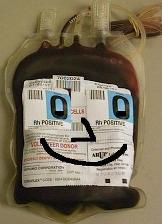
–Tommy Transfusion is the pseudonym of a blood bank supervisor in the midwest.
Another Passport Story, Part 2—A Bit of Horsing Around
In my last blog, I left off telling you about my lovely visit “on horseback” in the Kyrgyzstan mountains outside of Bishkek. I had taken off with a guide, marshaling my skills to stay in the saddle on a scrawny but feisty equine. As we traveled up the dirt road-trail, it was evident that my mountain pony was full of energy and a handful. We trotted and danced a bit, and I was using my best skills staying in the saddle. We were passed by a couple of cars racing up the dirt road and leaving a cloud of dust which didn’t help my nervous horse, and my guide kept a close eye on me. After a short ride into the hills he had me weave my way up a side trail so he could take my picture with the rocks and mountains in the background. As he was fiddling with my camera, a car came racing back down the dirt road and stopped just behind him, shouting out the car window. He looked at them, at me, back at them, and then shouted something to me in Kyrgyz, pointing and gesturing. I didn’t understand, so he raced his horse up the hill and shouted “Passport? Passport?” I said yes, I had it in my pocket, and pointed. “Show, show!” he said, and when I dug for it, the money was there but the passport was gone. During the horse-dancing and prancing, it had apparently worked its way out of my pocket and fallen by the side of the road. We looked back toward the car and the driver was waving a very familiar-looking little blue book out the car window and sporting a very mocking grin.
You can imagine that my rapidly increasing unease translated directly to my horse and he started a bouncing act amid trees and rocks, and dangerously close to a downhill cliff behind me. It was nearly impossible to get off without killing myself—but get off I did, handed the reins to my guide and ran downhill toward the car. The driver and his two passengers looked to be about college age, laughing and saying “road, road” and in gestures we communicated they had found it, showed me the picture and said “you!”. Now, since passport pictures are like driver’s license pictures, and I was shaggy and windblown, any reasonable passport control agent would have looked twice for verification…but it was indeed me. What they wanted was money and had they given it back I would have given them all I had, and gratefully. But the young man holding it did not offer it back, and raced the car engine. I was a bit angry and said rather forcefully “that is mine, you give it back!” I reached into the car and grabbed it from him, amid more laughter and a bit of harassment from his passengers that now he’d lost it and “no money!” By then my guide was standing behind me and the two of us were more of a menace than they were interested in, so they laughed and raced on down the road. Whew. After a few deep breaths, my guide looked at me with a very serious scowl and said “put passport HERE!” and demonstrated by shoving his fingers down the front of his shirt. I immediately followed directions and we trotted on back. My ASCP colleagues were waiting for me as we jogged back up the driveway at the resort and I quickly borrowed another $20 bill, tipped my guide heavily and thanked my lucky stars that:1) the passport didn’t fall out of my pocket into the river; 2) the kids in the car were more interested in a little fun money than fencing it and; 3) the driver had slow reflexes. Later that evening over a much-needed glass of wine, I reflected I had probably used up a couple of my “nine lives” on that adventure!
So if you are ever in the mountains outside of Bishkek, Kyrgyzstan and want to go horseback riding, I have a wonderful guide and a rather skinny Cossack pony I can recommend, just contact me at bsumwalt@pacbell.net. However, I would advise putting your passport close to your body somewhere OTHER than your jeans hip pocket!

–Beverly Sumwalt, MA, DLM, CLS, MT(ASCP) is an ASCP Global Outreach Volunteer Consultant.
Why I Love Microbiology
I’ve been off the bench for almost a year, and while I don’t miss clocking in at 7:00 am or shoveling my driveway at 5 in the morning so I can get to work, I do miss actually working in a microbiology lab. Here are a few reasons why.
1. Making something out of nothing. For me, growing microorganisms on an agar plate is the closest thing to magic a laboratory scientist can do. Today, the plate is sterile; tomorrow, teeming with bacteria!
2. Learning more about a patient’s personal habits than you wanted to. Gram negative bacteria in a throat culture, oral flora in a necrotic toe, a forty-something with a UTI caused by S. saprophyticus or isolating Pasturella canis from a buttock incision site. Microbiologists know everyone’s dirty little secrets.
3. The technologist becomes the patient. When my husband and I adopted kittens, I immediately broke out in an itchy, scaly rash. Of course I performed a calcofluor white stain on a skin scraping that … just happened … to find itself on a glass slide. Diagnosing my own ringworm infection was equal parts exciting and dismaying. And since some of my flaky skin also made its way to an agar plate, we had a great fungus for our students. (For the record, we identified Mycosporum gypsem.)
4. Finding the occasional zebra. I’ll never forget the feeling the first time I recovered Malessezia furfur or the day I found an H2S-producing E. coli.
5. Learning something new everyday. Whether it was a new process at the bench, a new organism I hadn’t seen before, or attending an infectious disease lecture given by a resident, I was constantly learning about the exciting world of bacteria.
And last, but certainly not least:
6. Using my unique skill set to make a difference in patient’s lives every day.
What are some of the reasons you love your job?

–Kelly Swails, MT(ASCP), is a laboratory professional, recovering microbiologist, and web editor for Lab Medicine.
On the Lab Medicine Website
We have some great new content on the Lab Medicine website.
Dennis Ernst discusses the 9 questions phlebotomists should be able to answer in this podcast.
Megan Harley writes about Sickle Cell Anemia.
And be sure to check our homepage and take the poll!
Engage Yourself to Transform Our Profession
It’s never too early to be an engaged pathologist-in-training. This means that we must understand our past and have a strong vision of the future we hope to shape. We must evaluate the forces that have influenced the role and perception of our profession within society, what we did or didn’t do in the past that has led us to our current status, and not only what things we would like to change but also to what do we want to change them.
Since I have an advocacy and organizing background, I may look at our profession a little differently than other residents. First, we are a small profession. The majority of medical students do not choose to become pathologists. But I believe that may be due to at least in part, to a lack of commitment to nurture our pipeline. There is no national medical student organization for those who are interested in learning more about pathology as a profession, and often the little exposure that medical students do get is not an accurate representation of what they would do during residency and ultimately, in the working world.
It’s never too early to be an engaged pathologist-in-training. This means that we must understand our past and have a strong vision of the future we hope to shape.
Secondly, we are still more discohesive (and I’m not talking about a lymphoma here) than we should be as a profession. This may partly be due to the diverse nature of our profession where AP and CP are all considered pathology. In many Asian or European countries, pathology residents must choose one track or the other; they, more times than not, do not have the option for combined AP/CP. So does this confuse or hurt us to educate our future pathologists in this manner where allegiances are often diluted? I say no, not directly. But since we do have so many subspecialties, and consequently, subspecialty organizations, many residents and pathologists who are limited in terms of time and energy have to choose and prioritize which organization to devote their efforts. Even though we have ASCP and CAP as more all-encompassing organizations, we could still have stronger solidarity and more frequent interactions between these groups.
Thirdly, from my n=1 (level 3 evidence which isn’t always worth much), most residents and attendings I see have very little interest or experience in political advocacy even though this may be the greatest avenue we have for palpable change. I have seen some committed to curricular reform. I have also seen some who promote the profession by serving on hospital and program committees as well as leadership in state and national societies. But what I don’t see much of are those who keep track of what is going on in DC and within society that affects our profession and who attempt to do something to change what they perceive as negative. We need to change our culture and encourage and train our residents to get involved early in such activities.
And last, but not least, we need to own our value as physicians. We must not allow anyone to treat as us less than a physician from another specialty. And practice makes perfect–we as residents should start early by serving on organizational committees, etc. I will be doing my part this weekend serving on the CAP Council on Education (COE). I’ll let you know how that goes.
As an aside, creating an organization to educate medical students about pathology is a pet project of mine. If you’re interested in helping to start such an organization where we can also serve as mentors to pathology residents-to-be, please feel free to email me at bchung73@uic.edu.
–Betty Chung, DO, MPH, MA is a second year resident physician at the University of Illinois Hospital and Health Sciences System in Chicago, IL.
Classified
“I retweeted an Instagram picture someone posted on their Facebook page that shows how to place blood tubes in a centrifuge. There is also a vine of it on their LinkedIn profile.” Confused yet? I’m a millennial, more commonly known as generation Y, and if there is a social network out there people my age are either on it or bored with it already. The question that keeps coming up is where do the social networks fit in to professional life? Perhaps the bigger question is can you be yourself while maintaining a professional persona? Most large organizations have social media policies that prohibit their employees from speaking badly about them on social media sites. Some policies also allow a company to terminate someone if the person lists them as their employer and does or posts something that the employer feels isn’t up to their standards.
The reality is if you are on these sites and you list your employer you must be careful. If people ask my advice on social media I usually tell them to stay as ghosts, and don’t list your employer. In my personal situation I don’t even have my real last name on my Facebook account plus it is private and even if you knew what my name was you couldn’t search it. Now, I really have nothing to hide seeing as I have over 1000 friends on my Facebook account but I not only want to control what goes out but more importantly who sees it. My feelings are, keep your personal life personal and your professional life exactly that.
Some may find it surprising that a young person isn’t posting every aspect of their life but I just feel that my organization doesn’t need to know what I have for dinner after I leave for the day. It is really each individual’s choice on what they want to follow or add but it just seems to me that it is a little to easy to become emotional about something and next thing you know it’s out there for all to see. It is pretty much a daily occurrence that some celebrity has to apologize for something that is taken out of context and the same goes for everyone else. When you tweet out that you can’t stand your boss, smiley face; you may not be around to explain the sarcastic nature of the post.
As a supervisor, I would never recommend being friends with people you lead unless you understand and realize that everything you post will be fair game in the workplace. I think a lot of people either forget that or simply don’t understand the significance of social media until it’s too late. Just because something happens outside of the organization, if one of your coworkers sees it you can bet that it will find its way back to the workplace. This is the personal aspect of social media and if your organization requires you to have a public account as a leader to be available for comment and questions nothing says you can’t have two accounts. Have a public profile and a personal one that you can set to private. When people ask me at work if I have any social media accounts I just tell them that information is classified.

–Matthew Herasuta, MBA, MLS(ASCP)CM is a medical laboratory scientist who works as a generalist and serves as the Blood Bank and General Supervisor for the regional Euclid Hospital in Cleveland, OH.
Another Passport Story, Part 1–A Bit of Horsing Around
On a recent trip to Kyrgyzstan, I had a wonderful time with an interactive training for laboratory pre-analytical procedures and specimen transport with key laboratory leaders. Our sessions were designed to give them a full picture of the challenges and opportunities ahead as they build stronger laboratory systems. The two week stay started with arrival in Bishkek, the capital city, on Easter Sunday morning. (Actually, it was the middle of the night!) It was still dark when we checked into the hotel and we took hot coffee to the hotel rooftop for an “Easter Sunrise”. I cherish sunrises all over the world, and taking a solitary moment to watch the sun move slowly through the haze over the distant mountains and bring the city to life was very special.
Sessions covered two weeks and in between we had a weekend to explore and see a bit of Kyrgyzstan. It was suggested we take an overnight into the mountains, which were covered in snow even in late spring, to enjoy their favorite “resort and spa.” A little relaxation and sightseeing in the mountains sounded excellent….we headed off with our ever-protective and accommodating driver.
One of the treats offered at the resort was a horseback ride along the dirt road into the mountains. Some of you may know I have horses and love to ride, so this was a natural attraction and I immediately signed up for a ride and a guide. They showed up with three of the tallest, skinniest, poorly-tacked horses I think I’ve ever seen and I secretly wondered how these ponies ever survived the tundra temperatures! But the ever tough “Cossack horses” are suited for it and much faster and well-adapted than our overly-coddled pleasure horses, so I quit frowning and clambered on. My mount was too tall and had a cock-eyed saddle, and I’m certain he could feel a bit of nervous body language. Riding takes your full attention and I wanted free use of both hands, and also a safe place for identification and tip money. So I put my passport, tip money, and the hotel phone number and cell phone in my jeans pockets. Safety first! However, this turned out to not be as safe as I thought …
Next time….the rest of the story!
–Beverly Sumwalt, MA, DLM, CLS, MT(ASCP) is an ASCP Global Outreach Volunteer Consultant.

