Go Outside And Play in the Dirt

Researchers may have made some headway in the fight against antimicrobial resistance. A paper published online in Nature today (abstract only unless you’re a subscriber) discusses a new method to grow bacteria that have previously been uncultivable. In doing so, researchers have discovered a new antibiotic they’re calling teixobactin that is active against gram-positive organisms (specifically, a precursor of peptidoglycan present in the cell wall). Initial tests suggest bacteria can’t form a resistance to this mode of action.

Maybe there’s something to the expression “throw some dirt on it and get back in the game” after all.

NPR and the Washington Post discuss this paper and its findings today, as well. It’s too soon to be excited, but I admit I’m cautiously optimistic.

Swails

Kelly Swails, MT(ASCP), is a laboratory professional, recovering microbiologist, and web editor for Lab Medicine.

There’s a Fungus Among Us

A 53 year old man with history of stroke, alcoholism, heart failure, hypertension, and atrophic right kidney presented to the ED with acute urinary retention and complained of dysuria and frequency. He was afebrile, denied nausea/vomiting or headaches. His labs at admission are listed below:

  • WBC: 21 k
  • Na: 122
  • Cr: 3 (baseline 1.2)

Urinalysis showed innumerable white blood cells, leukocyte esterase 3+ and negative nitrite.

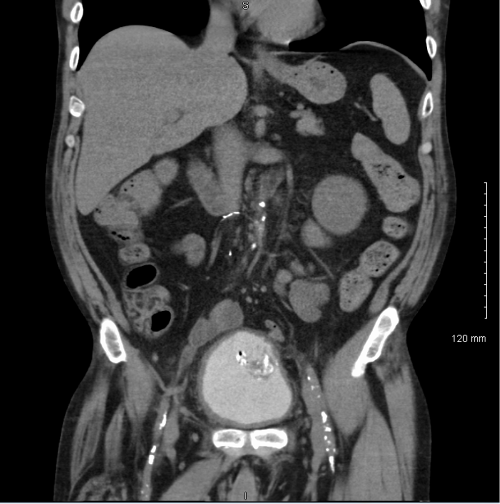
A catheter was placed and drained 1 L of yellow cloudy urine. The patient refused admission and he was prescribed ciprofloxacin 500 mg BID empirically and was sent home with a foley catheter in place with plans to follow up with Urology. He returned to the ED the following day because his foley catheter was not draining urine and he noted leaking around his catheter. CT scan was obtained and showed ill-defined areas of increased and decreased attenuation within the urinary bladder lumen and left hydroureteronephrosis.
fungusball1

Urine cultures obtained during his initial presentation grew >100,000 yeast and he was treated with fluconazole. The patient was taken to the operating room 11 days after first presentation to diagnose and treat the mass in the bladder. A tan-brown mass was removed and send to surgical pathology. Representative section (H&E stain) of the specimen is shown below:

fungusball2

Which of the following statements regarding Candiduria is true?

  1. Most patients with candiduria are asymptomatic and the yeasts merely represent colonization
  2. The presence of pseudohyphae in the urine or the number of colonies growing in culture help to distinguish colonization from infection
  3. The most commonly involved organ in disseminated candidiasis is the heart
  4. There is a higher propensity for fungal ball formation in adults than children

The correct answer is 1. Most patients with candiduria are asymptomatic and the yeast merely represent colonization. Infected patients may have symptoms (dysuria, frequency, suprapubic discomfort) while others might not. Pyuria is so common in patients with a chronic indwelling bladder catheter that it cannot be used to indicate infection.

Neither the presence of pseudohyphae in the urine nor the number of colonies growing in culture (unlike bacterial cultures) help to distinguish colonization from infection. Ascending infections are rare but usually subacute or chronic, unilateral and can cause perinephric abscesses.

Fungus balls in adults are uncommon with less than 10 adult cases reported in the literature. Risk factors include uncontrolled diabetes, prolonged use of antibiotics or steroids and immune compromise. Classic laboratory findings include marked leukocytosis, pyuria, hematuria and a concomitant bacterial urinary tract infection. Most cases are caused by Candida species although Aspergillus has been implicated in a few cases.

The kidneys are the most commonly involved organ in disseminated candidiasis and there is a higher propensity of fungus ball formation in neonates.

-Agnes Balla, MD is a 1st year anatomic and clinical pathology resident at the University of Vermont Medical Center.

Wojewoda-small

-Christi Wojewoda, MD, is the Director of Clinical Microbiology at the University of Vermont Medical Center and an Assistant Professor at the University of Vermont.


The Future Cost of Antimicrobial Resistance

Over on Superbug, Maryn McKenna (are you following her yet? No? If you’re into infectious disease, you should) discusses a recent report on the global ramifications of antimicrobial resistance. In it, the authors project by 2050, 10 million deaths a year will be attributed to infections caused by six resistant organisms. (Those are: Klebsiella pneumoniae, E. coli, MRSA; HIV, TB and malaria.) These deaths will cause an estimated loss of 100 trillion dollars of lost gross national product.

So what can laboratory professionals and pathologists do to help stop these predictions from coming true? For starters:

  • Advocate for and implement antibiotic stewardship programs.
  • Educate the public about proper antibiotic use.
  • Practice good laboratory safety practices.

What else can labs, microbiologists, and pathologists do to stem the tide of antibiotic resistance?

Swails

Kelly Swails, MT(ASCP), is a laboratory professional, recovering microbiologist, and web editor for Lab Medicine.

Fighting Fire with Fire

512px-Bacillus_subtilis_Gram_stain

A study published in PLOSone back in September analyzed the microbial-fighting capability of … well, microbes. The authors evaluated the efficacy of cleaning hospital rooms with food-grade Bacillus subtilis, Bacillus pumilus, and Bacillus megaterium. The authors concluded that cleaning hospitals rooms with these organisms reduced the number of hospital-acquired-infection-causing organisms on surfaces.

It’s an intriguing idea, and not that out of the box; lots of antimicrobial agents are derived from other microorganisms (I’m looking at you, penicillin). It’ll be interesting to see where other researchers take this.

Click here to read the full study.

Swails

Kelly Swails, MT(ASCP), is a laboratory professional, recovering microbiologist, and web editor for Lab Medicine.

New National Strategy for Antibiotic Resistance

Last week, the White House published a National Strategy for Combating Antibiotic Resistant Bacteria and President Obama signed an executive order that orders the implementation of the strategy. The report covers a lot of information, but two goals stuck out as being especially pertinent for laboratory professionals.

By 2020:

  • 95 percent of hospitals report data on their antibiotic use to the CDC
  • create regional laboratory networks for testing resistant bacteria and make the data publicly, electronically, available.

Both of these goals require the cooperation of clinical laboratories including (but certainly not limited to)  infrastructure upgrades, data collection, and procedural changes. In an era when laboratories have less resources than ever before, will this stretch microbiology departments too far? Based on available resources, are these goals attainable?

If you’d like a comprehensive overview of the government’s strategy, check out Maryn McKenna’s excellent post on Wired’s Superbug blog.

Swails

Kelly Swails, MT(ASCP), is a laboratory professional, recovering microbiologist, and web editor for Lab Medicine.

CDC Recommendations for Laboratory Detection of STDs

Several months ago the CDC updated their recommendations for laboratory detection of Chlamydia trachomatis and Neisseria gonorrhoeae.

A summary:

Chlamydia trachomatis

  • Swabs must have a plastic or wire shaft and a rayon, Dacron, or cytobrush tip.
  • Swabs must be inserted 2-3 cm into the male urethral or 1-3 cm into the endocervical canal followed by 2-3 rotations
  • Specimens should be sent to the laboratory 1) within 24 hours of collection, 2) in sucrose phosphate glutamate buffer or M4 media, and 3) at less than or equal to 4 degrees C

Neisseria gonorrhoeae

  • Gram stain of male urethral specimen that contains PMS and intracellular Gram-negative diplococcic is considered diagnostic
  • A negative Gram stain result does NOT rule out infection
  • Swabs must have a plastic or wire shaft and a rayon, Dacron, or cytobrush tip.
  • Swabs must be inserted 2-3 cm into the male urethral or 1-3 cm into the endocervical canal followed by 2-3 rotations
  • For specimen transport, culture transport systems are preferred over swab transport systems
  • Specimens should be plated and incubated in an increased CO2 environment as soon as possible
  • Culture media should include selective (such as Thayer-Martin or Martin-Lewis) and nonselective (such as chocolate) agar
  • Oxidase-positive, Gram-negative diplococcic that grow on selective media can be presumptively identified as N. gonorrhoeae

Nucleic acid amplification tests (NAATs) are superior when compared to other culture and nonculture diagnostic methods for both organisms. However, it’s important that lab professionals understand the limitations of these tests.

Microbiologists should take the time to read the report here.


Swails

Kelly Swails, MT(ASCP), is a laboratory professional, recovering microbiologist, and web editor for Lab Medicine.

CLSI Releases New Microbiology Standard for Detection of Anaerobes

Anyone who has worked in Microbiology for any length of time knows that anaerobes are finicky at best and impossible to identify at worst. Having guidelines for their identification would be helpful. Enter CLSI.

From their press release:

“The Clinical and Laboratory Standards Institute (CLSI) released a new microbiology standard, Principles and Procedures for Detection of Anaerobes in Clinical Specimens; Approved Guideline (M56-A). This document presents standardized, cost-effective, and efficient best practice processes for anaerobe bacteriology to assist clinical laboratories in selecting those methods that lead to improved patient care.”


It’s That Time of Year Again

It’s a few days after a major holiday (Memorial Day in the United States), and clinical microbiologists knows what that means. It’s foodborne illness season! According to the CDC, Norovirus and Salmonella are the biggest culprits, but several organisms can be implicated.

If your lab doesn’t recover Salmonella, Campylobacter, or E. coli O157:H7 often, consider brushing up on the identifying characteristics of these organisms. (Do you know which one doesn’t ferment sorbitol?) It’s also helpful to keep the patient history (in particular, their travel history) in mind when reading enteric cultures or performing a microscopic ova and parasite examination. Also, now is a good time to be sure your reporting procedures (including local public health contact information) are up to date.

Check out the CDC’s website for more information on foodborne outbreaks, including how many people are affected.


Swails

Kelly Swails, MT(ASCP), is a laboratory professional, recovering microbiologist, and web editor for Lab Medicine.


Your Microbiome and Your Health

The fine folks at Scientific American recently published a fascinating blog post about the diversity of one’s fecal bacteria. While it’s long been thought gut microbiomes can vary widely from day to day within the same person, the advent of direct-to-consumer microbiome testing has uncovered that variety can exist within the same specimen.

What? You’ve never heard of personal microbiome testing? Think of it as 23andMe for feces. Ubiome and American Gut provide this service for folks who aren’t squeamish about collecting their own stool swabs.

From the laboratory professional perspective, what do you think about this type of direct-to-consumer testing? Do you think testing a patient’s microbiome has a future in diagnostic or preventative medicine?


Swails

Kelly Swails, MT(ASCP), is a laboratory professional, recovering microbiologist, and web editor for Lab Medicine.