You Never Know What You Might Find on Peripheral Smear Review

A 15 month patient was seen in the Pediatric Hematology-Oncology clinic in June 2014 for mild normocytic anemia.

Review of Systems

Negative 12 system review. No history of pallor, jaundice or high colored urine.

Ref. Range 6/14
WBC 6-17 K/uL 11.4
Hemoglobin 10.5-13.5 g/dL 8.9 (L)
Hematocrit 33-39 % 25.4 (L)
Platelets 150-400 K/uL 648 (H)
RBC 3.7-5.3 M/uL 3.57 (L)
MCV 70-86 fL 71.2
MCH 23-30 pg 24.9
MCHC 31-36 % 34.9
RDW 11.5-14.5 % 16.4 (H)

His serum iron profile was normal, serum lead levels were normal. Reticulocyte percentage and absolute reticulocyte count were also both not elevated.

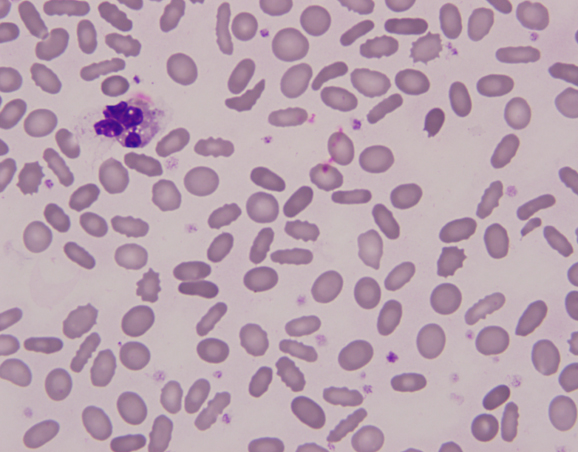
Review of peripheral smear revealed moderate anisopoikilocytosis with presence of numerous elliptocytes.

he1

he2

Molecular studies demonstrated a heterozygous mutation in the EPB41 gene associated with HE.

Patient was diagnosed with Hereditary Elliptocytosis (HE).

He has been followed up at the hematology clinic for a year now. His follow up CBC results are as follows. He has reached his age appropriate milestones and continues to grow well.

Ref. Range 7/14 10/14 12/14 4/15
WBC 6-17 K/uL 10.3 11.3 7.4 10.0
Hemoglobin 10.5-13.5 g/dL 9.3 (L) 9.9 (L) 9.7 (L) 11.0
Hematocrit 33-39 % 26.5 (L) 28.7 (L) 28.1 (L) 33.6
Platelets 150-400 K/uL 599 (H) 570 (H) 403 (H) 447 (H)
RBC 3.7-5.3 M/uL 3.74 3.91 3.87 4.58
MCV 70-86 fL 70.8 73.3 72.6 73.5
MCH 23-30 pg 24.8 25.4 25.1 23.9
MCHC 31-36 % 35.0 34.7 34.5 32.6
RDW 11.5-14.5 % 16.9 (H) 17.7 (H) 18.2 (H) 18.0 (H)

Hereditary elliptocytosis (HE) is an inherited hemolytic anemia, secondary to red cell membrane defect more commonly assembly of spectrin, spectrin-ankyrin binding, protein 4.1 and glycophorin C with a clinical severity ranging from asymptomatic carriers to a severe hemolytic anemia. It is more common in individuals from African and Mediterranean decent – neither applies to our patient.It is inherited in an autosomal dominant pattern, typically individual who are heterozygous are asymptomatic while those who are homozygous or compound heterozygous have a mild to severe anemia. Occasional patients with more severe hemolysis may require splenectomy.

Regardless of the underlying molecular abnormality, most circulating red cells are elliptical or oval. They still have an area of central pallor, since there is no loss of the lipid bilayer (as seen in Hereditary spherocytosis).

Vajpayee,Neerja2014_small

-Neerja Vajpayee, MD, is an Associate Professor of Pathology at the SUNY Upstate Medical University, Syracuse, NY. She enjoys teaching hematology to residents, fellows and laboratory technologists. 

Biomarkers of Renal Disease

When most laboratory professionals think of tests for renal disease, we think of creatinine and blood urea nitrogen (BUN). These two tests have been considered renal function tests for many years (creatinine for over 100 years), and yet neither is a very good marker of early damage to the kidneys.

Creatinine is a biomarker that really needs individual rather than population-based reference intervals. Each person has a range of creatinine values that are “normal” for them, and that individual range is generally much narrower than the population reference interval. Because the reference interval for creatinine is fairly broad, a person can lose 25 – 50% of their renal function before their creatinine rises out of the reference interval for “normal.” Thus creatinine does not detect early renal damage. BUN is also not great for detecting early acute renal damage. BUN concentrations rise when the kidneys sustain damage, but a rise in BUN is not specific to kidney damage. Other causes can elevate BUN as well, such as starvation and increased protein breakdown or intake. In general, BUN and creatinine provide the most useful information in conjunction with each other, and for trending when significant damage to the kidneys has already occurred.

For these reasons, there is a continuous search for better markers of renal damage, especially markers that indicate early renal damage, when perhaps something can be done to reverse it. Cystatin C is another biomarker that is being increasingly used to assess renal damage, and originally was hoped might outperform creatinine in detecting early renal damage. Cystatin C is a small protein which is freely filtered by the glomerulus and doesn’t have many of the drawbacks of creatinine, such as creatinine’s relationship to muscle mass. Unfortunately, although many studies have been done, cystatin C has not been shown to be better than creatinine at indicating early renal damage, and is considered a renal biomarker with uses similar to creatinine and BUN.

Currently, protein or albumin in the urine, and especially very small amounts of protein/albumin in the urine, is probably the earliest indicator of renal damage that is available in the US. Very small amounts of albumin in the urine, what has been called microalbuminuria, is one of the earliest indicators of renal disease.

A new biomarker for early acute renal damage that is gaining the most widespread acceptance is NGAL. Neutrophil gelatinase-associated lipocalin (NGAL) is being extensively studied and has been shown to detect early, acute kidney injury (AKI). In addition, NGAL levels have been reported to be associated with the amount and severity of renal damage. Already in use clinically in Europe, tests for this biomarker are currently working their way through the FDA in the US.

Some other new biomarkers for AKI that are being studied, but are not progressing toward general usage as quickly as NGAL include kidney injury molecule 1 (KIM-1), β-trace protein, liver-type fatty acid-binding protein (L-FABP) and interleukin-18. These are all proteins that appear to be up-regulated in response to AKI. Studies are on-going to see which of these biomarkers may be useful for detecting early AKI and for differentiating between types and causes of AKI. In addition, for all these new kidney biomarkers, studies are needed on the biomarkers’ efficacy in helping with clinical decision-making regarding treatment options and outcomes. It will be interesting to see if any of them become clinically useful tests for the detection of early acute renal damage.

-Patti Jones PhD, DABCC, FACB, is the Clinical Director of the Chemistry and Metabolic Disease Laboratories at Children’s Medical Center in Dallas, TX and a Professor of Pathology at University of Texas Southwestern Medical Center in Dallas.

Ebola and Stress on Health Care Professionals

A recent letter to the editor of CDC’s Emerging Infectious Diseases discusses the psychological stress of caring for an Ebola patient. The authors wondered if the caregivers of patients with Ebola experienced more stress than other providers. You can read the small study–and the surprising results–here.

Should We Do It Here?

How do you decide whether to bring a test in-house or to send it out (or continue sending it out) to a reference lab? It’s not an easy decision, and it should be one based on as many facts as you can gather. The bullet points below are the considerations I employ for making this decision.

  • Cost: This is almost always the first consideration. Compare what the test currently costs to send out versus what it will cost to run in-house. If it costs more to run in-house than to send out, then there had better be some pretty over-riding reasons for doing it on-site. There are many items that contribute to the cost to run a test including:
    • Basic bottom line cost of the test – i.e. reagents, kit, etc
    • Technologist time – actual time to run the test, and to report the results if it’s not auto-verified
    • Supplies – test tubes, pipets, controls, calibrators, proficiency testing samples, etc.
    • Cost of instrumentation – determine whether a new instrument is needed or whether the test can go on an existing instrument. Either way, depreciation and service contract costs must be considered.
    • Development – for bringing in a newly released, FDA-approved assay on a current platform available in-house, this cost may be minimal, especially if the company brings it in and verifies its performance. For a laboratory developed test, this aspect of cost may be extensive and needs to be considered.
  • Test volume: The number of these tests that are performed will figure into all the rest of the parameters, including the cost of running it and the tech time involved. In addition, the test volume should be high enough to be able to maintain competency in the techs performing it, as well as to be able to keep in-date reagents on hand and instrument maintenance up to date.
  • Turnaround time (TAT): This is often a big factor in the decision to bring a test in-house. Doctors may request that tests be performed in-house to allow for better patient care. For example drug dosing decisions are not optimal if a drug result takes four days to return.
  • Workflow/tech time: How the new test will fit into the current workflow needs to be considered. Will it require additional technologist time or re-shuffling of coverage of other tests? Will it be a random access test or run in batches a few times a week and how will it impact staffing?
  • Patient care: Occasionally the reason for bringing a test in-house may be related to providing the best patient care, despite costs analysis and impact on the lab workflow and staff. An example is pentobarbital. We brought this test in-house even though we perform less than 50 of these a year because results were needed to make decisions related to continuing life support of not. Under these conditions, a 3 to 4 day TAT is not acceptable.

When all these costs are considered, think about your return on investment (ROI). Determine if you will save your institution money, and if so, over what time period. Sometimes it’s not an immediately obvious ROI, but over time you will save money. Sometimes the ROI is actually improved patient care rather than monetary savings. And sometimes the ROI is simply improved relations with the doctors and clinical staff, and that’s not a trivial ROI.

-Patti Jones PhD, DABCC, FACB, is the Clinical Director of the Chemistry and Metabolic Disease Laboratories at Children’s Medical Center in Dallas, TX and a Professor of Pathology at University of Texas Southwestern Medical Center in Dallas.

Computers and Diagnostic Algorithms

As sophisticated as computers are now, isn’t about time we began using them more to help with the diagnosis of disease? Physicians tend to be diagnosticians, and primary care physicians need to have a massive breadth of knowledge these days in order to correctly diagnose the multitude of disorders in patients that may walk through their doors. The same goes for ER physicians. Currently, new doctors are relying more and more on information at their fingertips rather than information remembered. Perhaps relying even more on computers than we already do makes sense. Currently, we routinely use simple computer algorithms in clinical laboratory testing. Things like test results above an AMR causing the computer to direct the instrument to dilute and repeat the assay on that sample before reporting a result. Or diagnostically, a negative monospot test for Epstein Barr Virus (EBV) on a child under 4 years of age can be programmed to automatically order an EBV IgM and IgG, since the utility of the monospot test is unclear in that age group. This sort of “reflex” testing is already in use, and requires no operator intervention.

Here’s an example of a diagnostic approach that could be used: A sick infant comes in to the ED and has blood work run immediately. The initial results show a low pH, low bicarbonate and high pCO2. When a software program sees that combination of results, it could reflexively order more tests based on the differential diagnoses associated with a high anion gap metabolic acidosis (for example, ordering a blood glucose to detect diabetic ketoacidosis). If that is ruled out, the software then looks at the next most common cause of metabolic acidosis, and so on. The computer would not be diagnosing the child; the software would simply be ordering the appropriate next step tests to allow a rapid diagnosis, and probably doing it faster than the average multi-tasking ED doctor.

Software-based diagnostic systems exist and are on the market. So why are we so slow to adopt these systems into everyday use? We should let technology help us as much as we can. Software-based diagnostic systems have not been shown to be better than humans for diagnosing (http://www.nejm.org/doi/full/10.1056/NEJM199406233302506), and may never be. However, I would opine that they are faster than humans at deciding what tests to order based on lab results, or on a combination of lab results and clinical signs and symptoms. Using them this way would then leave the human to human interactions and the final diagnosis to the doctor and his patient when he has all the necessary test results at hand.


-Patti Jones PhD, DABCC, FACB, is the Clinical Director of the Chemistry and Metabolic Disease Laboratories at Children’s Medical Center in Dallas, TX and a Professor of Pathology at University of Texas Southwestern Medical Center in Dallas.

Can I Use This Figure in My Talk?

Ever found that perfect figure that beautifully illustrates a point you’re trying to make? Ever wonder if it’s okay to use that perfect figure in your presentation? Are you infringing on someone’s copyright when you do? I attended a nice session on copyright the other day and I learned a few things I thought I’d share.

The first thing I learned is that when you create something, a text, a picture, a figure, a song, it is automatically copyrighted. You don’t have to apply for a copyright, nor put the little copyright designation on it (c inside a circle). It’s belongs to you unless you sign away your copyright to someone else.

The next thing I learned is that in general, use of a single figure from something does not constitute copyright infringement, especially if you attribute it to the source. It is considered “fair use” of that figure. That may not be true in some circumstances however, depending on other factors. There are basically four factors that are considered when it comes to the courts deciding on copyright infringement versus fair use. Put very, very simply (and from what I consider most important to least important), the four factors are:

  • If your use of another person’s (or company’s) work will affect their bottom line, then you are infringing on their copyright.
  • Is it transformative use or derivative? Are you using the figure or text in the same way that it was originally used, or are you using it for a different purpose entirely? For example a figure from a published paper, with a clear attribution allowing anyone to find the original, used in an educational lecture is fair use.
  • If you copy an entire textbook and pass it to your students, that’s copyright infringement, and also goes to the fact that you’re eating into the publisher’s bottom line since now your students don’t have to buy the textbook. In general if you use less than 10% of a published work, you’re still in the fair use ballpark. Again, bottom line money can affect this.
  • Facts and ideas cannot be copyrighted. Expression of facts or ideas, or fixing them into a written work or figure, is copyrighted.

Another thing I learned is that Google images is probably not your best place to find images to use, especially if you want an image in something that you plan to publish. They are all copyrighted, and you will need to track them to their source and get permission to use them. However, for an occasional image in an educational powerpoint, including the attribution (usually in a link) is probably sufficient.

Of course, being a legal thing, copyright and fair use can be much more complicated than this, and lawyers and courts make their living making those decisions. I would say in general though, for a few random images in your powerpoint presentation, you are not breaking any copyright laws.

-Patti Jones PhD, DABCC, FACB, is the Clinical Director of the Chemistry and Metabolic Disease Laboratories at Children’s Medical Center in Dallas, TX and a Professor of Pathology at University of Texas Southwestern Medical Center in Dallas.

Food and Drug Administration and Next Generation Sequencing

As readers of this blog are probably aware, The Food and Drug Administration (FDA) is currently considering how to tailor its oversight of Next Generation Sequencing (NGS), methodologies that can produce extremely high quantities of genetic sequences. In turn, these sequences can be used to identify thousands of genetic variants carried by a particular patient. NGS will usher in an age of truly personalized medicine in terms of patient risk assessment, diagnostics, and personal treatment plans.

Currently, the FDA approves all in vitro diagnostic (IVD) tests with the exception of laboratory defined tests (LDTs). These tests are used in clinical laboratories and typically detect one substance or analyte in a patient sample, and this result is used to diagnose a limited number of conditions. (One example would be a cholesterol test; every manufacturer that makes the analyzer and reagents to detect cholesterol in a blood samples has to get their methodology approved.) However, NGSs have the potential to detect billions of base pairs in the human genome, and therefore the potential exists to diagnose or discover thousands of diseases and risk factors for disease. Also, many NGS tests are developed by individual laboratories, not big companies, and so would be considered an LDT.

The FDA has opened a public docket to invite comments on this topic. American Society for Clinical Pathology, as well as other professional societies—American Association of Clinical Chemistry and Association for Molecular Pathology among them—has publically commented on the FDA preliminary discussion paper “Optimizing FDA’s Regulatory Oversight of Next Generation Sequencing Diagnostic Tests.” In its comments to the draft paper, ASCP stated that the “CLIA framework offers a more logical model for providing federal regulatory oversight of LDTs.” Similar points were made by AACC and AMP. The associations also agree that any regulations should not interfere with the practice of medicine.

What do you think? How involved should the FDA be in genomic testing in the clinical setting?

Further reading:

AMP comments

AACC comments

But How does it Work?

There’s an old saying that goes like this: if you understand it, it’s obsolete. Sadly, in this day and age of rapidly advancing technology, this saying is truer than ever. I say “sadly” because what this means for us in the laboratory is that we are becoming less and less likely to be able to troubleshoot and repair our own instruments. This is another thing I sometimes miss about bygone laboratory medicine. Taking instruments apart used to be fun.

Many instruments now are considered “black boxes” by clinical laboratory scientists. They may not understand the principles behind how the instrument works, and even if they do know, they are not inclined or encouraged to attempt to fix it if it stops working. In the early days of laboratory medicine, we could repair most of the instruments we used in the laboratory. Now we can repair almost none of them. Instruments have become so sophisticated, with so many bells, whistles and extras, that even if you know the basics of how the instrument works, being able to fix it when it goes down is no longer a possibility.

For example, most big main chemistry analyzers work on the basis of two principles: some type of photometry and ion-selective electrodes (ISE). Knowing that information used to make it possible to troubleshoot and do some repairs on the photometer system, as well as replace ISEs. Troubleshooting and repair was a matter of checking the functioning of your optics and cleaning as necessary, replacing tubing and replacing electrodes and fluids for the ISE part. Medical technologists were much more likely to repair systems themselves than to call Service in. That ability is rapidly becoming a lost art however.

Modern instruments are much more than a photometer and a set of ISEs. The sheer volume of working parts in current instrumentation is orders of magnitude higher than in old instruments, and most of those parts are robotics in the instrument rather than analytical components. With more sophistication and technical abilities though, come more things that can go wrong. And these are things that cannot be fixed by the clinical laboratory scientist working the instrument.

Of course, for every lost ability is a gained ability. While local troubleshooting may not be possible, many of these major instruments are now connected to the internet. Troubleshooting can be done remotely by the people who do have the knowledge to service them. Honestly, I probably do not want to return to the days of fixing my own instruments in the case of the big chemistry analyzers, but I still do enjoy troubleshooting my mass spectrometers. And it was nice to know I could fix things.

-Patti Jones PhD, DABCC, FACB, is the Clinical Director of the Chemistry and Metabolic Disease Laboratories at Children’s Medical Center in Dallas, TX and a Professor of Pathology at University of Texas Southwestern Medical Center in Dallas.

What is the Patient’s Right With Respect to Laboratory Testing Orders?

I was recently in Arizona for a meeting and being there made me think of an email that I had received the day before I flew out. Apparently, the Arizona House of Representatives recently passed legislation (HB 2645) allowing direct lab test ordering by patients without a physician’s request or written authorization. This bill would still need to be signed into law to go into effect but I was still surprised to read about this bill.

Interested parties worked together to have the original bill amended with the stipulation that the laboratory would have the authority to decide which tests (or none) that patients may order. In some states, such a law I believe already exists (but don’t quote me on that…I tried finding confirming this but was not successful). But this begs the question, who takes responsibility for the test results? Currently, the Arizona bill states that test results would go to the person who provided the sample if a physician did not order the test. It would be their responsibility to consult with a physician for test result interpretation and required care and no physician would be liable for not acting on the test results if s/he did not order them.

So what is your opinion on patients self-ordering lab tests for themselves? Would this lead to patients second guessing their physicians if they want a lab test based on information that they personally gathered but that their physician disagrees with? Or would this make it easier for both the patient and physician in cases of routine testing? Are there implications that we have not thought of?

As an AP/CP resident, I’m not quite sure where I fall on this issue. Sure, having been “raised” in a training environment where vestiges of a previously patriarchal ethos and bias remain, it is difficult to imagine patients, and not physicians, choosing what tests to order. After all, hopefully, four years of medical school and multiple years of residency and eventual fellowship, should help inform these decisions more than internet searches and anecdotal stories can. But I have always been a patient advocate first. And I am always willing to take a step back to think about questions from the patient’s point of view and try to set aside my own biases, if doing so will improve patient care and safety.

But as with every human being, I’m cognizant that I do have biases. And as a resident who has had to navigate what we know as CP call, I understand that physicians, too, often have difficulty knowing what tests to order and what they should be looking for in a “good test” to provide them with the appropriate answers that they and their patients seek. I’m sure we’ve all dealt getting pages where we had to shut down what I like to refer to as “shotgun” ordering – multiple tests that are ordered hoping to find an answer in those cases where there is no differential or a very exhaustive one. Especially since without a targeted differential, test results may be difficult to interpret. Additionally, I’ve often seen other issues such as duplicate orders when a panel along with specific additional tests that are (unknowingly) included in the panel are ordered or the wrong test(s) ordered altogether. So it does pay to have another set of informed eyes look over test orders.

As a pathology resident, and even one with extensive lab and research experience prior to medical school, I can admit that I learn more and more each time I’m on a CP rotation about how to gauge the analytic and clinical validity of specific lab tests. Just because a test exists, doesn’t always mean that we should use it or always order it for every patient. This is the role I feel that we fill for referring physicians and patients. We develop and make sure tests are conducted properly, safely, and efficaciously. We also serve as a resource with knowledge on which tests, specimen sources and other analytic parameters, and patient populations are appropriate. We can also identify and troubleshoot when false positives or negatives are suspected as well as provide an interpretation of the test results within the context of clinical patient history that we can access through the EMR. But that is within the confines of the walls of the medical culture and environment, which I admit is not perfect and has areas that we can still work on to improve.

But when it comes to patients ordering tests outside the purview of direct medical care, I’m not sure what my stance is. In this country, patient autonomy is king. As physicians, we don’t always have to agree with our patient’s decisions, but we do need to respect them. We cannot arbitrarily subjugate patients to the dictatorship of a patriarchal perspective (at least not in this modern day), even within a patient care setting. So, at least in my mind, a grey zone exists in the context of a patient who is willing to pay or who can get his/her insurance to pay (although that is entirely another issue) for a specific test not ordered by their physician. But I do worry that this could set up complications for evidence-based patient care. There are multiple levels of implications that I’m sure we have not even thought of – not only for the physician who has to decide what to do when their patient brings in results from a test that they personally ordered without physician authorization but also for the patient to not feel as if they are falling through the cracks of our healthcare system if physicians decide to not act on these test results. I can imagine that there are medicolegal issues that are significant as well but I humbly admit that these are definitely beyond my expertise to comment on at this time. However, I do know that I believe that patients have a right to access their test results directly and not have to go through their provider if they choose not to.

I wrote this post not to necessarily push readers to one viewpoint or another but more so to provoke thought. So, how do you think this bill will affect healthcare in Arizona or set a precedent for other states to follow and what is your stance? I can honestly say, I’m still thinking it over…

This post is an edited version of one that appeared on 2/27/15.


Chung

-Betty Chung, DO, MPH, MA is a third year resident physician at Rutgers – Robert Wood Johnson University Hospital in New Brunswick, NJ.

Why We Should Care and Act on the Proposed FDA Regulation of LDTs

So, I wrote briefly to bring awareness about this topic when the U.S. Food and Drug Administration (FDA) first formally proposed in July of 2014 that they intend to begin regulating laboratory developed tests (LDTs). Now that draft regulations have been released, I want to encourage you to not only learn more about this issue but also to decide where you stand and most importantly, to act — to add your individual voice to strengthen a collective voice, whichever side of the argument you choose to stand by. You can read the FDA’s proposed Framework for Regulatory Oversight of LDTs (which are currently non-binding recommendations) to help decide your opinion on this issue.

Congress declared that most diagnostic tests are considered “medical devices” in the Medical Device Amendments (MDA) of 1976. The FDA oversees medical device regulation, but until recently, had only exercised “enforcement discretion” with respect to LDTs. There are 3 classifications for a medical device based on the presumed risk and regulation thought necessary to ensure validity and safety: class 1–general controls for devices considered low risk for human use, class 2–performance standards for devices considered moderate risk for human use, and class 3–premarket approval for devices considered high risk for human use.

So, what is a LDT? Lab developed tests are neither FDA-cleared or approved and are validated and performed in the same lab in which they are developed. While the majority of molecular genetic pathology tests that are currently offered in clinical labs are LDTs (often referred to as “home brew” or “in-house developed” tests), labs can—and do—develop tests for all areas of the laboratory. They would most likely fall under class 2, or for the more highly complex tests, class 3. And the time is now for the pathology workforce to show their value as the diagnostic experts in the development, validation, and interpretation of such tests.

The completion of the Human Genome Project and the basic and translational research that followed has ushered in a new clinical practice landscape. Personalized or precision medicine is a buzz word often touted in the media these days. I was a graduate student researching transcriptional regulation and signal transduction pathways during the Human Genome Project. It was an exciting time where those of us in research could imagine a future where our discoveries would form the foundation for clinical decisions to treat disease. It was a dream that we knew would take at least a decade to begin to achieve its first nascent steps. But personalized/precision medicine, albeit still immature, has arrived and is progressively demanding our care and attention.

It is a term that can be employed to incorrectly exaggerate the implications of diagnostic tests. It can be especially dangerous when misused to support testing that lacks a transparently or rigorously vetted validation process. And inflated clinical claims by a handful of test providers have focused the FDA’s attention in the direction of LDTs. No one disagrees that these highly complex diagnostic tests should require both analytic and clinical validation and continuous monitoring. The questions are who is the best to ensure that these parameters are met? And how can we best encourage the flexibility necessary to incorporate innovation and new discoveries into timely clinical care?

Currently, the Centers for Medicare and Medicaid (CMS) are charged with overseeing all clinical laboratory testing and enforcing adherence to Clinical Laboratory Improvement Amendments (CLIA) that regulate testing on patient specimens. So, all LDTs are under the purview of CLIA regulation and their analytic validation is reviewed biannually. However, CLIA does not address clinical test validity which falls under the FDA’s purview over medical devices during the PMA process. These two regulatory schemes are meant to be complementary and the FDA also includes a more rigorous analytic validation process.

Many clinical labs also participate in the College of American Pathologists (CAP) peer-reviewed biannual inspection process which has requirements more comprehensive than those currently required by CLIA. And having just co-inspected a new molecular genetic lab for the CAP last week, I can state that I believe in the peer-review inspection process. Inspectors must have specific and extensive training in the inspection topic area(s) in order to be certified to inspect those types of labs after successful completion of a certification process. We also have access to resources available through a large network of volunteer inspectors and CAP support so that we are not overburdened and can perform a thorough inspection. Those of us who are certified inspectors also hold the conviction that fastidiously enforcing compliance to accreditation standards is the best for patient care. This is because we know that we are the frontline–we not only know how to develop and validate these tests but need to make sure that other labs follow the same standards.

The average time and cost to complete the FDA approval process from concept to market can be prohibitive to patient care, on the order of 3-7 years and an average $24 million for a successful PMA. Even the time for 510(k) fast track FDA premarketing notification for class 2 devices that are “substantially equivalent” to a pre-existing marketed device (predicate) in terms of safety and effectiveness averages at least 6 months and this process has been criticized as flawed by the Institute of Medicine (IOM). Additionally, both the time and cost for approval have progressively increased over the years, making it more difficult to obtain with the exception of highly financially solvent commercial labs.

At this point, I want to be very clear that these are my personal opinions and not those of any of the organizations that I am affiliated with who may hold more moderate or opposing opinions to mine. Since we all have personal bias, I’ll fully disclose mine: 10 years of basic science research utilizing molecular and cell biology and transgenics, completion of a basic science graduate degree with molecular based research, a future molecular genetic pathology (MGP) fellowship, and hopefully, a future career as a public health (molecular epidemiology/biomarker discovery) focused physician-scientist practicing diagnostics and molecular hematopathology research. So I may have a more vested interest toward a particular view. But what is most important to me and one of the reasons I blog, is that others become aware and inspired to become more informed and engaged in the public health policy process, not that they necessarily agree with me.

Let me give an example of where I stand on this issue which I feel would be a more cogent argument than merely stating my opinion. Advanced non-small cell lung cancer (NSCLC) patients without an EGFR mutation prior to the discovery of the EML4-ALK fusion protein had very few effective therapeutic options. The FDA gave accelerated approval in August of 2011 and regular approval in November of 2013 for the use of crizotinib, a tyrosine kinase inhibitor, for ALK-positive lung cancers diagnosed with a break-apart probe ALK rearrangement fluorescent in-situ hybridization testing kit (Abbott Vysis) on genomic material derived from formalin-fixed paraffin embedded tissue.

Subsequently, ROS1, another tyrosine kinase like ALK, regardless of fusion partner, has also been shown in NSCLC to show 72% tumor shrinkage in response to crizotinib. Since there is no FDA-approved companion test for ROS1, under the current definition of an LDT and proposed regulation (of which this would fall under “LDT for Unmet Needs”), patient specimens would either need to be sent to a lab with an FDA-approved LDT to detect ROS1 rearrangement (of which, none currently exist) or receive diagnosis and treatment at the same facility that has a developed LDT. Currently, these types of specimens can be sent to one of the CLIA-approved labs for this test and the patient treated at their home institution.

Additionally, since the aforementioned FDA approval, genomic material derived in cases of tissue limitation from cytology specimens (eg – pleural effusions) and tested through alternative methods (IHC, qRT-PCR) has been shown to yield at minimum, similarly sensitive, and concordant results. Access to these options would be unavailable if the labs that developed these LDTs could not afford the cost to undergo the FDA PMA or 510(k) process. And even if labs could afford these costs, these tests would not be available to patients in a rapid enough timeframe from the initial discovery of a biomarker and its responsiveness in clinical trials to a targeted therapeutic. If FDA regulation of LDTs does become a reality, what I would like to see is an interdisciplinary conversation that results in an expedited approval process that would still ensure test validity and patient safety.

In response to healthcare reform, many academic based labs are increasingly implementing multidisciplinary clinical care and research teams and utilizing highly complex testing platforms such as next-generation sequencing and microarrays to guide diagnosis, prognosis, and/or treatment. More so now than ever before, healthcare professionals and trainees need to learn to continuously evaluate and practice evidence-based medical care – to really scrutinize whether these tests are valid, safe, and efficacious before recommending them to their patients. The highly dynamic and fast-paced momentum of “-omics” based research demands timely recognition, clinical validation, and test incorporation in order to provide the most up-to-date personalized/precision medical care. Government regulation has proven in the past to be unable to adequately meet this challenge, but I do admit that it is possible. So the time has come for stakeholders (and I hope you realize that you are one) to become informed and stand united behind their principles on this topic. Advocacy is a potentially powerful way that we can shape the current and future healthcare landscape that we will navigate as practitioners and patients. Many of our pathology and other subspecialty advocacy organizations have come out with position statements and signed on to currently available petitions. So FIND YOUR VOICE, STAND UP, and BE COUNTED!

A recent and well-written blog post by a current patient with metastatic lung cancer on this topic can be found at http://www.curetoday.com/community/janet-freeman-daily/2015/02/call-to-action-proposed-fda-regulations-could-limit-cancer-patient-access-to-life-saving-therapies.

References:

  1. Centers for Medicare and Medicaid (CMS). CLIA Overview: Frequently Asked Questions. Published online on 10/22/13. Accessed on 2/15/2015 at https://www.cms.gov/Regulations-and-Guidance/Legislation/CLIA/Downloads/LDT-and-CLIA_FAQs.pdf
  2. A Gutierrez, RB Williams, GF Kwass. FDA’s Plan to Regulate Laboratory Developed Tests (webinar powerpoint). Published online on 9/3/14. Accessed on 2/15/15 at http://www.cap.org/apps/docs/membership/fda-ldt-plan-webinar.pdf
  3. Institute of Medicine (IOM). Medical Devices and the Public’s Health: 510(k) Clearance Process. Released 7/29/11. Accessed on 2/15/15 at https://www.iom.edu/Reports/2011/Medical-Devices-and-the-Publics-Health-The-FDA-510k-Clearance-Process-at-35-Years.aspx
  4. National Cancer Institute (NCI) at the National Institutes of Health (NIH): Clinical Trials at cancer.gov. Crizotinib Improves Progression-Free Survival in Some Patients with Advanced Lung Cancer (updated). Last updated on 12/4/14. Accessed on 2/15/15 at http://www.cancer.gov/clinicaltrials/results/summary/2013/crizotinib-NSCLC0613
  5. Schorre. How long to clear 510(k) submission? Published online on 2/2014. Accessed on 2/15/15 at http://www.emergogroup.com/resources/research/fda-510k-review-times-research
  6. H Thompson. How much Does a 510(k) Device Cost? About 24 Million. Published online on 11/22/10. Accessed on 2/15/15 at http://www.mddionline.com/blog/devicetalk/how-much-does-510k-device-cost-about-24-million
  7. KM Fargen, D Frei, D Fiorella, CG McDougall, PM Myers, JA Hirsch, J Mocco. The FDA Approval Process for Medical Devices. J Neurointervent Surg, 2013; 5(4): 269-275. Accessed on 2/15/15at http://www.medscape.com/viewarticle/807243_2

Chung

-Betty Chung, DO, MPH, MA is a third year resident physician at Rutgers – Robert Wood Johnson University Hospital in New Brunswick, NJ.