Transfusion Associated Graft-Versus-Host Disease

Transfusion-associated graft-versus-host disease (TA-GVHD) is a rare complication that develops 4 to 30 days after the transfusion of cellular blood products (i.e. red blood cells, platelets, granulocytes). It can occur in both immunocompromised and immunocompetent patients, and recognition is often delayed because the nonspecific symptoms are attributed to the patient’s underlying diagnosis. TA-GVHD affects the transfusion recipient’s bone marrow and is nearly universally fatal, making prevention absolutely essential.

TA-GVHD is mediated by viable mature immunocompetent donor lymphocytes against the recipient’s antigen presenting cells. TA-GVHD does not occur after most transfusions because the donor lymphocytes are destroyed by the recipient’s immune system before they can mount a response against the host. However, this protective response does not occur in certain settings. One is profound cell-mediated (T cell) immune deficiency, resulting from congenital, acquired, or iatrogenic causes. Another occurs when there is a specific type of partial Human Leukocyte Antigen (HLA) matching between the donor and recipient. HLA molecules are the primary means of distinction between self and non-self. If the donor HLA phenotype is homozygous and the recipient expresses the same HLA haplotype, it may mask donor lymphocytes from the recipient. The end result is engraftment and proliferation of mature donor T cells in the recipient’s bone marrow.

The donor T cells are then activated by mismatched HLA class I major antigens. This immunologic assault typically manifests clinically with fever and an erythematous, maculopapular rash which often progresses to generalized erythroderma. In addition to skin dysfunction, liver, gastrointestinal tract, and bone marrow symptoms are also common. The main laboratory findings of TA-GVHD include pancytopenia due to hypocellular marrow, abnormal liver function tests, and electrolyte abnormalities induced by diarrhea.

The differential diagnosis of TA-GVHD is broad. A more definitive diagnosis is suggested from skin biopsy which classically reveals vacuolization of the basal layer and a histiocytic infiltrate, and occasionally shows an almost pathognomonic finding — satellite dyskeratosis, which is characterized by single, dyskeratotic cells accompanied by lymphocytes. The definitive diagnosis of TA-GVHD relies in demonstrating that circulating lymphocytes have a different HLA phenotype from recipient APCs, proving that they came from the donor.

As mentioned above, TA-GVHD portends a high mortality rate and is poorly responsive to the available therapies; therefore prevention is of primary importance. Current strategies include gamma irradiation or leukocyte inactivation (i.e. pathogen reduction technology) of the blood products prior to transfusion to disable donor lymphocytes. Some of the more common indications for patients requiring irradiated blood products include those who are immunosuppressed, who have received a hematopoietic cell transplant, who are receiving blood components from a related donor, or who are given HLA-matched platelets. There is also evidence that transfusing older products decreases the risk of TA-GVHD due to the shortened lifespan of T cells within the products. In summary, TA-GVHD can occur in both immunocompetent and immunocompromised recipients, is mediated by donor T lymphocytes, and is almost always fatal.

For further reading, please see the review article by Kopolovic et al. A systematic review of transfusion-associated graft-versus-host disease. Blood. 2015;126(3):406-14.


Rogers

-Thomas S. Rogers, DO is a third-year resident at the University of Vermont Medical Center, a clinical instructor at the University of Vermont College of Medicine, and the assistant medical director of the Blood Bank and Transfusion Medicine service.

FDA Halts Blood Donation in Two Florida Counties Due to Zika Virus

From the Washington Post:

“In a notice sent to blood centers and posted on the agency’s website Wednesday evening, the FDA said it is requesting all blood centers in Miami-Dade and Broward counties to ‘cease collecting blood immediately’ until those facilities can test individual units of blood donated in those two counties with a special investigational donor screening test for Zika virus or until the establishments implement the use of an approved or investigational pathogen-inactivation technology.”


A Brief Overview of 7-day Platelets

The transfusion community has targeted platelets as the primary culprit in transfusion-associated clinical sepsis and fatal microbial infection. Platelets (PLTs) are associated with a higher risk of sepsis and related fatality than any other transfusable blood component. Concerns over bacterial contamination in PLT concentrates prompted the US Food and Drug Administration (FDA) in 1986 to issue a memorandum limiting the storage time of platelet products to 5 days. Only recently did the FDA issue draft guidance describing bacterial testing to improve the safety and availability of PLTs, and outlined the steps necessary for transfusion services to extend apheresis PLTs to 7 days.

Microbial infections were the 4th leading cause of transfusion-related mortality, accounting for 8% of them between 2010 and 2014. PLT storage at ambient room temperature supports high titer bacterial proliferation. Skin flora are the most common source of contamination, occurring at the time of collection. Despite the introduction of improved pre-collection arm preparation and analytically sensitive culture-based bacterial detection methods, the risk of fatal and non-fatal clinical sepsis has persisted.

Most recently, the 2016 AABB standards stated that PLTs may be stored for 7 days only if: 1) storage containers are cleared or approved by FDA for 7-day PLT storage and 2) labeled with the requirement to test every product stored beyond 5 days with a bacteria detection device cleared by FDA and labeled as a “safety measure.” The Verax PGD test is a rapid, single use, lateral flow immunoassay, and the only rapid, day of transfusion test the FDA has cleared as a “safety measure.” The proprietary test detects surface bacterial antigens, namely lipotechoic acid found on gram positive organisms and lipopolysaccharide found on gram negatives. The PGD test as a “safety measure” is to be used in concert with culture, not replace it.

Verax PGD test

Approximately 2.2 million PLT transfusions are administered yearly in the United States, of which more than 90% consist of apheresis PLTs. If the available data were generalized to the entire US apheresis PLT supply, approximately 650 contaminated apheresis PLTs would be caught with the PGD test, preventing septic transfusion reactions and potential fatalities each year. The FDA approval of this test allows non-culture based testing to extend dating from 5 to 7 days and further closes the safety gap that exists in apheresis PLTs.


Rogers

-Thomas S. Rogers, DO is a third-year resident at the University of Vermont Medical Center, a clinical instructor at the University of Vermont College of Medicine, and the assistant medical director of the Blood Bank and Transfusion Medicine service.

The author declares that he has no disclosures.

Cryoprecipitate 101

Cryoprecipitate, or cryo for short, is a fresh frozen plasma (FFP)-derived concentrate including fibrinogen, factors VIII and XIII, von Willebrand factor, and fibronectin. Cryo contains only 40-50% of the coagulation factors found in a unit of plasma but is concentrated into a reduced 15-20 ml volume. Cryo is prepared from FFP as it is thawed slowly at 4° C. A precipitate forms at the bottom of the bag, which is then separated from the supernatant plasma. Cryo is stored frozen at at least 18° C and must be transfused within 6 hours of thawing or 4 hours of pooling. Each unit from a separate donor is suspended in 15 mL plasma prior to pooling.

Dose per unit

Half-life

Fibrinogen

150-250 mg

100-150 hours

Von Willebrand factor

100-150 U

24 hours

Factor VIII

80-150 U

12 hours

Factor XIII

50-75 U

150-300 hours

Cryo is used most commonly for replacement of fibrinogen in patients that are bleeding or at increased risk of bleeding. Fibrinogen replacement may be indicated for hypofibrinogenemia (fibrinogen < 100 mg/dL) or dysfibrinogenemia. The target increase in fibrinogen level is 30-60 mg/dL in adults and 60-100 mg/dL in pediatric patients. Many institutions transfuse cryo prior to administration of factor VIIa concentrate to ensure adequate fibrinogen for clot formation given the cost and short half-life of factor VIIa of about 4 hours. Fibrinogen replacement can be monitored with a fibrinogen level assay and clinical response.

Cryo may be used to treat von Willebrand disease, Hemophilia A (factor VIII deficiency), or Factor XIII deficiency only when the appropriate plasma-derived or recombinant factor concentrates are unavailable and/or desmopressin (DDAVP) is ineffective or contraindicated. Cryo is sometimes useful if platelet dysfunction associated with renal failure does not respond to dialysis or DDAVP. Cryo also contains fibronectin; however there are no clear indications for fibronectin replacement.

Topical application of cryo in combination with thrombin as a “fibrin glue” has been used as a surgical hemostatic agent. This application is being discontinued due to the preferred commercially available virus-inactivated fibrin sealants with higher fibrinogen concentrations.

Historically, the dosing was a 10-unit pool for adults and 1-2 units/10kg for pediatric patients based on fibrinogen content. However, Blood Bank and Transfusion services should check with their blood supplier on actual fibrinogen content in individual and pre-pooled units as the fibrinogen content has likely increased (~325 mg) due to improved preparation. Therefore Blood Bank and Transfusion services can probably decrease the standard dose to 4-5 pooled units for adults and 1 unit/10 kg for kids.

A previous version of this post said that cryo is frozen at 1-6°C; this is incorrect. The correct temperature is 18°C, and has been corrected in the text. Thank you, astute readers, for correcting our errors! –Lablogatory editors


Rogers

-Thomas S. Rogers, DO is a second-year resident at the University of Vermont Medical Center, a clinical instructor at the University of Vermont College of Medicine, and the assistant medical director of the Blood Bank and Transfusion Medicine service.

Collaboration is King

In the April issue of Transfusion journal, Joseph et al report their 1½ -year experience with the use of 4 Factor Prothrombin Complex Concentrate (4F-PCC) for urgent reversal of Vitamin K antagonists (Transfus 2016;l 56: 799-807).

As the authors mention, their “…study supports the safety of 4F-PCC for urgent vitamin K antagonist reversal even in unselected patients.”

I highlight this article for several reasons. It is incumbent upon those of us in the clinical laboratory, and especially the Blood Bank/Transfusion Service, to be aware of these new pharmaceutical agents that help provide rapid reversal of anticoagulants and allow for the potential elimination of unnecessary transfusions. I have found that often our clinical colleagues are unfamiliar with these strategies and we must take the lead in helping to establish protocols for their appropriate use. This article speaks, as well, to the need for ongoing evaluation of these drugs in, as they state in their title, the “real-world” of medical practice. Knowing how specific drugs affect outcomes outside of select studies with exclusions of particular patient populations (in this case, those with TE risk) is so valuable to our everyday work.

Another reason that this article is important is it underscores the importance of collaboration. The authors are representatives of departments of Pathology, the School of Medicine and Pharmacy. It is vital that we, as laboratory professionals, push to participate alongside our clinical colleagues in the assessment and implementation of new therapies and adjuvant treatments.

It is obvious from the Transfusion Medicine perspective, that our Pharmacy “friends” play a huge role in patient care, often spearheading and specializing in areas such as anticoagulant reversal strategies, release of factor concentrates, antifibrinolytics, IVIg and albumin. All of these pharmaceuticals can ultimately affect our laboratory testing and our potential interventions. Be certain you have representative from Pharmacy as a member of your Transfusion Committee.

It always pleases me to see, not only excellent literature, but also ongoing collaboration with laboratory professional often at the helm!


Burns

-Dr. Burns was a private practice pathologist, and Medical Director for the Jewish Hospital Healthcare System in Louisville, KY. for 20 years. She has practiced both surgical and clinical pathology and has been an Assistant Clinical Professor at the University of Louisville. She is currently available for consulting in Patient Blood Management and Transfusion Medicine. You can reach her at cburnspbm@gmail.com.

How We Treat Weak D and Partial D Transfusion Recipients

The weak D (formerly Du) phenotype describes an individual with a variant RHD allele, leading to low expression of complete D antigen on the surface of their red blood cells. The partial D phenotype describes a variant RHD allele that results in modification of the surface D antigen and can result in the loss of D epitope. The prevalence of these phenotypes is thought to occur in 0.2 to 1% of Caucasians. Typically, alloimmunization with anti-D is more likely to occur in partial D individuals who are exposed to the Rh(D) antigen than in weak D individuals. However, there are instances when weak D individuals may develop an anti-D alloantibody after exposure to Rh(D) positive blood.  Since the most common methods of immunohematology testing in the Blood Bank cannot reliably discern between weak D and partial D expression, a standard practice is treat both weak D and partial D individuals as Rh(D) negative when they are recipients of blood products.

The AABB Standards for Blood Banks and Transfusion Services does not require that weak D testing be performed on Rh(D)-negative recipients of blood products. In line with this, our transfusion service does not routinely perform serologic weak D testing on transfusion recipients and our testing algorithm is designed to consider weak D and partial D individuals as Rh(D) negative for transfusion purposes. We believe our testing strategy helps prevent anti-D alloimmunization in a vulnerable population, especially women of childbearing potential, and helps streamline test utilization in the Blood Bank. That said, we continue to perform weak D testing on potential red blood cell donors (i.e. fetus and newborn of Rh(D) negative mother, stem cell and solid organ donors).

Rh typing discrepancies may occur in the following situations:

  1. Obstetric patients: A patient typed as weak Rh(D) positive during her prior pregnancy and did not receive Rh immune globulin prophylaxis (RhIg). However, during the current pregnancy, this patient is now typed as Rh(D) negative due to our updated procedure. If the newborn is Rh(D) positive, a fetal screen and Kleihauer-Betke test will be performed as needed, and an appropriate RhIg dose is recommended.
  2. Previous blood donors, organ donors, and cord blood from neonates: It is important to identify the weak D phenotype in blood donors (including cord blood from neonates) since very low levels of D antigen are sufficient to elicit the formation of an anti-D alloantibody in Rh(D) negative transfusion recipients. A patient who was previously a blood donor would be typed by the blood collection center as Rh(D) positive due to the presence of weak D, but as a transfusion recipient would be typed as Rh(D) negative since weak D testing is not performed on transfusion recipients.


Rogers

-Thomas S. Rogers, DO is a second-year resident at the University of Vermont Medical Center, a clinical instructor at the University of Vermont College of Medicine, and the assistant medical director of the Blood Bank and Transfusion Medicine service.

A Strategy for Patients with Sickle Cell Disease

Transfusion of red blood cells (RBCs) is a cornerstone of treatment to prevent the complications of sickle cell disease (SCD). SCD is caused by a mutation of the β-globin gene, resulting in glutamic acid being substituted by valine at position 6. The mutation results in an abnormal hemoglobin (Hb SS) that aggregates into a rigid sickle-shape under certain conditions. Individuals with SCD frequently require transfusion of RBCs to treat acute pain crisis (i.e. acute chest syndrome) and prevent chronic complications (i.e. stroke). RBC transfusion helps SCD patients by providing RBCs with hemoglobin A thus decreasing the amount of HbSS RBCs that can sickle and contribute to pain crisis and chronic complications. Unfortunately, alloimmunization to non-ABO RBC antigens is a potential complication of any patient receiving chronic transfusion therapy. The most life-threatening consequence of alloimmunization in SCD is the development of a delayed hemolytic transfusion reaction with hyperhemolysis. Alloimmunization also puts SCD patients at increased risk of receiving an incompatible transfusion due to difficulty in finding compatible blood and increases costs for the health care system.

Antigen matching beyond standard ABO and Rh typing can help reduce the alloimmunization rate in chronically transfused patients. A widely accepted antigen matching strategy used by transfusion services is to initially provide Rh and Kell-matched RBC units to SCD patients, even if the patient has not yet made an alloantibody (i.e. antibody screen negative) since the Rh (D, C, c, E and e) and Kell (K) antigens are among the most immunogenic.  Providing Rh and K-matched RBC units continues until the patient proves to be an antibody former (i.e. anti-Jk(b)), after which the transfusion service provides fully phenotype matched RBCs for non-emergent transfusion when available.  A “full” phenotype usually includes Rh, K, Jk(a), Jk(b), Fy(a), Fy(b), M, N, S and s.

In summary, the strategy for patients with SCD is as follows:

  1. Determine the patient’s full RBC phenotype (D, C, c, E, e, K, Kidd, Duffy, M, N, S, s) before transfusions begin. If transfusions already started, consider molecular testing.
  2. Provide Rh (D, C, c, E, e) and K-matched RBCs until the patient proves to be an antibody former.
  3. If the patient proves to be an antibody former, provide full phenotype matched RBC units to attempt to prevent any additional antibody formation and it becomes increasingly impossible to find compatible units.


Rogers

-Thomas S. Rogers, DO is a second-year resident at the University of Vermont Medical Center, a clinical instructor at the University of Vermont College of Medicine, and the assistant medical director of the Blood Bank and Transfusion Medicine service.

FDA Allows Experimental Zika Virus Test

From the press release:

The U.S. Food and Drug Administration today announced the availability of an investigational test to screen blood donations for Zika virus. The screening test may be used under an investigational new drug application (IND) for screening donated blood in areas with active mosquito-borne transmission of Zika virus.

Teachable Moments

Transfusion is the most common procedure performed in our in-patient and out-patient facilities, representing a high-volume, high-risk process. Sadly enough, general knowledge regarding appropriate transfusion practice, anemia management, blood conservation modalities and other PBM strategies are notoriously lacking for most healthcare providers.

The Biomedical Excellence for Safer Transfusions (BEST-TEST) investigators highlight the need for ongoing commitment to education. This group first developed, validated and studied a transfusion medicine knowledge assessment tool in 2014 as an international collaborative for evaluation of internal medicine residents.¹ Internal medicine trainees in this original BEST-TEST study had a mean knowledge score of 45.7%. Just this February, the BEST-TEST2 results were published and, once again, reinforce the need for a focused curriculum for our physicians-in-training.²  Hematology residents in the current BEST-TEST2 study had a mean score of 61.6%. Of concern is that the lowest scores were related to questions regarding transfusion reactions/transfusion-associated adverse events.

Having been 20 years in private practice and subsequently 5 years consulting with numerous facilities on Transfusion Medicine/Patient Blood Management issues, it is glaringly apparent to me that we, as laboratorians, play a vital role in the day-to-day “teachable moments”. Studies such as these, with tools that provide meaningful data, could potentially be expanded to target education for all healthcare providers, ultimately utilized for on-going updates in the field of Transfusion Medicine and PBM.

As members of ASCP, it is incumbent upon us to take an active role in the provision of education for our colleagues. Sharing the evidence and experience will promote the effort for optimal, safer patient care and potentially avoid unnecessary transfusion and their potential serious risks.

 References

1. Haspel R et al. Transfus 2014; 54: 1225-1230.

2. Lin Y et al. Transfus 2016; 56: 304-310.


Burns

-Dr. Burns was a private practice pathologist, and Medical Director for the Jewish Hospital Healthcare System in Louisville, KY. for 20 years. She has practiced both surgical and clinical pathology and has been an Assistant Clinical Professor at the University of Louisville. She is currently available for consulting in Patient Blood Management and Transfusion Medicine. You can reach her at cburnspbm@gmail.com.

Five Things to Know … Granulocyte Transfusions

This is the first in series of “5 Things to Know” updates on various Transfusion Medicine topics, posted on Lablogatory and the Blood Bank Guy website. Today, we will cover a topic that is a mystery to many: Granulocyte transfusions!

1. We aren’t totally sure that granulocytes actually work! In the nearly half-century that granulocyte concentrates have been transfused, numerous retrospective articles, case reports, and small series about granulocytes have been published. If you ask Hematology-Oncology docs, you will likely find a general consensus that granulocytes can be effective (including a really cool, almost miraculous-sounding story!). Sadly, stories are not evidence. A study begun in 2008 called The “RING study” (Resolving Infection in people with Neutropenia with Granulocytes) was designed to gather evidence by randomizing recipients into either a group that received granulocytes or one that did not. Unfortunately, the study failed to gather enough participants before closing in 2013 to be truly meaningful (though the data that was gathered did not show a substantial beneficial effect, according to data presented at the 2014 American Society of Hematology Annual Meeting). PByoukeepusingthatword-Product-2

So, does this mean that granulocyte transfusions are stupid? Not from my perspective! Honestly, if the standard for producing a product is proof positive that the product is effective, we blood bankers would have NOTHING on our shelves! Some of my colleagues disagree with me, but from my perspective, granulocytes have value in some limited settings (outlined below).

2. Modern granulocyte collections are a multiple day process. Historically in the United States, granulocytes were collected by apheresis either from “walk-in” unstimulated donors (more common) or from donors given a single dose of oral steroids to increase their white blood cell count. The unstimulated collections resulted in a product with a total granulocyte count of about 1.0 x 10¹⁰ (that number is the minimum requirement in at least 75% of collections, according to AABB Standards, and is a GREAT number to remember if you are studying for an exam!). However, if we have learned anything about granulocytes, we know that 1.0 x 10¹⁰ just isn’t enough! A “modern” U.S. granulocyte collection is from an apheresis donor stimulated the day before collection with an injection of Granulocyte Colony Stimulating Factor (“G-CSF”), in many cases supplemented by an oral dose of steroids (typically dexamethasone); this regimen typically results in a yield of 4.0 x 10¹⁰ granulocytes or more (please note that G-CSF is not FDA-approved for use in stimulating donors, so donors should have a formal informed consent prior to undergoing stimulation). As an aside, granulocytes may be produced in different ways outside of the US. The United Kingdom, in particular, does not permit G-CSF or steroid stimulation of granulocyte donors that are not family or friends of the patient. As a result, non-family member UK granulocyte products are produced from pooled buffy coats from ten random donors, with a yield of approximately 1.0 x 10¹⁰ granulocytes. These collections require lots of extra effort by numerous people (including our donors!), which leads us to number three…

3. Granulocytes should only be ordered in specific clinical settings Granulocyte collections are not easy, and they should not be ordered carelessly. While there is no universally agreed-upon set of conditions, granulocytes are most commonly utilized in one of the following clinical situations:

  • Patients with hematologic malignancies and low neutrophil counts due to chemotherapy
  • Stem cell transplant recipients during pancytopenic phase
  • Neonates with sepsis
  • Patients with chronic granulomatous disease

This is not to say that everyone in one of those situations will or should receive granulocytes. Instead, we are looking for some specific clinical and laboratory findings before agreeing to start the granulocyte collection process, especially in the first three groups of patients on the list above. Here’s what we like to see:

  • Proven or highly probable bacterial or fungal infection (NOTE: Available data suggests granulocytes work better with bacterial infections)
  • No response to appropriate antimicrobial therapy
  • Absolute neutropenia (<500 granulocytes/microliter)
  • A reasonable expectation that the patient will begin producing granulocytes soon

Traditionally, blood bankers have strongly resisted “prophylactic” granulocyte transfusions (for immunosuppressed patients without current evidence of infection but at high risk of acquiring one) or use in fever of unknown origin. There has been some debate about this recently, but most still believe (as do I) that granulocytes should only be given for patients who have an infection.

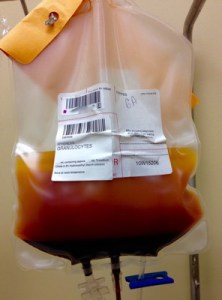
4. Granulocytes look funny, and have unusual storage, matching, and modification requirements. If you have never seen a granulocyte product, you might guess that granulocyte and platelet concentrates look alike, since both cells reside in the “buffy coat” and both are collected in the US primarily by apheresis technology. Your guess would be wrong! Apheresis granulocyte units typically contain between 30 and 50 mL of RBCs, because it is essentially impossible to get a good granulocyte yield without harvesting some RBCs as well (they are immediately adjacent to each other by density separation in the apheresis machine). 30-50 mL sounds like a small amount, but that quantity makes the granulocyte product look almost as “red” as a unit of RBCs! (see images below)
GrannieonhookGranniebag

Notice how the same 30 mL that makes the bottom of the bag look red during collection (on left) makes the whole bag look REALLY red after mixing!

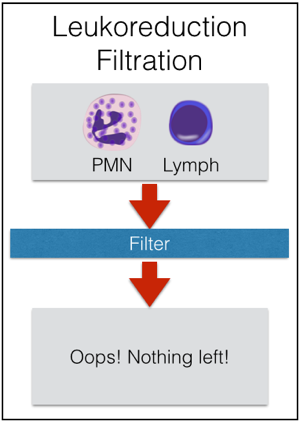
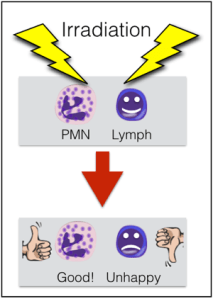
Granulocytes have pretty much the shortest shelf life of any product that we collect directly from donors. They should be transfused “as soon as possible” after collection, but definitely within 24 hours of collection. They are stored at room temperature, like platelets, but they should not be continuously agitated, unlike platelets. This out-of-the-ordinary storage is really another reason that granulocytes are only collected on an “as-needed” basis. Granulocytes are also unusual in that they are almost always issued prior to the availability of the infectious disease screening results! For that reason, essentially all unrelated apheresis granulocyte donors will be recent apheresis platelet donors who have had negative results on a donation within the previous 30 days. We still perform the testing, of course, but the results just aren’t available before the product has to be transfused. Because there are so many RBCs in each granulocyte product, the donor must be ABO compatible with the recipient, and the unit must be crossmatch-compatible with the recipient. By AABB Standards, if more than 2 mL of RBCs are present in any product, those RBCs must be compatible with the recipient’s plasma antibodies. In addition, if the recipient has an unexpected RBC antibody (like anti-D, anti-K, or any others), the granulocyte unit must come from someone who is negative for that antigen, as well. To make matters even more challenging, if the patient has developed anti-HLA antibodies (most commonly in previously pregnant females), then the donor should be HLA matched or at least HLA compatible with the patient’s antibodies. Finally, to complete the weirdness, it is essential to remember which modifications CAN and CAN’T be done to granulocytes. First, granulocytes CAN (and must) be irradiated to prevent Transfusion-associated Graft vs Host Disease (TA-GVHD). This is an extremely fresh product, full of highly active T-lymphocytes in addition to the granulocytes, and the recipient is immunocompromised, by definition. As a result, irradiation is essential to deactivate those donor T-lymphocytes and protect the patient (see image below). Second, granulocytes CAN’T be leukocyte-reduced. Every now and then, people will ask me about leukoreducing granulocytes for prevention of Cytomegalovirus (CMV) transmission. Rather than make fun of them, I usually just sit quietly while they work it out themselves (“OK, let’s see: Granulocytes are WBCs, which some people call ‘leukocytes,’ so if I leukocyte-reduce a unit of a product that is primarily composed of leukocytes, I would be left with…nothing! OHHHH!”). As a result of our inability to make a granulocyte product “CMV-safe” by leukoreduction, CMV-seronegative donors will be recruited to provide products for CMV-seronegative patients whenever possible. Note that it is totally fine to run granulocyte concentrate through a “standard” transfusion filter, just not a leukoreduction or microaggregate filter.
IrradOKNoFilter

Irradiation is not only OK for granulocyte concentrate, it is essential! Leukocyte reduction, on the other hand, makes no sense for granulocytes, and shouldn’t be done.

5. Granulocytes very commonly cause reactions in recipients. Granulocytes are famous for causing transfusion reactions much more often than other components. The two issues that are seen most often are fever and chills (without hemolysis) and pulmonary reactions. I won’t discuss the self-explanatory fever and chills issue, but the pulmonary reactions are worth mentioning here. Considering that current thought suggests that neutrophils are the primary cell involved in the pathogenesis of Transfusion-related Acute Lung Injury (TRALI), it is not surprising that granulocyte transfusions are thought to cause pulmonary compromise quite often (5% in one study). Granulocytes LOVE the lungs, and they localize there very quickly (especially when the infection being treated is pneumonia). So, even if full-blown TRALI does not occur (which certainly CAN happen!), granulocyte transfusions are notorious for at least transient pulmonary compromise. Clinicians should be prepared to manage dypsnea and hypoxia during granulocyte transfusion. Note that the previously suggested “link” between more pulmonary reactions when granulocytes were given with the antifungal Amphotericin B seems to be disproven (though many still advise avoiding transfusing granulocytes within a few hours of administration of that medication). As mentioned in item 4, TA-GVHD is a risk for a fresh product, so irradiation is required. Further, HLA alloummunization can certainly occur as a result of granulocyte transfusion. Final thoughts: There is no question to me that granulocytes CAN, in some circumstances, appear to make a difference for patients. Unfortunately, there’s not a lot of objective proof that they are a predictably helpful treatment. However, given our current ability to collect granulocyte products with substantially higher yields than in years past, I expect that interest in this product will continue despite the lack of “proof” of its effectiveness.

I hope that this quick “5 Things to Know” has been useful for you!

Chaffin

-Joe Chaffin, MD, is the new Vice President and Chief Medical Officer for LifeStream, a Southern California blood center headquartered in San Bernardino, CA. He has a long history of innovative educational efforts and is most widely known as the founder and chief author of “The Blood Bank Guy” website (www.bbguy.org).