Generation Gap from a Resident’s POV

I was talking with my attending and fellow this week and was struck by the generation gap in terms of how we were/are trained. When my attending was in residency, he had to handle over 100+ CP calls in a week – he even keeps one of his call sheets to back up his stories. In some ways, we are spoiled because we can just say that there is an APP to do many of the calculations he had to do then and so we’re not even paged on these types of calls. These days, I may average 10+ CP calls/week at the same institution where he trained at. He also said that they didn’t have PAs back then and it wasn’t unusual to gross until close to midnight…and the grossing resident also covered all frozen sections at the same time, too. His is not the first attending story that I’ve heard like this. Obviously, this was before we had work hour reform. But I wonder what we’ve lost in training since his time?

I’ve often heard residents complain that we have too many service duties and that they feel that service duties supersede our education. Most of the time these complaints revolve around not having enough time to read and too much “scutwork” including grossing routine specimens. I’m no expert by any means but I feel that for me, I’ve learned more when I’ve had to do things as opposed to reading textbooks. And by doing things, I mean performing those duties that are required of my attending as close as possible to the real experience. And yes, that does include lots of reading, not just textbooks but also journal articles and other resources, but is not limited mainly to reading.

Gone are the days where I could skip (or attend) my medical school classes and watch a video of the lecture and read the textbook and do well on exams. The more important difference is that now the consequences of my actions can more directly harm patients so it’s vitally important to gain “attending skills” as well and as soon as I can. And even after graduation, I know that it will still take a few years before I am comfortable in my clinical competency. I know that I’ll be more stressed and OCD about details because it will be my name at the end of the report that is responsible for patient care decisions and also liable for medico-legal action. But I want to be as prepared as possible when that time comes.

Residency is the time when we should transition from passive learning (ie – learning mostly by reading textbooks) to active “on the job” learning. Sure, if no one at your program wants to teach you, then you may be stuck with textbooks and online resources. But I’ll take a bet that even at the most “malignant” programs, there is always at least one golden mentor (including non-attendings) who wants to teach. And remember, that during fellowship, your attendings will expect that you have most of these skills in your portfolio and that you have good time management skills. No one expects that we have knowledge of everything (even our attendings don’t have that), but they will expect that we know how to approach that situation if we find ourselves unsure.

Anyway, that’s not my most important point. I find that complaining just wastes my energy that can be directed to a more useful endeavor. Yes, if I feel something is truly unjust, I will be one of the first to say something. But I realize that the patient is the center of my training and not me, their needs supersede mine, and yes, there will always be scut but it depends on how I approach it what I get out of it. Plus, I realize that compared to other specialties, I didn’t have an intern year and don’t have to do overnights, so I’m thankful that my residency experience is not as bad as it could be.

A generation gap exists where our attendings can’t understand why we complain and where we don’t feel our attendings understand us. But I think that there is a middle ground. I don’t think that we should go back to unregulated work hours where we are dangerously fatigued and never get to see our family and friends. But I also don’t believe that residency training is there to spoon-feed me. It is the time for me to spread my wings (with supervision, of course) and learn how I’d navigate my clinical duties as a future independent attending.

For those going into surgical pathology, you may still end up working at a hospital where you may need to gross or at least, look at specimens or teach how to gross. The end of residency doesn’t necessarily mean the end of grossing (or insert you least favorite aspect of residency here). A friend was telling me that he overheard attendings at a networking reception complaining about a new hire they had who didn’t know how to gross. If that was at a private practice, I would expect that after a short time allowed for remediation, that if that new hire didn’t improve, s/he would be fired. There may be more leniency at an academic or VA institution, but I also believe that if a better replacement could be found, that person would still be fired.

So residency is the time to make sure we gain competency in skills like grossing, lab management, billing, CLIA regulations…even if these are usually the things that we find to be boring. Sign-out is not even half of what will be required of us when we are full-fledged attendings, especially if you want to work in private practice, which is where most of us end up since the compensation is greater.

Getting involved in leadership positions, whether at your hospital, state society, or within a national advocacy organization in my experience opens doors to many practical opportunities as well. For instance, I’ll be going with my hospital’s CAP lab accreditation inspection team this month to help inspect the hematology section of a lab in another state. Because my department chair knows I have an interest in hematopathology and because I performed well on my first CP rotation here, I was given this great opportunity. I’m now certified as a CAP inspector and will have a better idea of lab management issues after this experience. Due to my involvement as the junior member on CAP’s Council on Education, I’ve also been given the opportunity to serve as the ACCME/AMA compliance monitor at a joint CME activity of CAP and a state pathology society in the near future. I see this as active learning and a step toward gaining the competencies that I will need.

Right now, we are buffered from much more than we realize. Probably as a fellow, we will understand the end game better, just how much our attendings’ days are filled with more than just sign-out. I suggest reading the article, “Adequacy of Pathology Resident Training for Employment: A Survey Report from the Future of Pathology Task Group” that outlines specific competencies that employers wanted and that residents did not possess adequate competencies in. It goes on to state that 50% of employers felt that new graduates that they hired needed more support and guidance than was required 10 years ago. So what can we do now during training to ensure that we are not those new graduates who are perceived as needing “more” supervision at our first job?
 

Chung

-Betty Chung, DO, MPH, MA is a third year resident physician at Rutgers – Robert Wood Johnson University Hospital in New Brunswick, NJ.
CDC Update on the Ebola Outbreak

Yesterday Dr. Tom Frieden, Director of the Centers for Disease Control in Atlanta, briefed the media about the current Ebola outbreak in Africa and called for an immediate global response to the outbreak. “There’s nothing mysterious about what we need to do,” says Frieden. “The only real question is whether we’ll do it fast enough.”

Read the full transcript on the CDC website.

Read Maryn McKenna’s astute summary on the Superbug blog.

Laboratory Testing in A High-Containment Facility

The team at Emory that cared for the patients infected with the Ebola Virus have published a paper on Lab Medicine about laboratory testing within a high-containment facility. You can read the entire paper on the Lab Medicine website.

Biobanking and Sample Stability

A common question often asked of laboratory professionals is the length of time an analyte is stable in a sample. This question may arise simply because a sample has been delayed reaching the lab, but can also be asked in the case of adding on a test to an existing sample a day later, or a week later. Most laboratory professionals can tell you the stability of an analyte in a patient sample, at both ambient temperature and refrigerated, because assay manufacturers perform those short term stability studies when they create their tests. And many of them also include the stability of the analyte in a frozen sample. Beyond this information, it’s harder to find stability information for analytes.

Some stability information can be found at large reference labs, as they have often done their own stability studies and may know how stable an analyte is when frozen for a month, or for 6 months. The really difficult information to come by is how stable an analyte is for really long term storage. This is a question that needs to be answered as biobanking becomes increasingly popular.

Biobanking is the use of repositories to store biological samples, usually for use in later research. Biological material can be stored frozen in many forms, including tissue, cell culture, serum and plasma and dried blood spots. Determining how stable an analyte is under long term storage conditions is important in order to be able to use those samples for research in the future. And yet sometimes determining the long term stability is itself difficult. For example, if a person wished to see if albumin was stable frozen at -80 degrees for 25 years, the difficulty would be in having the same assay available 25 years apart to perform both sets of measurements. (Not to mention the personnel). Measurement technologies change over time, some very rapidly, making longitudinal studies difficult.

The design of studies utilizing biobanked samples will be important. Even when not performing longitudinal studies, if a sample has been stored for 10 years frozen in a biorepository and I remove it and measure the calcium, how do I know the calcium present is the amount of calcium that was present when the sample was stored? If I have knowledge of the patient the sample came from, I could use this data to say that in stored samples, patients with X disease have higher calcium than patients without disease, but I could not necessarily make the jump to what is true in vivo, without knowing how stable calcium is upon long term storage.

Often stored samples are used for measuring analytes that weren’t able to be measured when the samples were originally stored. In those cases, you may be able to infer stability if the amount of analyte measured in the stored samples is comparable to the amount measured in fresh samples.

Biobanking is a growing enterprise, and stability studies will need to grow along with it.


???????????????????????????????????????????????????????????????????????????????????

-Patti Jones PhD, DABCC, FACB, is the Clinical Director of the Chemistry and Metabolic Disease Laboratories at Children’s Medical Center in Dallas, TX and a Professor of Pathology at University of Texas Southwestern Medical Center in Dallas.

CDC Recommendations for Laboratory Detection of STDs

Several months ago the CDC updated their recommendations for laboratory detection of Chlamydia trachomatis and Neisseria gonorrhoeae.

A summary:

Chlamydia trachomatis

  • Swabs must have a plastic or wire shaft and a rayon, Dacron, or cytobrush tip.
  • Swabs must be inserted 2-3 cm into the male urethral or 1-3 cm into the endocervical canal followed by 2-3 rotations
  • Specimens should be sent to the laboratory 1) within 24 hours of collection, 2) in sucrose phosphate glutamate buffer or M4 media, and 3) at less than or equal to 4 degrees C

Neisseria gonorrhoeae

  • Gram stain of male urethral specimen that contains PMS and intracellular Gram-negative diplococcic is considered diagnostic
  • A negative Gram stain result does NOT rule out infection
  • Swabs must have a plastic or wire shaft and a rayon, Dacron, or cytobrush tip.
  • Swabs must be inserted 2-3 cm into the male urethral or 1-3 cm into the endocervical canal followed by 2-3 rotations
  • For specimen transport, culture transport systems are preferred over swab transport systems
  • Specimens should be plated and incubated in an increased CO2 environment as soon as possible
  • Culture media should include selective (such as Thayer-Martin or Martin-Lewis) and nonselective (such as chocolate) agar
  • Oxidase-positive, Gram-negative diplococcic that grow on selective media can be presumptively identified as N. gonorrhoeae

Nucleic acid amplification tests (NAATs) are superior when compared to other culture and nonculture diagnostic methods for both organisms. However, it’s important that lab professionals understand the limitations of these tests.

Microbiologists should take the time to read the report here.


Swails

Kelly Swails, MT(ASCP), is a laboratory professional, recovering microbiologist, and web editor for Lab Medicine.

Radiologic and Pathologic Correlations

So last night I stayed later than usual after work to prepare for an interdepartmental conference that I will be giving next Friday before I fly out that night to attend the CAP Residents Forum and Annual Meeting. A radiology resident and I will be presenting two cases together to correlate their radiology and pathology, two specialties that have much in common, at least on the surface.

Both radiologists and pathologists, at least pre-ACA era and except for subspecializations like interventional radiology and transfusion medicine, do not often interact with patients directly. Therefore, both fields rely heavily on clinical observations and notes written by the primary care doctors caring for “their” patients. Both also require a broad knowledge of disease differentials, and frequently, understanding the prognostic and treatment considerations of the disorder under examination even though they are not involved in direct care of the patient. Additionally, both fields require good communication with primary care physicians.

Senior radiology residents attend a month-long course correlating radiology with the corresponding pathophysiology of diseases at the Armed Forces Institute of Pathology (AFIP) now known as the American Institute for Radiologic Pathology (AIRP). I remember during medical school trying to set up an elective at what was then called AFIP but was not able to since it is only open to radiology residents.

At both my previous and current institution, the “rads-path conference” as it is affectionately called, is informal and driven by the radiology department in terms of case choices. It’s meant to be a learning experience but generally the only pathology residents who attend are the one(s) presenting while all the radiology residents available have to attend. Seems somewhat ironic that the learning is mostly one-sided, and it’s bad that our two departments don’t do this more as a true inter-departmental conference.

Pathology and radiology are two fields that also often get left out when publications are written even though our final diagnoses, and sometimes, even images are used within publication submissions. As residents in these fields, we should make an active effort to interact with our primary care counterparts frequently. We should do this not only to be included in such scholarly endeavors but also to show that we are also equal members of the patient care team and are not forgotten when treatment discussions take place.

It also happens with tumor boards as well that most of the choice of cases and topics for discussion come from the non-pathology department. So what are your opinions on how we should interact with other departments for patient care discussions and inter-departmental conferences?


Chung

-Betty Chung, DO, MPH, MA is a third year resident physician at Rutgers – Robert Wood Johnson University Hospital in New Brunswick, NJ.
If Suitcases Could Talk

I know this is a “lab blog” not a “travel log” but after the long and arduous global outreach visit to Tajikistan, I simply can’t resist.

My last blog introduced our Tajikistan colleagues and the challenges they face with pre-analytical processes and our experiences and time with them. It’s for all those reasons the ASCP Global Outreach Volunteer Consultants endure the not-so-fun rigors of travel, experience countless hours of joy in airline terminals, work/eat/sleep at odd hours because we don’t know what time zone we’re in, and throw our shoulders out carrying our carry-on luggage…because if you don’t, it will definitely get lost. I’m living proof that it can happen even if you ARE carrying it on.

Our complicated itinerary for return flights from Dushanbe to the USA gave me indigestion and guaranteed luggage challenges. However, even my compact and well-packed little rogue suitcase was over full with paperwork and reports that needed returned after our workshops, making it way too full and way too heavy to carry-on back home. I had four plane changes ahead of me and 36 hours of travel, including having to stay overnight in Istanbul. With very little confidence I checked the bag with the Russian-speaking airline agent, who told me to pick it up in Moscow and re-check to Istanbul. At least I thought that’s what she told me. In Moscow (why we were flying to Moscow to get to Istanbul to get to Chicago still puzzles me…) they pulled both Dave and me out of passport control lines, gave us armed escort across the tarmac to another terminal, and with gestures and points told us to re-check into airline transfer. In my mind’s eye, I thought I remembered seeing my name/contact info stripped off the handle when they threw it on the loading belt—well you guessed it, my little rogue suitcase was in for another adventure.

If the suitcase could talk, it might tell us about the intricacies of airline baggage handling, the rough and ready haulers who toss it like a marshmallow into huge cargo holds, the pounding and radiation it gets inside the security checks. I’d also like to think it would tell us about the people it sees, the faces that are going about their business, smiling and frowning, complaining and cajoling, living in the proximity of global travel. I’d like to think it would tell us to watch and listen and experience and absorb the adventures we are privileged to be part of. I’d like to think it would tell us to pack light, stay fit and travel well. I’d like to think it has seen the world from the belly and not the shoulders…and from that point of view, there surely is much to learn and understand about the people I meet and the places I visit. If my little rogue suitcase could talk, I think it might have interesting global wisdom to share.

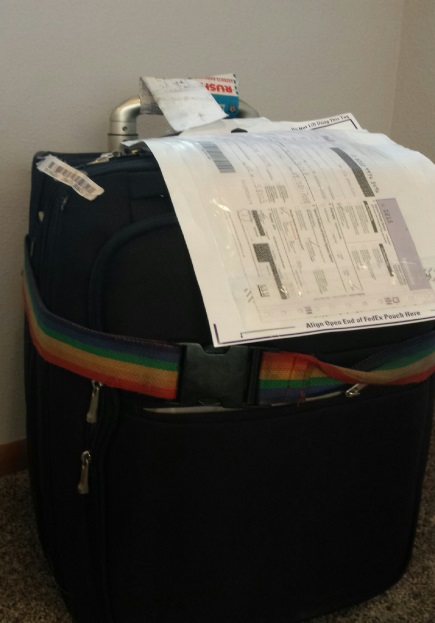
Late last evening, 10 days after landing in my hometown airport, my rogue suitcase showed up unannounced and unceremoniously on my front porch. It had several numbers and bar codes attached in various places, most of them torn and damaged beyond bar-code-reader recognition, from places like VNO and IST and ORD and a couple I didn’t recognize. Nothing short of amazing, it made its way home once again, traveling around the globe with a mind of its own. I stand in awe and offer my thanks and appreciation to all those involved in tracking and re-directing it back home.

luggage

As I close this little travel story, I also think of the global outreach colleagues I work and travel with and our vision and mission to improve and strengthen laboratories around the world. We’ve all lost luggage, missed flights, traveled complicated itineraries, and used a lot of “air time” trying to keep up with our families and friends. But in the end, if our suitcases could talk, they might agree that it’s all worth it.

And…I hope your travels are always safe, on time, uneventful and that you never lose your luggage!


???????????????????????????????

Beverly Sumwalt, MA, DLM, CLS, MT(ASCP) is an ASCP Global Outreach Volunteer Consultant.

Cryptococcus gattii and Trees

Today I stumbled across this story on NPR about the source of Cryptococcus gattii (formerly Cryptococcus neoformans var gattii) infections in California. The short answer: trees. What’s notable about this discovery? A high-school student (Elan Filler) is a co-author of the paper.

You can read the paper in PLOS Pathogens.

You can read about this organism, diagnostic testing, and treatment on the CDC website.


Swails

Kelly Swails, MT(ASCP), is a laboratory professional, recovering microbiologist, and web editor for Lab Medicine.

CLSI Releases New Microbiology Standard for Detection of Anaerobes

Anyone who has worked in Microbiology for any length of time knows that anaerobes are finicky at best and impossible to identify at worst. Having guidelines for their identification would be helpful. Enter CLSI.

From their press release:

“The Clinical and Laboratory Standards Institute (CLSI) released a new microbiology standard, Principles and Procedures for Detection of Anaerobes in Clinical Specimens; Approved Guideline (M56-A). This document presents standardized, cost-effective, and efficient best practice processes for anaerobe bacteriology to assist clinical laboratories in selecting those methods that lead to improved patient care.”


The Importance of Supportive Mentorship and “Junior Attending” Experiences

Over the last few weeks I have spent more time revising my fellowship application personal statements than I would like. While my attendings have been a great source of feedback, it’s hard to know what fellowship directors would like to see highlighted. But going through this process, I have realized even more palpably than I had previously thought before, that two things have been important in bringing me to this point: supportive mentorship and “junior attending” experiences.

Let’s start with supportive mentorship and the definition of mentor. The word Mentōr derives from the Greek name of the friend of Odysseus and advisor to his son, Telemachus, in Homer’s Odyssey. Therefore, first and foremost, a mentor is an advisor: someone who is more expert and who guides you. But what I’ve found is that a professional mentor is more than a mere advisor.

I have been extremely blessed and grateful when it comes to my mentors. Not only do they advise me but they also think of me when opportunities arise such as a possible research project or publication or to be a member of their CAP lab accreditation team that inspects another institution’s lab. Besides building up my CV, these activities also help me to acquire skills that I will need in my future professional capacity. I at first didn’t necessarily think of including some of these experiences on my CV but after a talk with a fellowship director, realized that these are the types of experiences that they would like to know about – if I’ve had previous experience where I gained a skill, then they feel I will be faster to train in terms of skills that build on that initial skill.

This brings me to my second point: the importance of “junior attending” experiences. What I mean by this term is the opportunity to participate in patient care or directorship duties in as close to a capacity as your attending would have. This could mean initial sign-out without direct supervision (of course, attending review has to occur prior to true verification) in terms of patient cases, whether it be AP or CP cases, or the initial preview of a frozen section. In terms of lab management, this could mean participating in preparation for a CAP inspection or serving on a CAP inspection team that goes to another institution. And in terms of most CP rotations, serving as the primary consultant for primary physicians about lab tests and discussing evidence-based and cost-effective ordering of appropriate tests or developing, troubleshooting, or validating a new assay.

Whatever the attending does in the course of their daily workload is where we should focus on acquiring skills. While writing my personal statement and CV, I talked with fellowship directors, and this became clearer to me. It’s all about having the proper attitude. Yes, there can be a lot of “scut” during our training but in comparison to other specialties (and those who have to do an intern year), we are fortunate to have less of it. Either way, the work has to get done, “scut” or not, so might as well learn from it and you might be surprised how it helps you later. Our attendings are not free from “scut” in their daily work either. If we think of the “scut” as attached to a patient who is waiting for their diagnosis, it makes the work go easier and faster in my opinion.

Having a positive attitude, working hard, and becoming known for certain qualities and skills only help in terms of developing strong relationships with mentors (who will one day be your colleagues) and being given those “junior attending” opportunities. Strive to be the first person they think of in those situations. Remember we are no longer in school and the faster you acquire the characteristics, knowledge, and skills of an attending, the better off you will be when it comes to progressing to the next phase.


Chung

-Betty Chung, DO, MPH, MA is a third year resident physician at Rutgers – Robert Wood Johnson University Hospital in New Brunswick, NJ.