
Changing the Way We Talk about Domestic Violence

Language can have an indirect but profound impact on perception. The words we use to describe events can change how the act is interpreted, either consciously or subconsciously.

With that in mind, the way professionals and media speak about domestic violence (DV) often leaves much to be desired. Predictably, assaults and murders are described as “incidents” or “episodes”. This gentle substitution is a way to sanitize the physical and emotional trauma for a general audience. It is so commonly used that many professionals implicitly recognize ‘incident’ and ‘situation’ as a code for ‘abuse’. Yet these seemingly innocuous terms of convenience diminish the significance of the event. An “incident” is something small; a fender bender, or two people arguing in the security line at an airport. Tensions are raised but nobody is hurt, and things are soon back to normal. To label something an incident suggests it is of minimal importance to the general population. But when speaking about DV, this isn’t true. Unfortunately, the scope of the problem is incredibly wide. One study from the U.S. indicated 35.6% of women and 28.5% of men will be victims of DV in their lifetime (1). So even if you have not personally experienced it, you absolutely know someone who has (whether you know it or not). Every time someone is injured or murdered in a domestic violence “incident”, the entire community bears the loss – whether it is the loss of a friend, a parent, a co-worker, or all three.

In one relatively recent example, the District Attorney of Norfolk, Massachusetts described a double murder followed by suicide as a ‘domestic violence situation’ and a ‘domestic incident’. He stated it was ‘confined’ in the typically ‘nice neighborhood…safe community’. This ignores the obvious contradiction – safe community for most might be a better statement. But perhaps the most glaring mischaracterization is calling a crime of this nature ‘confined’. The intent is easy to interpret – there is no immediate threat to the safety of other residents – and that is an important piece of information. But to treat an act of violence so dismissively in a press conference is dishonest and diminishes the repercussions for the family, friends, and community of the victims. The effects reverberate through surviving family and friends in the community. There is nothing ‘confined’ about the effect of homicidal violence on a community. To speak about it that way treats the victims as though they were property of the perpetrator.

Relegating homicide to the category of ‘incident’ also dampens the emotional response to the loss. To place this in perspective, we would never describe the natural death of an elderly individual as a ‘cardiac incident’, or a fatal car crash as a ‘motor vehicle incident’. By allowing this compartmentalization, there is less public urgency to investigate the root causes and implement prevention efforts.

There are multiple tiers of responsibility. Media cannot do a better job reporting on these crimes if the professionals who autopsy, prosecute, and investigate cannot improve the language used. As one of the professionals who has used the term ‘incident’, I’m also trying to do better.

If you or someone you know is affected by domestic violence, please contact the National Domestic Violence Hotline at www.thehotline.org, or 1-800-799-SAFE.

References:

  1. Black, M.C., Basile, K.C., Breiding, M.J., Smith, S.G., Walters, M.L., Merrick, M.T., Chen, J., & Stevens, M.R. (2011). The National Intimate Partner and Sexual Violence Survey (NISVS): 2010 Summary Report. Atlanta, GA: National Center for Injury Prevention and Control, Centers for Disease Control and Prevention.

-Alison Krywanczyk, MD, FASCP, is currently a Deputy Medical Examiner at the Cuyahoga County Medical Examiner’s Office.
Crisis Management: Dealing with Blood Culture Bottle Supply Shortage, To Bottle or not to bottle?

In June 2024, BD (Becton Dickinson) notified their customers that there will be a global shortage of BACTEC blood culture bottles which is anticipated to last several months. Blood culture bottles are critical for diagnosing infections in patients, and their scarcity could lead to delays in diagnosis and challenges in managing patient care, especially for those with serious systemic infections. During supply shortages, it is paramount that management relies heavily on careful inventory oversight, and prudent use and stewardship of available reagents. Here we will summarize key measures recommended to ensure continuity of care. However, it must be emphasized that there is no ‘one size fits all’ approach and each institution need to consider what works best for their patients and workflow. It is a team effort-laboratorians must work collaboratively with infectious disease providers, hospital leadership, supply management teams and other stakeholders to implement and manage efforts without duplication of efforts.

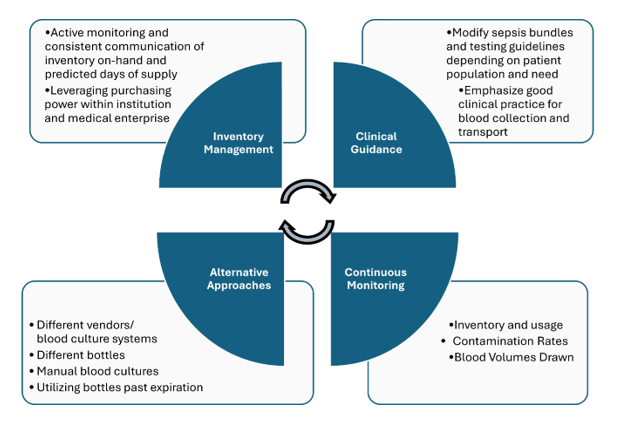
Figure 1. Summary of key measures used in dealing with blood culture bottle supply shortage
  • Inventory Management:
    • There needs to be continuous monitoring and communication among all stakeholders regarding inventory and usage. It is imperative that hospital leadership are aware of the current inventory on-hand and the predicted days of supply.
    • If the hospital is within a medical center, consider centralizing supplies and reallocating to those in dire need. If your institution is part of a larger system or corporation, consider leveraging system’s purchasing power vs. a single institution purchasing power to ensure availability of the blood culture bottles.
  • Clinical guidance:
    • In many institutions, laboratory and infectious disease teams, in collaboration with the clinical partners, developed sepsis bundles, in which blood cultures and lactic acid testing are the corner stones of the bundle. Most of the time, such bundles are built around the CMS guidelines, as part of the overarching Medicare’s Hospital Value-Based Purchasing Program (VBP). Such bundles are great tools to promote the best standard of care practices, as well as serving as a standard communication tool. Most organizations institute two separate types of sepsis bundles: the severe sepsis bundle and the sepsis shock bundle. With time, we need to consistently leverage quality and patient safety approaches, as well as regulatory standards to ensure the most optimal test utilization overall, especially during the times of shortages. Implementation of organization testing guidelines in the bundles promotes standardization and compliance.
    • Before ordering any tests for infectious diseases, it is crucial to carefully evaluate the pre-test probability of bacteremia and the likelihood of identifying a clinically significant organism.  Repeating blood cultures within 48 hours of the initial set typically yields low results. Blood cultures should be collected before initiation of antimicrobial therapy. Indications for blood culture draws may vary depending on the patient population (e.g. adults versus pediatrics, immunocompetent versus neutropenic, inpatients versus from the emergency department) [1, 2]. For certain patient populations, consider performing only two blood cultures (1 set) vs. widely accepted and recommended four blood cultures (2 sets). While this is beyond the scope of this blog post, please refer to the sources below for specific clinical guidance.
    • Due to the typically low levels of bacteria present in the bloodstream, collecting a larger volume of blood increases the chances of obtaining a positive culture. To maximize the likelihood of detecting bacteria, blood culture bottles should be filled with the optimal volume recommended by the manufacturer, typically 8-10 mLs up to the fill line, and be sent to the microbiology laboratory in the timely manner. Reducing contamination in blood cultures decreases the need for additional resources, such as repeat blood cultures, unnecessary antibiotic treatments, and further diagnostic tests. Contamination can be minimized by strictly adhering to antiseptic procedures at collection sites, ensuring proper training for collectors. It is also crucial to remind healthcare providers and clinical staff to follow institutional guidelines for proper specimen labeling, maintaining specimen stability, and adhering to transport instructions to reduce the risk of sample rejection and prevent unnecessary waste of supplies [3].
  • Thinking outside the box:
    • Despite the shortage, patient care continues, and laboratories may need to think of alternative approaches. As of writing this post, other blood culture systems and their respective bottles are not affected. That said, implementing new instruments and switching to an alternative supply chain from a different manufacturer may be an option but often can take up to several months due to contractual requirements. Additionally, massive re-education and training (laboratory staff, phlebotomy, and nursing) will need to take place as different systems have unique collection procedures. Some institutions may opt to send out their blood cultures to reference laboratories that use an alternative system, although turnaround time may be an issue. Manual blood cultures, although laborious, could be set up and be done in-house. While it is not recommended to use expired blood culture bottles, recent published studies have shown that expired bottles up to 3 months are just as effective [4, 5]; institutions should maintain expired bottles if regulatory bodies allow for their utility at an later date as BD have extended the expiration date for certain lots already (see BD manufacturer webpage below). BD has recently announced the re-introduction of anaerobic media in glass bottles. Laboratories should prepare staff and develop plans for validation work to ensure that these bottles can be rapidly implemented for usage.
  • Continuous monitoring:
    • Aside from monitoring inventory and bottle usage, it is important for laboratories to regularly monitor contamination rates and implement a quality system that tracks blood culture volumes. To allow for targeted and more efficient education, monitoring trends stratified by different departments can help offer specific feedback to the clinical partners collecting the samples.
    • As we implement additional testing methodologies, remember to continuously revise your Clinical Practice Guidelines (CPGs), order sets, test utilization, etc. as part of such implementations.

A lesson learned from the COVID-19 pandemic is the need to be agile and quickly adapt to the changes in supply chain. For many laboratories, this was an effective strategy to ensure testing availability for all patient populations. Although this blood culture bottle shortage is a crisis many are facing, implementing diagnostic stewardship for blood culture collection may have overall benefits such as decreasing the amount of unnecessary testing, treatment of clinically insignificant infections, unnecessary blood draws, and potential central line-associated bloodstream infections.

Here are external resources/references available to help laboratories and healthcare providers: 

  • Manufacturer’s web page: https://bdbactec-update.com/
  • American Society for Microbiology (ASM) guideline, endorsed by the Society for Healthcare Epidemiology of America (SHEA): https://asm.org/guideline/blood-culture-shortages-management-diagnostic-stew
  • Informational web page from the Infectious Disease Society of America (IDSA): https://www.idsociety.org/clinical-practice/blood-culture-bottle-shortage/

References

1.         Fabre, V., K.C. Carroll, and S.E. Cosgrove, Blood Culture Utilization in the Hospital Setting: a Call for Diagnostic Stewardship. J Clin Microbiol, 2022. 60(3): p. e0100521.

2.         Fabre, V., et al., Principles of diagnostic stewardship: A practical guide from the Society for Healthcare Epidemiology of America Diagnostic Stewardship Task Force. Infect Control Hosp Epidemiol, 2023. 44(2): p. 178-185.

3.         Clinical and Laboratory Standards Institute,  Principles and Procedures for Blood Cultures, CLSI guideline M47. 2nd Edition. 2022.

4.         Hardy, L., et al., Blood culture bottles remain efficient months after their expiration date: implications for low- and middle-income countries. Clin Microbiol Infect, 2024. 30(10): p. 1327-1328.

5.         Klontz, E.H., et al., Evaluation of expired BD BACTEC blood culture vials. J Clin Microbiol, 2024: p. e0108224.

-Rebecca Yee, PhD, D(ABMM), M(ASCP)CM is the Chief of Microbiology, Director of Clinical Microbiology and Molecular Microbiology Laboratory at the George Washington University Hospital. Her interests include bacteriology, antimicrobial resistance, and development of infectious disease diagnostics.

-Olga Kochar, MS, CSSGB, is the Divisional Director of Laboratory and Transfusion Services with the GW Hospital, as well as faculty with the GWU School of Medicine and Health Sciences. With over 29 years in the healthcare industry, Olga Kochar is passionate about quality and patient safety, performance improvement and teaching.

A Time for Disinfection

We do it several times a day, every day we work in the laboratory. We disinfect, but how much do we really think about what we are doing? Some may think we disinfect our benches at the end of the shift because it is expected, and that we only perform this task because it is listed on our maintenance log. Others disinfect at the beginning and at the end of their shift because of how they were trained. Since the pandemic, I bet many lab techs, nurses, and hospital staff disinfect religiously out of fear of catching COVID. The real reason we disinfect is to keep ourselves, our coworkers, and the people we care about safe.

As laboratorians, we have practices to preemptively and proactively ensure that the samples and patients we work with do not put us in harm’s way. We clean and disinfect anytime we have a spill of patient specimen. With that spill we know there is a potential for exposure, and we take steps to remove the threat. We also routinely disinfect our work areas throughout the day to eradicate any unseen pathogens. It is easy to visually spot a spill of whole blood, but a few drops of serum or plasma can easily go undetected.

To keep everyone safe, we need to fully comprehend the difference between “cleaning” and “disinfection.” Cleaning is the act of removing the physical component of a spill, sample, or mess. This could be dirt, dust, blood, body fluid, or even a piece of tissue. If there is a spill of blood on the floor, we first clean up the spill by applying an absorbent and sweeping up the material. We can see that the blood is removed from the floor, but what we cannot see poses the most danger. Simply cleaning up a spill does not kill any potential pathogens. We still have one more step, disinfection.

Disinfection is the process of killing the pathogens and it must take place after cleaning. Only after we disinfect is the area considered safe. It takes both the cleaning and disinfection steps to make sure the spill is properly handled. Spraying bleach directly on a blood spill and wiping with a paper towel may leave pathogens under the spill lurking on the surface of the floor or counter. For disinfection to be the most effective, it is essential to expose the potential pathogens to the disinfectant, and cleaning helps remove any barriers.

We have the why behind the process, so let’s discuss how we disinfect. Our best defense against most pathogens is bleach. Ah, the glorious smell of bleach; either you love it or hate it. Bleach is one of the few products that can effectively neutralize Clostridium difficile. That is why bleach is used for benchtop and post-spill disinfection. In the lab setting, we typically see two types of bleach products, a spray and wipes. Each has their own minimal contact time, so make sure to leave the product on the area for the allotted amount of time. Bleach wipes typically require a longer contact time than bleach spray. It is also important to make sure the lids on any disinfectant wipe container remain closed when not in use. If the lids are left open, the wipes can dry out, making them a less effective disinfectant.

Some labs may allow for a bleach alternative when employees with a bleach allergy are present in the lab. Individuals with a documented bleach allergy may be permitted to use alternatives such as a concentrated broad-spectrum quaternary agent as a means for disinfecting. Usually, approval must come from an organization’s employee health or physician to accommodate the request. As with bleach wipes, quaternary disinfectants may require a longer contact time than your usual bleach spray.

You may see products from other manufacturers that use alcohol with an ammonium chloride ingredient. Many labs use these types of disinfectants in areas to eliminate the residue seen when using a bleach product, such as cleaning stainless steel biological or chemical safety hoods, glass, or other office appliances. Often, alcohol or ammonium chloride disinfectants are used on telephone headsets, computer screens, select Point of Care instruments, and other items for which bleach is prohibited. In addition, some instrument manufacturers recommend only using a particular product to clean the surface of their equipment to ensure the cleaning does not damage the outer casing or internal components. Sometimes, though, staff will accidentally substitute these types of products in place of bleach when it is time to disinfect at the end of the shift or help with a spill. It may be convenient to just grab a bottle of an alcohol-based disinfectant and jump into action. However, it is more important not to take short cuts and locate a bottle of bleach spray and disinfect the proper way. Sometimes it may seem like a hassle, but disinfection is part of our laboratory culture, and we need to keep up with the practice. If we maintain our disinfection routines, there is no reason to doubt our safety inside and outside of the lab. You can take it a step further and always be on the lookout for expired products or open lids to ensure your products can do their jobs effectively. Understanding why we perform these tasks and the importance they have for our safety is something that should be shared with all employees. Together, with the right mindset, you can be confident that your lab is a safe, clean, and properly disinfected lab.

-Jason P. Nagy, PhD, MLS(ASCP)CM is a Lab Safety Coordinator for Sentara Healthcare, a hospital system with laboratories throughout Virginia and North Carolina. He is an experienced Technical Specialist with a background in biotechnology, molecular biology, clinical labs, and most recently, a focus in laboratory safety.