
Letting Safety Slip

On a recent trip to my parents’ house for Thanksgiving, the second-row seat in my wife’s crossover vehicle broke. My wife and I, along with our two daughters were excited to set out for a long holiday weekend, the first in many years. We took that vehicle with three rows of seating so that when we visited my folks, everyone can fit in one car. While on vacation, we returned from a park, and my father exited the second row, followed by my daughter. The lever was flipped in order to fold the seat forward.  When the lever was activated again to fold the seat back into its normal position, I noticed the pop-up indicator on the seat did not retract (the indicator lets you know when the seat is locked into place and safe for passengers). After tinkering with the lever, I discovered that the bottom right side of the seat was not locking completely into the floorboard. I immediately thought about the trip home. Our oldest child gets car sick when she rides in the last row, and our youngest’s car seat occupies the other second row seat. Should I take the risk and let my child ride in the semi-broken seat? After all, three out of the four sides were locked in place, and she would only be in danger if we got into an accident. I just had to make sure we drove extra carefully, and nothing would go wrong. The alternative was dealing with a carsick child- a very unpleasant option.

 I share this story because I have seen lab staff having to make similar decisions and potentially compromising their safety. I wonder how many of you reading this blog have one piece of broken equipment in your lab that you continue to use. Maybe it is not all the way broken. Perhaps it is just a centrifuge with a broken latch or lock. It might be a drawer with a missing handle, and the drawer falls off the track when you open it all the way. There are worse scenarios. Right now there is someone working in a lab where the biological safety cabinet sash doesn’t go down all the way, and all the chairs have at least one rip in the leather. I know lab chairs are not cheap, and the company that comes out to fit the BSC costs a pretty penny, but how much do you think do you think it would cost if something catastrophic occurred because these issues were not addressed?

Sometimes we don’t think too much about broken equipment until something bad happens. Why would someone continue to use a broken centrifuge? Would you get on a rollercoaster if it were broken? Would you put your child in a seat that was not fully locked into place? I hope not. I sometimes hear managers say they are looking into fixing the issue, or they are waiting to get a quote, but they are still using the broken equipment. We should never be complacent when it comes to safety. Accidents will happen, fires will occur, and people will get injured while working in the lab. We put safeguards in place to reduce these occurrences, but when we choose to work with broken equipment, we negate all of those efforts. If you notice a piece of broken equipment, you need to take it out of service immediately and let your supervisor or manager know. Managers may not be aware of everything that happens in the department, and they depend upon staff to keep them in the loop when equipment gets damaged. Do not encourage working in an unsafe environment.

We made the executive decision to let our daughter ride in the far back row on the trip home. It was raining and we knew there would be a great deal of traffic. My child’s life was on the line, so of course I chose to do the right and safe thing. Did we have to make a few extra stops? We sure did, about three extra stops were included because she felt nauseated.  We were actually about 15 minutes from home before she got sick. I knew it would happen; it was just a matter of time. I didn’t mind this time because it beat the alternative of having something happen to her if we were involved in an accident. In life we have to assume the worst will happen so we can make decisions that protect those we care about. It made the trip a little longer, a little messier, but for safety’s sake we have to be willing to take the long road, work a little harder, and maybe even be inconvenienced at times. Lab life isn’t always easy either, but it is worth the effort to protect those in our department. We should always take on the work to make sure the patients, our coworkers, ourselves, and even our loved ones are always as safe as possible.

-Jason P. Nagy, PhD, MLS(ASCP)CM is a Lab Safety Coordinator for Sentara Healthcare, a hospital system with laboratories throughout Virginia and North Carolina. He is an experienced Technical Specialist with a background in biotechnology, molecular biology, clinical labs, and most recently, a focus in laboratory safety.

Three Safety Cultures Questions to ask Yourself, Your Staff and Your Leaders

Whether you are a newly graduated scientist or a seasoned individual starting at your fifth lab in your career, you might be surprised by the safety culture at the new facility. You could be so impressed by the safety culture at your new laboratory that you question how no one was seriously hurt at your former one. Or you could walk into the lab on your first day and immediately get a bad feeling in your gut. No matter how you feel on day one, two, or maybe day 32, just know that there are some things you can do to help understand your new perception of the culture. Any great piece of research starts with a question or two. Let’s examine some queries that can help you wrap your head around why some labs win, and others fall short when it comes to their safety culture.

First, let’s start with the why. When the safety culture does not look good, it is easy to assume that the deviant behaviors you witness are simply people taking advantage of the system. But not all bad behaviors are spawned from a desire to do harm. You need to find out what is influencing their unsafe behaviors. Most of the time, subpar safety behavior stems from a lack of understanding the consequences of unsafe actions. For example, some folks may not realize that handling their cell phone with gloved hands in the lab has the potential to transfer pathogens into the breakroom when they place that same phone on the table when they are eating their lunch. When the timing is right, you should have a conversation with the employee about what you saw and inquire if they are aware of the potential safety risks. You never know, you could discover that it was a topic skipped in safety training and you single-handedly just improved the quality of your safety training program!

The next question you should ask yourself is, are laboratory leadership aware of the safety issues present in their lab(s)? In most labs, the managers are often overburdened, spending most of their time chasing a schedule, trying to fill open positions, or putting out fires (figuratively we hope). Therefore, you should not assume that leadership is aware and allow unsafe practices to occur in the lab. Sometimes managers and supervisors are so hyper-focused on one thing, they might not be able to see a safety issue right in front of them. If you see unsafe habits, bring it up to lab leadership and share with them that your intentions are to avoid a potential harmful event from occurring. In some cases, managers are already aware of the situation and are trying to come up with solutions. Your conversation with them and perspectives about the safety concerns might be the missing piece that helps complete the puzzle they are trying to solve. So, you should feel comfortable bringing your concerns and be prepared to come with solutions to any problems you present to them.

Finally, ask yourself if the safety issues you see are isolated to a particular shift or certain individuals. Although it is the responsibility of laboratory leadership to champion the safety culture, it is up to the staff to feed and nurture its existence. When everyone works together, it is reflected positively in the safety culture, the audit results, and the injury and exposure reports. When gaps are present, there will be an increase in the negative indicators until the issues are identified and resolved. Instead of making assumptions about the safety culture of the entire lab, try to see where the gaps exist and then revisit the first question- why? It is a lot easier to coach a single individual that wears earbuds in the lab than the entire night shift crew that refuses to wear a lab coat until 5 minutes before the day shift supervisor appears. If that single person is the root of your safety concerns, don’t let their behavior go unchecked. As with negative attitudes in the department, poor safety habits can spread like wildfire. If a single individual’s behavior is not addressed, then others will soon follow suit. They will see that there are no repercussions to lax safety behaviors or worse, they will think nothing bad can come of cutting safety corners. Laboratory leaders and coworkers that normalize poor safety habits are only making the situation worse and damaging the safety culture of the lab while putting the entire staff at risk.

You should never assume a safety culture persists on its own. A good or bad safety culture is the sum of many different factors, and the reason behind the factors can be vast. So, before you are ready to write off a lab as unsafe, take the time to dig a bit deeper and find out what contributed to making the safety culture what it is today. If the lab has a great safety culture, find out why. The lab you are in today may not be the place at which you retire. Your path might lead to a different workplace that has an even worse safety culture than the one you left behind. By asking questions about what creates a great safety culture, you become equipped with the right tools and knowledge and will then be in a strong position to use what you know to improve the lives of others in your new lab.

-Jason P. Nagy, PhD, MLS(ASCP)CM is a Lab Safety Coordinator for Sentara Healthcare, a hospital system with laboratories throughout Virginia and North Carolina. He is an experienced Technical Specialist with a background in biotechnology, molecular biology, clinical labs, and most recently, a focus in laboratory safety.

As Laboratory Professionals, Are We Immune from Microaggressions?

Microaggression is a term first coined by Dr. Chester Pierce, a Harvard psychiatrist, in 1970, where he described the lived experiences of an African American man navigating in white predominant spaces. It took 37 years for the term microaggression to come into mainstream acceptance when it was re-introduced by Dr.  Derald Sue in 2007, where he expanded the definition to include general disrespect, devaluation, and the exclusion of minorities.

I still remember my first frozen on-call as a PGY-1 AP/CP resident; I came to work at 6am to prep the gross lab. I was told to fill the big formalin container for the day ahead, log all the refrigerated patient specimens from overnight surgeries, ink to orient and then cut the specimens so they can be fixed. Then finally when I moved to change the water in the stain line, suddenly the tech walked in and asked, “Are you Muslim?” I paused and froze for a moment, didn’t have any words to answer his question. Then I said, “No!”, and he walked away. This incident set me back the whole day, because I was replaying it in my mind again and again, to see why he had asked this specific question to me. Maybe I should have answered differently. I didn’t know of the term, “microaggression” back in 2009.

Now I am equipped with this term and training my colleagues to respond in real-time to these types of instances, I wonder how empowered I would have been if I knew about microaggressions from med school/residency training. I would have been more confident in my interactions, rather than walking on eggshells.

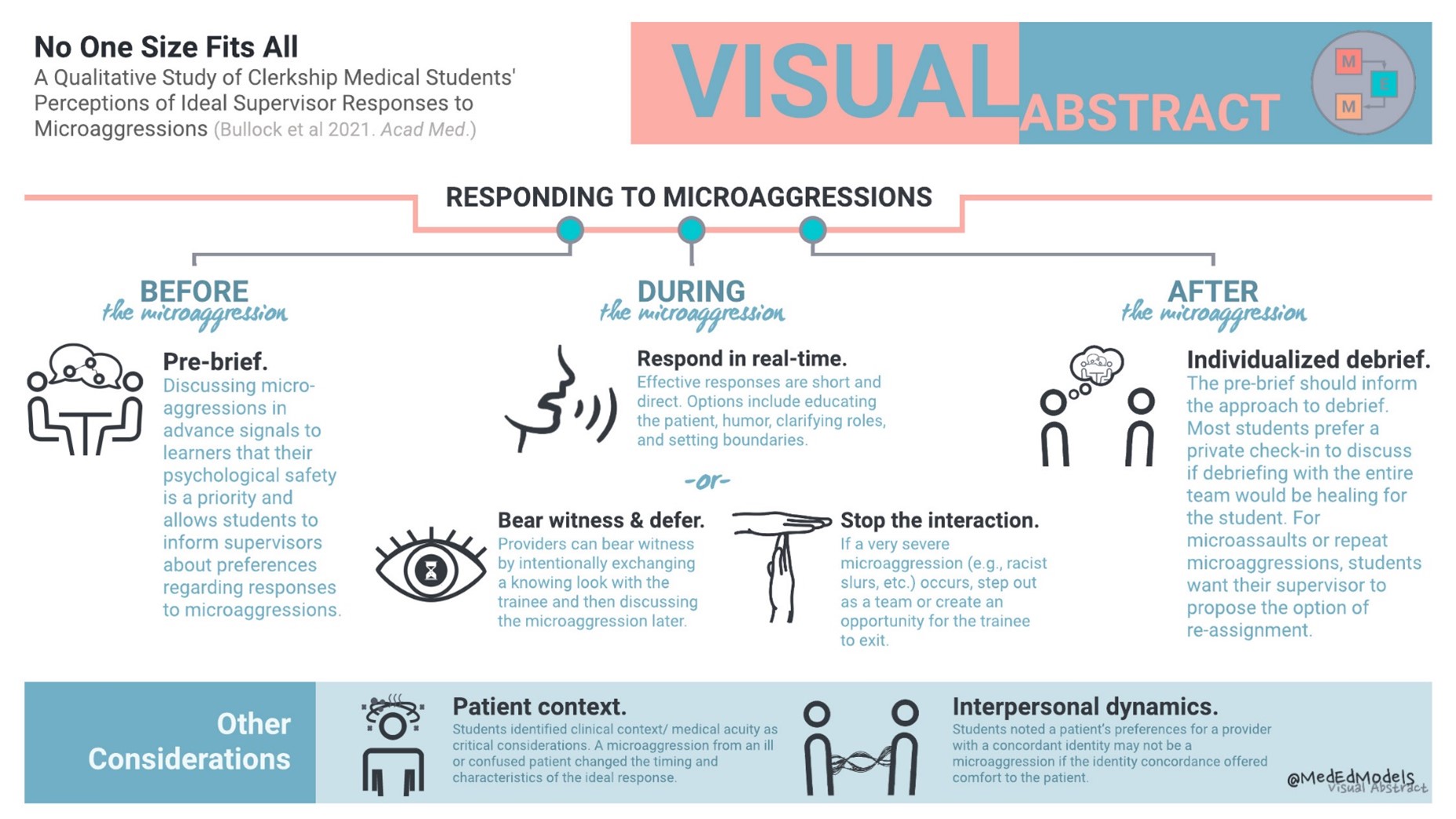
When teaching bystander intervention, there are multiple mnemonics, so that you can quickly react to the situation rather than lack of response in the moment. The 5D’s from American Psychology Association that calls to action are: Distract, Delegate, Document, Delay and Direct.  In JAMA Surgery, Dr. Nafisseh Warner introduced GRIT (Gather, Restate, Inquire, Talk It Out). In a learning environment to shift the power dynamics to the clinical learner, the visual below from Dr. Justin Bullock is helpful in breaking down each segment of bystander response: pre-brief, during and after the microaggression.

Reference: Bullock JL, O’Brien MT, Minhas PK, Fernandez A, Lupton KL, Hauer KE. No One Size Fits All: A Qualitative Study of Clerkship Medical Students’ Perceptions of Ideal Supervisor Responses to Microaggressions. Acad Med. 2021;96(11S):S71-S80.

When trainees come into laboratory spaces, it is essential to conduct a pre-briefsession to create a safe-learning environment. During orientation, talk to learners about the possibility of racism and bias. In medicine, the hierarchy is engrained and overemphasized within the system, so learners are hesitant to respond to microaggressions, report bias and racism. Therefore, taking the time to pre-brief will shift the power to learners to say something when being the target of racism and bias.

During microaggression, recognize and analyze it. Is it objectifying? Is it prejudice or negative attitude/stereotype? The usual response to microaggression is no response because you freeze, like I did in my scenario. The effective response is short and direct, most importantly respond in real-time. The degree of response will vary according to the situation and learner’s preference, sometimes the supervisor may bear witness or stop the interaction to create an opportunity for the trainee to exit.

After the microaggression, do not ignore what happened and move on. Supervisors should take the time to privately check-in with the learner and offer support, which is the most preferred approach. Team debriefs might invite an exhausting dialogue and may cause the target to relive the traumatic experience. Also, if there are instances of repeat microaggressions, propose the option for re-assignment.

To create a safe learning environment for our learners it is essential to prioritize psychological safety in our busy clinical services.  Taking the time to pre-brief with learners, check-in and offer support to the target will promote a better work culture. Together we can support and empower each other to mitigate microaggressions at our workplaces.

-Deepti Reddi, MD, Assistant Professor of Pathology, Department of Laboratory Medicine and Pathology, UW School of Medicine; UW Medicine’s equity, diversity, and inclusion (EDI) peer trainer at the Office of Healthcare Equity (OHCE) and teaches Racism & Bias for Center for Learning & Innovation in Medical Education (CLIME) in Advanced Clinical Teaching Certificate program.  She is also a 2021 ASCP 40 Under Forty Honoree.

Fright Knife

One of my favorite scary movies is the original Fright Night, a campy horror film from the 1980s. In it, the main character, Charlie, discovers he is living next door to a vampire. He realizes there is danger, so the first thing he does is research. He asks his friend “Evil Ed” about vampire knowledge and tries to get as much information as possible. He performs a risk assessment in his home and then puts into place some engineering controls (crosses, wooden stakes, windows nailed shut), some PPE (a garlic necklace), and even work practice controls (do not invite a vampire into your home). Charlie also utilizes help in the form of an out-of-work actor who starred in cheesy vampire flicks. These actions taken by Charlie make sense: he takes the time to learn about the danger, and then he prepares to deal with it safely.

As a lab safety professional, I often wonder why people who work in the laboratory do not follow the same pathway. They are educated in school and in training about the multiple dangers in the department, but many work throughout their lab careers utilizing unsafe practices. For example, it is common for staff in a histology lab to work with or near sharp blades in cryostats and microtomes without using any implements or safety guards. The number of reported cuts that repeatedly occur in these labs is shockingly high, and the number of unreported injuries is likely much higher. What is interesting is that when having conversations with those laboratorians, they are fine with accepting the risk and accepting the injuries or exposures when they occur.

The concept is the same, isn’t it? Vampire teeth can kill you, so you protect yourself. Bloodborne pathogens and sharps can also be deadly, but why isn’t there concern about the use of safe lab practices with blades? There may be a few reasons.

The use of large, sharp blades is, of course, common in histology labs. They are a part of the everyday job. Hands go near them when tissue is cut, when tissue blocks are changed, when moving the blade, and when changing the blade. In some busy cutting labs, a microtome blade can be changed up to twenty times a shift. This ubiquitousness of this item tends to create a sense of complacency about it. Yes, people have been injured, some badly, some amputations have even occurred, but in comparison to the number of tissue blocks cut, those reported injuries may seem like small numbers…unless it happened to you.

Another reason for complacency is that often, when blade injuries occur, the blade has been used with fixed (and essentially harmless) embedded tissue or when they haven’t been used at all. Many cuts are “clean” and minor, so there is no true perception of danger.

A third reason I have often heard about why blades are handled with no safety measures in place is that productivity in the lab is key. There are standards about how many tissue sections should be made during a standard shift, and using implements to move or change the blade would hinder those goals. Read that again- productivity, in the minds of some, is more important than staff safety – and that is an acceptable stance for them.

As a lab safety professional, one of my goals is to change that unsafe mindset. It does not matter in which section of the laboratory work is performed, staff should be made aware of the risks, and they should be taught how to utilize engineering controls, administrative controls, and PPE to avoid the hazards in the department. Then there should be ongoing management of the safety program which includes risk assessments, safety audits, and follow up when injuries or exposures do occur.

Train those who work with blades in the department. Show them how to work with and handle them safely by using magnet-tipped brushes and rubber-tipped forceps to change and move them. Teach them to always engage the blade guards when hands go anywhere near the blade. Talk about serious cuts and amputations that can occur when unsafe practices are utilized. Review work practices regularly to ensure staff remain safe each time they use the equipment associated with the blades. With sharp blades, the danger has already been invited into the lab. Take the next best precautions you need to make sure your blade doesn’t bite and become a “fright knife.”

Dan Scungio, MT(ASCP), SLS, CQA (ASQ) has over 25 years experience as a certified medical technologist. Today he is the Laboratory Safety Officer for Sentara Healthcare, a system of seven hospitals and over 20 laboratories and draw sites in the Tidewater area of Virginia. He is also known as Dan the Lab Safety Man, a lab safety consultant, educator, and trainer.

“CHiPs” and Dips

A delivery truck is backing up to the loading dock of an empty warehouse. You are about to receive the first ever delivery from your supplier, and soon this new lab will be up and running. Are you going to unload the truck and stash the new chemicals in the corner? I hope not. Getting started with chemical management can be a little overwhelming, but it certainly can be done. Benjamin Franklin said, “By failing to prepare, you are preparing to fail.” It is best to start with a plan, preferably a chemical hygiene plan (CHP). So, let’s take a dip into a few important sections of the CHP.

The creation of a great CHP begins by listing the chemicals you have onsite and their associated hazards, and this will be your chemical inventory. Categorizing your chemicals by hazard type helps you to determine where and how they should be stored and handled once in the lab. It’s important to determine the compatibility of your chemicals before you place them on the shelves. Storing your inventory in alphabetical order may make it easier for staff to locate a particular item, but not all chemicals play nice with each other when they are neighbors. A bottle of chloric acid stored next to calcium hydroxide could be an accident waiting to happen. Make sure incompatible chemicals are kept apart, stored on separate shelves, or kept in separate bins. Do you store ethanol onsite? What about xylene? Both are flammable chemicals, so you may be able to store them in the same flammable safety cabinet. Separate corrosive storage cabinets may also be needed for your strong acids and bases.

Now that we have the chemicals separated, what do you do when it is time to use them? Your CHP should outline training and personal protective equipment (PPE) requirements for the different hazards as well as any engineering controls required to ensure work can be performed safely. Do you have a biological safety cabinet (BSC) in your lab? Be careful, not all BSCs can or should be used as a chemical fume hood (CFH). A CFH is designed with specialized filters and/or ducting to eliminate hazardous vapors that BSCs lack. Only a few classes of BSCs can provide protection from volatile chemical fumes. Check with the manufacturer to determine if it is safe to handle volatile chemicals in your BSC.

Next, you decide how you are going to dispose of the chemical waste you may generate in the lab. Never assume that liquid chemical waste is allowed to be poured down the drain. Some acids and bases that are poured down the drain will alter the pH of your wastewater. The Environmental Protection Agency (EPA) and the local wastewater authority will not be fans of that practice. Hazardous waste disposal requirements vary from state-to-state, so be sure to know the laws in your area for your place of business (see website: EPA Hazardous Waste Programs).

So now your chemicals stored properly, you know how to use them safely, but what is the plan when something unexpected happens? The accidental release of chemicals can be quite dangerous, and so can a poor response. A well written spill response procedure and periodic training can make clean-up a much less risky operation. The first and most important step is to correctly identify the chemical that spilled. Make sure staff know the location of your Safety Data Sheets (SDS), know how to access them, and that they are up to date. You may use an online database to access the SDS, and some services will even automatically update the SDSs to ensure you are viewing the most current version.

Make sure there is a spill kit in the lab that can effectively handle the accidental release of the different types of hazardous materials in your area. The kit should include the materials for a biohazardous spill as well. Ensure you have a well written procedure that describes the steps to safely and effectively clean up the spill. Your procedure should outline actions such as securing and surveying the site, donning the required PPE, laying down barriers to prevent spreading, and applying absorbents. Also include information about extraction of the clean-up material and proper disposal. Remember, the waste created from a chemical spill is considered a hazardous waste and must be treated as such. Absorbed chemical waste should be placed in a bag specially designated for hazardous waste (and segregated for offsite removal by your waste vendor.

The drafting of a CHP does take time and attention, but you cannot stop there. Your CHP is a living document that requires attention, and once it is created, you never want to let it go stale. It is important to keep your CHP fresh by updating it often. In fact, OSHA and most accrediting agencies require laboratories to review their CHP annually and assess its effectiveness. Keep staff knowledge about your CHP crisp. When staff know how to locate and use their CHP, they are more prepared to work safely with hazardous materials.

-Jason P. Nagy, PhD, MLS(ASCP)CM is a Lab Safety Coordinator for Sentara Healthcare, a hospital system with laboratories throughout Virginia and North Carolina. He is an experienced Technical Specialist with a background in biotechnology, molecular biology, clinical labs, and most recently, a focus in laboratory safety.

A Culture of Safety Transparency- Three Reasons Why

Gena was working in the microbiology lab when she failed to notice a possible N. meningitidis from a cerebrospinal fluid culture. Not thinking there was any danger, she prepped the organism for identification on the analyzer, but she used a vortexer that was not in the biological safety cabinet and did not cap the tube. The next day when she saw the organism identification, she realized she had created an aerosol the previous day in the open lab when co-workers were nearby. She was afraid of getting in trouble, so she did not report the incident. Three days later, Gena was in the hospital and not expected to recover. Two other co-workers had also fallen ill with minor symptoms. After the investigation, the manager did not relay the details of the incident to all of the staff fearing that the department would get in trouble with hospital administrators. One lab employee decided to call OSHA and report what she felt were unsafe working conditions.

There are at least three reasons it is important to create a safety culture in the laboratory where all staff members feel comfortable discussing potential safety issues, incidents, and near-misses. The first reason is so that every single safety incident in the department will be reported. Even something as minor as a paper cut that occurs within the walls of the lab should be reported. A tiny wound can quickly become an infection if skin is broken while working in an area where bloodborne pathogens are present. Staff should understand why reporting is essential, and they should be aware of the follow-up procedures that are put in place by the organization. To get lab employees to realize near-miss situations may be more difficult- there needs to be education about unsafe practices and potential consequences. For example, an employee might successfully retrieve a lost specimen from a sharps container without injury, but they and others should understand the high potential consequence of that action, and it should be reported. That is a tie to discuss unknown source exposures and potential impacts.

A second reason for a culture of transparency in the lab is to help the staff know the organization s working to keep them safe and to make them comfortable enough to talk to leadership about incidents and questions they may have about them. Sometimes, if employees feel leadership is not doing a good job of this, they will report to agencies outside of the workplace. It is easy for an employee to report incidents to OSHA, and if that happens, the lab will need to do much more work for the response. When an incident occurs, being open and honest about the details, the response, and the follow up to ensure it does not happen again can go a long way toward comforting staff. Hiding information just helps to generate rumors and a feeling by some that they are not working in a place that is doing all it can to keep their employees safe. It can be difficult after certain events to tell the story. While names may not be mentioned, it is likely in many situations that staff will know who the involved parties are. That is still better than hiding information. When OSHA responds to a safety report, even if the response is written and no inspectors come on site, the incident report and the written response from the organization must be posted in the department per regulation. The employees are going to know what happened either way. It is always best to be up front about incidents and to make staff aware that their safety is important and monitored, and that issues have swift follow-up.

Safety transparency also has a third benefit- it generates an overall better safety culture for the laboratory. When staff are comfortable reporting issues without punishment or pushback, and when they see they can work with leadership to continually correct issues, safety becomes a natural part of the job. Openly reporting incidents in staff huddles, discussing routine safety fixes and improvements, and educating about near-misses are all normal in a department where the safety culture is strong. A strong safety culture means fewer incidents and fewer injuries and exposures, a goal for which all labs should strive. Once Gena realized her mistakes in the microbiology lab, she should have felt comfortable enough to report them for her safety and for the safety of others in the department. Even if she were new to the field or to the department, her leadership should have conveyed to her how vital it is to report safety incidents or potential safety issues. When staff understand that their organization cares about them and will work to protect them, even when something goes wrong, they will feel confident they work in an environment where safety transparency is the norm, and where the safety culture is strong.

Dan Scungio, MT(ASCP), SLS, CQA (ASQ) has over 25 years experience as a certified medical technologist. Today he is the Laboratory Safety Officer for Sentara Healthcare, a system of seven hospitals and over 20 laboratories and draw sites in the Tidewater area of Virginia. He is also known as Dan the Lab Safety Man, a lab safety consultant, educator, and trainer.

It’s Getting Hot in Here

Each laboratory is required to create and maintain a fire prevention plan. What exactly does this plan entail? A fire prevention plan should include, at minimum, the identification of potential fire hazards in your lab, your available firefighting tools, and an action plan that outlines employees’ responsibilities during a fire or evacuation.

First, it is best to determine what fire risks are present in your labs. The best way to begin would be to inventory any flammable chemicals used and stored on-site. Some flammable materials such as alcohol can accumulate quickly, and it is necessary to know how much is stored in the department and where. The Occupational Safety and Health Administration (OSHA) mandates that quantities of flammable liquids greater than 25 gallons in a single room must be stored inside of a flammable storage cabinet (1926.152(b)(2)). The National Fire Protection Agency (specifically standards NFPA 45 and 30) takes it a bit further and focuses on limits based on total square footage in the lab. The NFPA limits the amount of flammable liquid stored outside a flammable storage cabinet to no more than 1 gallon per 100 ft2, or 2 gallons per 100 ft2 if you use fire safety cans. This storage limit doubles if an automatic fire suppression system is in place. The limitation of flammable materials in a concentrated area enables a fire suppression system to more easily extinguish a fire if one were to occur.

Next, look at the amount of combustible items stored around the lab. Are there several boxes of paper stacked next to photocopiers? Large amounts of combustible material in a single area can help fuel a potential fire. Are items stored too close to the ceiling? Check to see that there is at least 24 inches of clearance from the ceiling so that sprinklers are not blocked. Finally, inspect your electrical equipment. Look for daisy chains or permanently placed extension cords in the lab. As part of routine physical environmental rounding, it is best to search for these prohibited situations while also seeking out frayed cords and damaged electrical equipment.

                Another component of the labs’ fire prevention is having the correct tools in place to combat a fire should one occur. The local fire authority will determine how many fire extinguishers are required in the laboratory and where they should be placed. To ensure adequate operation of this firefighting equipment, extinguishers should undergo routine checks which include annual maintenance. OSHA also requires a monthly visual inspection of all portable extinguishers (OSHA-1910.157(e)(2)). Verify that staff know the locations of their nearest fire extinguishers and that they can operate the specific types provided. Is there an automated sprinkler system in the facility? Staff should be aware of the location of fire pull alarms and have education about the alarm process (including calling any emergency numbers).

Lastly, the fire prevention plan should detail information about staff response to a fire, including fire drill and evacuation training. The safest way to evacuate is to have a predetermined evacuation route and muster (meeting) location. Staff should physically walk their full evacuation route annually all the way to their muster location and back. If this route becomes impassable, there should be an alternative evacuation route. During drills, walk one route to the muster location, then walk back via the alternate route. It is also wise to outline the expectations of staff members once they reach that muster location during the drill. If a large group evacuates at the same time, using a checklist or a buddy system can help staff keep track of who is present and who is not. Encourage your staff to stay at the muster location and not to wander off. If a supervisor is taking a roll call at the muster location, a staff member might be counted as missing if they leave to chat with a buddy in a different area. The last thing anyone wants is for a rescue worker to run into a burning building to search for a person who is not even at work that day. As the laboratory grows, so should the fire prevention plan. The addition of new equipment or a change in the current procedure warrants a review of the plan. It is recommended that fire safety policies and procedures are reviewed annually, and when changes are made, communicate that information to staff quickly. Ensuring that equipment is in place, that items are stored properly, and that staff are made ready to respond can lead to much better outcomes should a real fire occur in the laboratory.

-Jason P. Nagy, PhD, MLS(ASCP)CM is a Lab Safety Coordinator for Sentara Healthcare, a hospital system with laboratories throughout Virginia and North Carolina. He is an experienced Technical Specialist with a background in biotechnology, molecular biology, clinical labs, and most recently, a focus in laboratory safety.

Journey into Mystery: Unknown Source Exposures

In 1962, Marvel Comics introduced a new super-hero in their comic book titled “Journey into Mystery!” That character would become famous both in the book and eventually on the big screen. He was the mighty Thor. Through the years this Norse god of thunder would have many adventures and travel into many strange and unusual places all to protect his home of Asgard and to save the people of his adopted home planet, Earth. While the character of Thor willingly chose to journey into those many unknown places, those who work in the laboratory with bloodborne pathogens should not.

Evan popped the tops off of the serum separator tubes and placed them into the analyzer rack. He used a counter-mounted shield to protect himself from a splash. He picked up the rack containing five specimens and walked over to the chemistry analyzer to run them, but as he neared the analyzer his grip loosened, and he dropped the rack. It fell about an inch onto the analyzer and serum splashed up into Evan’s eyes. He did not know from which tube or tubes was the source of his exposure.

Rose was running late when she started her shift in the histology grossing lab. She did not notice that the small sharps container for scalpel blades was over full at the bench. When it was time to change her blade, Rose reached up without looking to eject the blade into the sharps container. She felt a sharp pain and saw that she had cut herself on several used blades that were sticking up out of the container access hole. Her injury had to be treated as an unknown source exposure.

If a bloodborne pathogen exposure occurs in the lab, there are several regulations that should be in place to help protect the exposed employee. OSHA’s Exposure Control Plan includes hepatitis vaccinations for employees, and follow up source testing instructions to discover the HIV and hepatitis status of the known source patient. Prophylaxis for an HIV exposure in the lab must be administered quickly to be effective, usually within 2 hours of the exposure, so rapid testing is key.

There are, unfortunately, accidents that occur for which the bloodborne pathogen source cannot be determined. The incidents described above could have been prevented, and they should have been, because treatment for an unknown source exposure is a journey no ne should want to make. In some cases, like with the sharps exposure, it is impossible to determine the source. In other cases, as with a rack of tubes, it is too costly and there is no time to test all possible exposure sources.

In some facilities, after an unknown source exposure, the policies call for complete serological testing of the exposed victim for HIV and hepatitis. This does not provide useful information, however, it only provides the serological status before the exposure, it does not alter the necessary treatment.

Treatment for an unknown source exposure usually consists of the immediate administration of prophylactic drugs. While these drugs are designed to help prevent the post-exposure development of HIV or hepatitis, they are known to be toxic to the body and can have many ill effects. Personal consequences can occur as well after such an exposure. As a precaution, the exposed victim may be told to avoid intimate relationships for six months. Clearly, this is not a journey anyone would willingly want to take.

All exposure incidents in the laboratory setting should be prevented, and the majority of them can be prevented easily. Pay attention to the surroundings and look for potential sources of exposure. Consistently use proper PPE including face protection whenever handling open specimens or performing maintenance on an analyzer where tubing or reservoirs are involved. Empty sharps containers when ¾ full, and never allow anyone to open them or dig through them, even for a lost specimen. The risk is too high.

In many ways, the work of a laboratorian should be a journey into mystery. There are test results to produce, diagnoses to be made, and new techniques to discover. With the work in the lab environment, all exposure risks should be assessed, and they should be mitigated using engineering controls, safe work practices, and PPE so that this work can be performed safely. Let the scientific mysteries be those that prevail and not the scary alien consequences of an unknown source exposure.  

Dan Scungio, MT(ASCP), SLS, CQA (ASQ) has over 25 years experience as a certified medical technologist. Today he is the Laboratory Safety Officer for Sentara Healthcare, a system of seven hospitals and over 20 laboratories and draw sites in the Tidewater area of Virginia. He is also known as Dan the Lab Safety Man, a lab safety consultant, educator, and trainer.

Containment and Contagion: How Far Do We Go?

One of my favorite older horror movies is The Shining. The acting, the music, and the pace of the story create a good long scare for the audience. In one scene, the mother and child are playing in an outdoor maze constructed of tall bushes. Later in the film they would be running for their lives in that selfsame maze, but I do not want to give away any spoilers if you haven’t watched it. The maze sometimes reminds me of some laboratory departments that I have seen, and I have seen how winding hallways and multiple doorways create confusion for lab employees and others in the facility.

The International Organization for Standardization (ISO) states in its standard Medical Laboratories — Requirements for Safety (ISO 15190:2020) that clean and dirty areas need complete separation from floor to ceiling. For example, the break room must be a completely separate room from the space where lab work is performed. While not all laboratories are ISO-certified, this is clearly an infection control and safety best practice. The Occupational Safety and Health Administration (OSHA) has been known to enforce this when they cite labs for incomplete separation of clean and dirty areas.

The Centers for Disease Control (CDC) published its resource, Biosafety in Microbiological and Biomedical Laboratories (BMBL-6th Edition) in 2020, and it requires a hand hygiene sink near the exit of laboratories so that hands can be washed before exiting the department. That means door handles inside the department must be considered clean and not touched with gloved hands.

Think about those requirements and apply them to your lab space(s). Do they work? Do they make sense to you? If you work in a Biosafety (BSL) 2 or 3 laboratory, you should understand the basics of pathogen containment. After all, the Biosafety Level of your laboratory is determined by the infectivity of pathogens present, the severity of disease they could cause, their transmissibility, and the nature of the work conducted. Based on risk and task assessments, labs should utilize the personal protective equipment (PPE) appropriate for the tasks performed, and that PPE should never be brought outside of the laboratory (another OSHA regulation).

One of the most common questions I receive from lab safety professionals is how to improve PPE compliance. The answer is, we need to make it easy for our staff to do the right thing. That means providing education so they understand the consequences of unsafe behaviors, and it means putting practices in place that make sense and are easy to follow.

In my travels I have seen labs that require that gloves must be removed before touching lab telephones and keyboards. I have seen specimen transport policies that allow for the use of wearing one glove for holding specimens and keeping the other hand clean to touch doors, and I have also seen staff who are told to keep a glove on to touch all lab door handles. If your staff are required to figure out that crazy maze of practices, they are not ever all going to get it right, and someone is going to acquire an infection.

If you require all gloves to be removed and hands to be cleaned before exiting the lab (as you should), are there sinks and waste cans at the exits? If lab coats must be hung up before going into the break room or rest room (as they should be), do you provide coat hooks near those doors? If staff must leave one BSL2 lab and walk through a clean hallway to deliver specimens to another lab, what do they wear? Do they wear their PPE (violating OSHA’s regulation) and do they touch door handles with gloves that other staff will use without gloves when leaving the department for the day?

Lab Acquired Infections (LAIs) are vastly under-reported, and many time people do not even realize how they got infected. There are probably many lab practices (like the ones mentioned above) that lead to these. Could this happen in your workplace? How can you prevent it?

Start, as always, with a risk assessment. Determine the hazards in your workplace, create hazard mitigation steps, and determine if any residual risks still exist. Take a good look at your physical layout. Can a “clean” hallway be designated as “dirty?” Would something as simple as adding a door to close off a hallway make it so safety regulations can be followed? Those risk assessments and diagrams used as a show-and-tell for facility leadership can often be what gets you the approval or funds you might need to make those changes. Correcting those unsafe practices and those long lab winding hallways and exits will certainly make it easy for staff to find the way in and out while containing the pathogens where they should be.

Dan Scungio, MT(ASCP), SLS, CQA (ASQ) has over 25 years experience as a certified medical technologist. Today he is the Laboratory Safety Officer for Sentara Healthcare, a system of seven hospitals and over 20 laboratories and draw sites in the Tidewater area of Virginia. He is also known as Dan the Lab Safety Man, a lab safety consultant, educator, and trainer.

Guess Who’s coming to the Lab?

When we enter the laboratory, we know of the dangers that can be encountered. Our training tells us there could be microbes and other potential pathogens in the samples we are about to analyze. We also learned how to protect ourselves; how our behavior while in the lab has consequences. We even know how to dress properly and what engineering controls we have at our disposal to keep us safe. We put on our personal protective equipment (PPE) before we start to work and remove it before leaving the lab. For some, these behaviors are automatic, actions that are done almost without even thinking. But is this the same for all who enter the lab? Do visitors who comes into the department know what they are really walking into or how to keep themselves safe in an environment that may be foreign to them? One common question asked by lab staff regarding visitors is “do they have to adhere to the lab safety policies and if so, why?”.  

On a recent safety audit, I visited a lab that happened to be getting a new chemistry analyzer installed. I noticed the vendor team, which consisted of 5 individuals, were not wearing any PPE. There were backpacks, open water bottles, and cell phones sitting on the counters and floors. The new instrument was not hidden in a back corner of the lab far away from the daily work. It was close to the area where the lab process, spins, and runs patient samples. Members of the vendor team were lying on the floor and crawling around. How does that scene make you feel?

Vendors and service representatives are regular visitors in your lab. A laboratory can have a representative on site a dozen times before you even begin to use that piece of equipment.  Once it is installed, you can bet you will see them multiple times for preventative maintenance and service calls. How does your lab welcome these guests? Do you let them in and have them get right to work? If they are there to repair an analyzer   you are likely eager to have them get started, but do you ask them to wear a lab coat?  Did they bring one of their own that was kept in their backpack?  If so, do you think that coat is clean or was it used in a different lab, packed up, and brought to your lab? Vendor compliance is a safety issue for many labs because these visitors are not lab employees, yet they are in your department and may be putting themselves and your team at risk. Often vendors are seen with drinks in labs, using cell phones or touching instruments without gloves – behaviors lab folk are told not to follow. So why is it tolerated? It shouldn’t be, and you have the right to speak up and ask them to adhere to your lab policies.

What about other potential laboratory visitors? Do pathologists come in to look at a patient slide in Hematology? Do they just sit down at your bench and look at the slide without gloves or a lab coat? Is lab staff allowed to scan a smear without PPE? Probably not, and no one else should be allowed too either. The microscope has most likely been touched with dirty gloves, and no one else should touch the same scope without gloves. Even lab doorknobs are a consideration. Staff should wash hands before leaving the department. That means no one should use contaminated gloves to open the door.

Speaking up about these safety issues to lab visitors can feel uncomfortable. A conversation with a physician about safe practices in the lab can be daunting, but the cost of not speaking up can be high. Take the opportunity to show you care about visitors and want to keep them protected. Sometimes you know who is coming to the lab, and you feel confident they have been trained and will use the best safety practices. At other times, though, those guests may be unexpected and lacking in safety knowledge. Make sure to treat them with respect, give them the safety training and tools they need so they can leave both happy and healthy.

-Jason P. Nagy, PhD, MLS(ASCP)CM is a Lab Safety Coordinator for Sentara Healthcare, a hospital system with laboratories throughout Virginia and North Carolina. He is an experienced Technical Specialist with a background in biotechnology, molecular biology, clinical labs, and most recently, a focus in laboratory safety.