
Dr. Frank Artress and FAME Africa

A couple of weeks ago I had the wonderful fortune of reconnecting with someone from my past. In 2007 I lived and worked in Tanzania and through that work had the pleasure to meet Dr. Frank Artress and his wife, Susan Gustafson. In rural Tanzania, Dr. Frank, as he is known, stands out. He is a tall white guy with an infectious laugh and booming voice. An American cardiac anesthesiologist, he spent the early part of his career building a successful practice in California. However, in 2002, after a near death experience as a tourist climbing Mt. Kilimanjaro, he and Susan changed paths. They sold everything, uprooted their lives, and moved to Tanzania where he has practiced medicine ever since.

They started by conducting mobile medical clinics in rural Tanzania out of a large red and white van reaching areas with no access to Western medical care. Today, Frank and Susan run a 24 bed hospital. The hospital, located in Karatu, Tanzania, continues to grow and recently began to offer not only maternity care but has a fully functioning surgical ward where they are now able to deliver babies via c-section. They have an outpatient clinic, a dispensary, and a laboratory and are almost entirely staffed by Tanzanian nurses, doctors, lab techs, and administrators. Their laboratory, operational since 2011, has a fully automated blood chemistry machine which makes them the only hospital within a 140 kilometer radius with the diagnostic capabilities it provides. The lab is also in the process of developing a telepathology program in conjunction with ASCP, the College of American Pathologists, and the American Society of Clinical Oncology.

As their reputation spreads throughout the region, their catchment area continues to expand. In a country where the average doctor to patient ratio is approximately 1/50,000 they are providing critical care to a large population of people.

Our recent interaction was while they were in town on a fundraising tour in the United States. Over 70% of their funding comes from grants and individual donations. They are always in need of more support. In addition, they have a small volunteer program for people with the skills that match their current needs.

They are wonderful people doing amazing work. I could sing their praises for hours, but Dr. Frank is the best at telling his story. Check out this video: https://www.youtube.com/watch?v=_-ud_cS6Mek and find their organization, FAME Africa, online: http://www.fameafrica.org/.
Levy

-Marie Levy spent over five years working at American Society for Clinical Pathology in the Global Outreach department.
World TB Day

Did you know? March 24th was World TB Day. The date commemorates the day in 1882 when Dr. Robert Koch announced he’d discovered the cause of Tuberculosis.

Did you know? Every day there are 24,000 new cases of TB diagnosed. This means more than 2 billion people are infected with TB and 1.5 million people die each year (according to the Stop TB Partnership).

Did you know? The number of people diagnosed with multi-drug resistant TB (MDR-TB) has tripled since 2009 (according to the WHO TB fact sheet).

The burden of TB is highest in resource limited countries and in places where the incidence of HIV is highest. TB is the most common opportunistic infection for individuals with HIV/AIDS and is the most common cause of death in HIV/AIDS patients. In resource limited countries diagnosis and consistent treatment is a challenge. Lack of laboratory resources to use for diagnosis means TB diagnosis are often made based on empirical signs and symptoms.

Once a patient is diagnosed (either clinically or based upon a confirmed laboratory test) given the strenuous treatment, it can be difficult to keep people on a consistent treatment plan. Most treatment lasts six to nine months. In rural settings where access to drugs is limited this can be a prohibitive amount of time. Not only does the cost of the drug add up but the opportunity cost involved in missing work to travel to get the drug, the cost of the travel, and the physical strain of the travel all hamper a patient’s ability and commitment to sticking with the full course.   This can and has led to increased prevalence of MDR-TB.

Unfortunately, the ways to prevent the spread of MDR-TB (quick, accurate diagnosis; taking medication exactly as prescribed; avoiding exposure) aren’t easy in resource limited areas. Basic cell phone technology may be one tool helping to make a difference, however. Some researchers and health care providers are experimenting with sending text message reminders to other health care providers and/or patients to take their medication. Multiple studies are currently underway to determine whether this method of communication has been useful in increasing drug regimen adherence and improving the TB cure rate. If this can solve one of the challenges related to TB, it will be a big step in the right direction.


Levy

-Marie Levy spent over five years working at American Society for Clinical Pathology in the Global Outreach department.


What Does a Global Outreach Volunteer Consultant Do?

So what exactly do I do on my international escapades? I work with my laboratory professional association (mostly), American Society of Clinical Pathology (ASCP) who is under contract with the CDC to help improve laboratory capacity, quality, standards and processes in developing nations. Basically, I work with labs around the world to help them establish lab processes and procedures that meet international standards to collect, handle and process and test laboratory specimens safely and with accuracy, so that the results: 1) are the right patient 2) can be counted on for accuracy and 3) provide info to the clinician in a timely manner so he/she can diagnose and initiate treatment if necessary.  And, most of the lab work in these nations are for the “big three” HIV/AIDS, tuberculosis, hepatitis (and in some places, malaria). So…I get called to work closely with international colleagues, review processes and procedures, help mentor lab scientists with quality and process improvement—and do a lot of training, especially in the blood collection part of the process. My last trips over the past several years have included a variety of these things and recently in Central Asia, mostly blood collection training.

The work I get to do is rewarding, engaging, energizing, humbling, and one small way to give back some knowledge and experience to things I am passionate about—but it’s always so good to be home!

Hosh Ohmadet!

???????????????????????????????

-Beverly Sumwalt, MA, DLM, CLS, MT(ASCP) is an ASCP Global Outreach Volunteer Consultant.

Significant, but Fragile, Gains In the Fight Against Malaria

Marie Levy

January 2015 Lablogatory post

In recent months it seems that the only news stories about sub-Saharan Africa presented by western media are about Ebola. There are some bright spots in that news, but in general it is scary and saddening. Lost in the Ebola shuffle, however, is some good news about the fight against malaria. A recently released report from the WHO Global Malaria Programme states that worldwide the malarial mortality rate fell by 47% between 2000 and 2013 and currently 55 countries are on track to reduce their malarial burden by 75% by 2015. Those are exciting numbers. The report attributes these improvements to increased use of insecticide treated bed nets, accurate diagnostic testing, and increasingly effective drug therapies.

Accurate diagnostic testing means that the lab is playing a crucial role in the fight against malaria. Data from 2013 shows an increase in the use of diagnostic tests in sub-Saharan Africa. This supports additional data that shows there has been a shift from presumptive treatment to diagnostic treatment.

As a public health community, however, we cannot become complacent. The WHO report states that, in Africa, over 43,000 children die from malaria each year, 15 million pregnant women do not have access to preventative treatment, and over 200 million people live in households without access to insecticide treated bed nets.   Drug and insecticide resistance is a serious concern (thus underscoring the importance of accurate diagnostic testing to prevent presumptive treatment that can contribute to drug resistance). In the West African countries hit by the Ebola outbreak, health care resources have all been directed towards the fight against Ebola leaving them vulnerable to increases in other disease occurrence. If nothing else, however, the Ebola outbreak has provided a reason and impetus for discussions surrounding the importance of health systems strengthening. Strengthening that will not only fight future outbreaks of diseases such as Ebola, but will improve health care networks for every day care and treatment.

Thus, in the spirit of the holidays, let’s celebrate this good news. But while doing so, let’s also continue the fight and keep up the good work.

Links for further reading:

http://apps.who.int/iris/bitstream/10665/144852/2/9789241564830_eng.pdf

http://www.nytimes.com/2014/12/14/opinion/sunday/fragile-gains-against-malaria.html?_r=0

http://kff.org/news-summary/significant-global-gains-made-against-malaria-but-ebola-threatens-progress-in-west-africa-who-report-says/

Levy

-Marie Levy spent over five years working at American Society for Clinical Pathology in the Global Outreach department.

Season of Greetings

It’s amazing the year is nearly over, the halls are decked, candles lit, celebrations scheduled. Friends and families gather, eat too much, hug and kiss, pass around gifts and graciousness…and microbes.

Laboratory professionals know all too well that “Seasons Greetings” are just the thing for passing along your favorite virus or enteric pathogen. This year, we are especially conscious of the contagious nature in the world of unseen assailants. Global health has faced the disastrous affects of improper hand washing and challenging sanitation conditions; and not just with the Ebola crisis, but in refugee camps and among those facing the strife of war.

Laboratories don’t close for holiday celebrations…and laboratory professionals don’t always get the days and times off that would make them happy around the holidays. But this year I challenge us with two things:

  • Remember to offer “Seasons Greetings” with best practices and don’t take any of your laboratory favorites along to the parties and gatherings!
  • If you’re working that extra shift, or one that is encroaching on your family and personal time—remind yourself that there are so many in the world who would rejoice in the opportunity to be working, to be healthy enough to be working and free of disease, strife and conflict, and could watch their children and families smile, eat too much, hug and kiss and pass along “Seasons Greetings”.

My best to you for this holiday season, whatever ways you celebrate, and ‘tis the season to remember our colleagues globally and do something to make the world a little better place locally! Happy Holidays!

???????????????????????????????

Beverly Sumwalt, MA, DLM, CLS, MT(ASCP) is an ASCP Global Outreach Volunteer Consultant.

CDC Press Release–Passenger Notification

CDC and Frontier Airlines Announce Passenger Notification Underway

On the morning of Oct. 14, the second healthcare worker reported to the hospital with a low-grade fever and was isolated. The Centers for Disease Control and Prevention confirms that the second healthcare worker who tested positive last night for Ebola traveled by air Oct. 13, the day before she reported symptoms.

Because of the proximity in time between the evening flight and first report of illness the following morning, CDC is reaching out to passengers who flew on Frontier Airlines flight 1143 Cleveland to Dallas/Fort Worth Oct. 13.

CDC is asking all 132 passengers on Frontier Airlines flight 1143 Cleveland to Dallas/Fort Worth on October 13 (the flight route was Cleveland to Dallas Fort Worth and landed at 8:16 p.m. CT) to call 1 800-CDC INFO (1 800 232-4636). After 1 p.m. ET, public health professionals will begin interviewing passengers about the flight, answering their questions, and arranging follow up. Individuals who are determined to be at any potential risk will be actively monitored.

The healthcare worker exhibited no signs or symptoms of illness while on flight 1143, according to the crew. Frontier is working closely with CDC to identify and notify passengers who may have traveled on flight 1143 on Oct. 13.  Passengers who may have traveled on flight 1143 should contact CDC at 1 800-CDC INFO (1 800 232-4636).


Frontier Airlines Statement

 “At approximately 1:00 a.m. MT on October 15, Frontier was notified by the CDC that a customer traveling on Frontier Airlines flight 1143 Cleveland to Dallas/Fort Worth on Oct. 13 has since tested positive for the Ebola virus. The flight landed in Dallas/Fort Worth at 8:16 p.m. local and remained overnight at the airport having completed its flying for the day at which point the aircraft received a thorough cleaning per our normal procedures which is consistent with CDC guidelines prior to returning to service the next day. It was also cleaned again in Cleveland last night. Previously the customer had traveled from Dallas Fort Worth to Cleveland on Frontier flight 1142 on October 10.

Customer exhibited no symptoms or sign of illness while on flight 1143, according to the crew. Frontier responded immediately upon notification from the CDC by removing the aircraft from service and is working closely with CDC to identify and contact customers who may traveled on flight 1143.

Customers who may have traveled on either flight should contact CDC at 1 800 CDC-INFO.

The safety and security of our customers and employees is our primary concern. Frontier will continue to work closely with CDC and other governmental agencies to ensure proper protocols and procedures are being followed.”

Internationally Safe

With the serious and concerning news about international contagious disease, it’s always appropriate to remind ourselves of safety, both personal and protective. What laboratory professional has not donned the gown, the mask, the gloves…in an effort to protect ourselves, and also protect the patients we serve? We all have…but we all have also occasionally been cavalier about it.

In these times of viruses and antibiotic-resistant strains of microbes—and who knows what iterations of the above are in the “evolutionary muck” of the future—we stand in the cautionary shadow of the devastation they can cause. The invention of the microscope only served to give us a view of our un-seeable enemies, and they are countless.

I travel extensively, internationally and within the USA, and the risks of contagion are all around. It helps to keep yourself personally prepared by encouraging a robust immune system, eating/sleeping and hydrating well, and staying as healthy as is possible—but as we all know that is not always enough. It will also serve us well, as laboratory professionals, to both practice and teach personal protection in compromised situations. When at work, it’s obvious…but when in someone else’s lab, or hospital, or clinic, or even railway station, we must be diligent and alert to the unseen dangers of contagious disease contamination. Laboratory scientists are trained to treat every single action, specimen, and encounter as if it were a threat to health and safety, and yet…do we?

Life is short, disease is inevitable, and safety precautions are a must…but also a choice. Choose wisely, and don’t compromise! If your hospital/laboratory/healthcare system is following PPE and international safety regulatory compliance, good for you and those around you. We are the most knowledgeable infectious control specialists on the planet, and we have the obligation to lead the way in international and personal safety.

And as I mentioned in my last blog, let’s roll up our lab coat sleeves—and put those gloves and masks on…we have a lot of work to do!


???????????????????????????????

Beverly Sumwalt, MA, DLM, CLS, MT(ASCP) is an ASCP Global Outreach Volunteer Consultant.


Pandora’s Box

Archived in the ever-rich and exotic mythologies of the Greeks is the story of Pandora’s Box. It was actually a “jar”—which is strangely close to a “test tube” in my opinion. Pandora was given a wedding gift, a beautiful jar, with instructions not to open it under any circumstances. Curiosity killed the cat, so to speak, and she finally couldn’t resist. When she opened it, all the evil contained in the jar escaped and spread over the earth. She tried to close it but too late—the contents had already escaped. Only one thing remained in the jar at the very bottom—the Spirit of Hope.

I’m not sure the World Health Organization would agree with me, but “Pandemic” is very close to “Pandora.” In a world where international travel is commonplace the spread of contagious disease is a major concern. Rats on ships carrying plague may be a thing of the past, but viral-loaded passengers on an international flight happen every hour of every day. Think of all the headlines in the past decade that have highlighted international health risk issues. It seems that Pandora has unleashed a few additional mutated “evils,” and I doubt we’re through with all her mischief.

As laboratory professionals, we are essential to solving the public health issues confronting our world today. Rapid diagnosis, evidence-based research, viral load monitoring, susceptibility and pharmacological validation, managing toxicity—familiar territory for us, and just think of how much relies on our expertise? We are called on daily to be the platform and framework for “pandemic control” measures. Sitting in our clean, efficient, well-lit, safe and busy laboratories throughout our country it’s easy to forget there are bacterial and viral war zones not far from our shores…all it takes is a small rat on a creaky ship (or a young child on a red-eye international flight) to initiate a modern day plague world-wide.

Next time you hear “pandemic”, remember Pandora. Wash your hands, put on a mask, and peer inside that jar of hers and shake out some Spirit of Hope. Sprinkle it liberally around our laboratories and colleagues, and let’s roll up our lab coat sleeves—we have a lot of work to do!


???????????????????????????????

Beverly Sumwalt, MA, DLM, CLS, MT(ASCP) is an ASCP Global Outreach Volunteer Consultant.


If Suitcases Could Talk

I know this is a “lab blog” not a “travel log” but after the long and arduous global outreach visit to Tajikistan, I simply can’t resist.

My last blog introduced our Tajikistan colleagues and the challenges they face with pre-analytical processes and our experiences and time with them. It’s for all those reasons the ASCP Global Outreach Volunteer Consultants endure the not-so-fun rigors of travel, experience countless hours of joy in airline terminals, work/eat/sleep at odd hours because we don’t know what time zone we’re in, and throw our shoulders out carrying our carry-on luggage…because if you don’t, it will definitely get lost. I’m living proof that it can happen even if you ARE carrying it on.

Our complicated itinerary for return flights from Dushanbe to the USA gave me indigestion and guaranteed luggage challenges. However, even my compact and well-packed little rogue suitcase was over full with paperwork and reports that needed returned after our workshops, making it way too full and way too heavy to carry-on back home. I had four plane changes ahead of me and 36 hours of travel, including having to stay overnight in Istanbul. With very little confidence I checked the bag with the Russian-speaking airline agent, who told me to pick it up in Moscow and re-check to Istanbul. At least I thought that’s what she told me. In Moscow (why we were flying to Moscow to get to Istanbul to get to Chicago still puzzles me…) they pulled both Dave and me out of passport control lines, gave us armed escort across the tarmac to another terminal, and with gestures and points told us to re-check into airline transfer. In my mind’s eye, I thought I remembered seeing my name/contact info stripped off the handle when they threw it on the loading belt—well you guessed it, my little rogue suitcase was in for another adventure.

If the suitcase could talk, it might tell us about the intricacies of airline baggage handling, the rough and ready haulers who toss it like a marshmallow into huge cargo holds, the pounding and radiation it gets inside the security checks. I’d also like to think it would tell us about the people it sees, the faces that are going about their business, smiling and frowning, complaining and cajoling, living in the proximity of global travel. I’d like to think it would tell us to watch and listen and experience and absorb the adventures we are privileged to be part of. I’d like to think it would tell us to pack light, stay fit and travel well. I’d like to think it has seen the world from the belly and not the shoulders…and from that point of view, there surely is much to learn and understand about the people I meet and the places I visit. If my little rogue suitcase could talk, I think it might have interesting global wisdom to share.

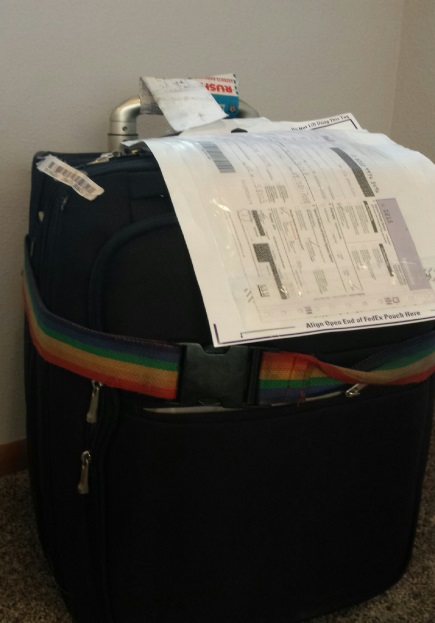
Late last evening, 10 days after landing in my hometown airport, my rogue suitcase showed up unannounced and unceremoniously on my front porch. It had several numbers and bar codes attached in various places, most of them torn and damaged beyond bar-code-reader recognition, from places like VNO and IST and ORD and a couple I didn’t recognize. Nothing short of amazing, it made its way home once again, traveling around the globe with a mind of its own. I stand in awe and offer my thanks and appreciation to all those involved in tracking and re-directing it back home.

luggage

As I close this little travel story, I also think of the global outreach colleagues I work and travel with and our vision and mission to improve and strengthen laboratories around the world. We’ve all lost luggage, missed flights, traveled complicated itineraries, and used a lot of “air time” trying to keep up with our families and friends. But in the end, if our suitcases could talk, they might agree that it’s all worth it.

And…I hope your travels are always safe, on time, uneventful and that you never lose your luggage!


???????????????????????????????

Beverly Sumwalt, MA, DLM, CLS, MT(ASCP) is an ASCP Global Outreach Volunteer Consultant.

Unexpected Challenges in Laboratory Testing

In July 2012 I traveled to Dushanbe, Tajikistan as part of a team that conducted initial site visits and needs assessments at laboratories around the country. Clearly it has been a couple of years since that visit and I must admit that I haven’t done a good job at keeping up on any developments. I am sure there is much we did not see, and did not learn and various items that were lost in translation, and I realize that one visit does not an expert make. All that being said, however, I wanted to share my impressions from that visit, as I was surprised by the differences between the challenges laboratory services face in Tajikistan (and reportedly much of the Central Asia region) and those faced in many countries in Africa. In many African countries, challenges related to laboratory services and infrastructure can be linked to lack of resources, materials, testing supplies, supply chain issues and difficulty for rural patients to access the laboratory.

In Tajikistan, at the time of our visit, there was a severe lack of reagents needed to continue running multiple tests. This was due to a delay in receiving a specific international source of funding dedicated to purchasing these reagents. In general, however, the laboratories we visited appeared to be better supplied and stocked than many I have seen in various African countries.

To me, the most striking observation was how the structure of the laboratory system made it difficult for patients to obtain the appropriate testing and care. There was one lab for TB tests, and one lab for routine CBC’s, and another one for HIV tests, etc. Some of this separation was due to different sources of funding for the labs, which restricted those funds to be used only for specific tests (an issue for sure, but one related more to international aid and funding than the Tajik structure). Another explanation we received was that some of the separation was due to bygone practices from the communist era government where many services were very siloed. No matter the explanation, however, it could be challenging; a patient who needed multiple tests had to traipse around to numerous locations in order to have samples taken for each test.

Imagine what that would be like as a patient. Would you follow through on doctor’s orders if it was going to take all day and multiple stops? I’d like to think I would, but perhaps not if it was too much of a challenge.


Levy

-Marie Levy spent over five years working at American Society for Clinical Pathology in the Global Outreach department.