Microbiology Case Study: Fastidious Bacteria from a Patient with Aortic Valve and Implanted Device

Case History

A 73 year old male with a complex medical history, including type 1 diabetes, coronary artery disease, atrial fibrillation, hypothyroidism, hyperlipidemia, glaucoma, previous coronary artery bypass grafting (CABG), transcatheter aortic valve replacement (TAVR), and an implanted cardioverter-defibrillator (ICD), presented with bilateral persistent paraspinal neck pain, shaking chills, and myalgias. The initial evaluation involved broad laboratory and imaging work-up, which showed mildly elevated CRP and erythrocyte sedimentation rate (ESR). Chest X-ray, CTA head/neck, and CT thorax were normal. The patient was discharged with symptoms resolved using Tylenol and Valium, and instructions for follow-up care were provided. Two days later, the patient was recalled to the ED after blood cultures were positive for gram positive cocci in pairs and chains. The patient, asymptomatic at the time, was informed of the findings and agreed to return for further evaluation.

The patient had undergone a tooth extraction followed by implant placement one month prior, raising concerns for endocarditis due to prosthetic valve and pacemaker. He was transferred to the cardiology service, and repeat cultures were ordered. Initially afebrile, he later developed a fever (101.7°F), and his condition was complicated by diabetic ketoacidosis (DKA) and septic shock requiring ICU admission. The patient was treated with IV Vancomycin 1.5 g q24h and recommended to have repeat blood cultures until clearance. The discharge diagnosis was bacteremia caused by Abiotrophia defectiva, with a possible prosthetic valve endocarditis. A six-week course of Vancomycin was prescribed.

(A) Gram stain of the positive blood culture bottle revealed gram positive cocci in chains and pairs. (B) Inoculation of the positive blood culture bottle onto bacterial agar plates showed no growth on sheep’s blood agar but growth on chocolate agar.

Discussion

The genus Abiotrophia most resembles well-known gram positive cocci in chains and pairs such as streptococci and enterococci. Abiotrophia were originally thought to be a relative of the viridans Group Streptococcus but sequencing analysis created a new genus called Abiotrophia which consisted of two species, A. defective and A. adiacens.1 Abiotrophia is classified as nutritionally variant streptococcus (NVS) and is a part of normal flora in the intestinal tract, oral cavity, and urogenital tract. The organism accounts for up to 6% of streptococcal infective endocarditis and have been associated with native and prosthetic valve infection.2 Other types of infections that have been described for Abiotrophia include sepsis, infections of the eye, central nervous system, musculoskeletal, and arthritis.3-6 It is crucial to recognize A. defectiva for timely and effective treatment, given its propensity to cause severe complications like septic embolization.7

Abiotrophia is coined a NVS because this microorganism requires specific nutrients like L-cysteine or pyridoxal for growth on sheep’s blood agar. They can usually grow without supplementation on chocolate agar, brucella agar with 5% horse blood, and in thioglycolate broth. Sometimes sheep’s blood agar supplemented with pyridoxal can also be used. Due to the release of specific nutrients by lysed red blood cells, the satellite test is important for growth and identification. Briefly, the suspected isolate is streaked for confluent growth on an agar that does not support growth for Abiotrophia (such as sheep’s blood agar) and then overlaid with a cross streak of beta-hemolytic Staphylococcus aureus. After incubation, colonies of Abiotrophia can grow near the S. aureus streak, giving rise to the ‘satellite’ phenomenon. However, it should be noted that other fastidious organisms such as Granulicatella and some Haemophilus species can also satellite around the S. aureus streak. Hence, further confirmation is needed for identification. For example, Abiotrophia is non-motile. Common biochemicals reactions to help characterize Abiotrophia genus is PYR (production of pyrrolidonyl arylamidase) positive, LAP (production of leucine aminopeptidase) positive, and no growth in 6.5% NaCl.

Molecular approaches have been proven to be accurate for identification of Abiotrophia . Sequencing of the 16S rRNA gene have shown to be more accurate than phenotypic, biochemical tests. PCR testing for the rpoB, groESL, and also the ribosomal 16S-23S intergenic spacer region (ITS) genes have all shown to be reliable targets for identification.8-10 The introduction of MALDI-TOF mass spectrometry has facilitated more accurate identification in clinical settings.11

Prompt diagnosis and targeted antimicrobial therapy are essential in managing infections caused by Abiotrophia defectiva, especially in older patients with underlying health conditions. Early detection and appropriate treatment are vital to mitigate potential complications.6,7 Abiotrophia species exhibit varying antibiotic susceptibility, with increasing resistance to penicillin. Common treatments include penicillin, ceftriaxone, and vancomycin.

References

1.         Kawamura, Y., et al., Transfer of Streptococcus adjacens and Streptococcus defectivus to Abiotrophia gen. nov. as Abiotrophia adiacens comb. nov. and Abiotrophia defectiva comb. nov., respectively. Int J Syst Bacteriol, 1995. 45(4): p. 798-803.

2.         Christensen, J.J. and R.R. Facklam, Granulicatella and Abiotrophia species from human clinical specimens. J Clin Microbiol, 2001. 39(10): p. 3520-3.

3.         Niu, K. and Y. Lin, Abiotrophia defectiva Endocarditis Complicated by Stroke and Spinal Osteomyelitis. Cureus, 2024. 16(3): p. e56904.

4.         Wilhelm, N., et al., First case of multiple discitis and sacroiliitis due to Abiotrophia defectiva. Eur J Clin Microbiol Infect Dis, 2005. 24(1): p. 76-8.

5.         Taylor, C.E. and M.A. Fang, Septic arthritis caused by Abiotrophia defectiva. Arthritis Rheum, 2006. 55(6): p. 976-7.

6.         Yang, M., et al., Abiotrophia defectiva causing infective endocarditis with brain infarction and subarachnoid hemorrhage: a case report. Front Med (Lausanne), 2023. 10: p. 1117474.

7.         Faria, C., et al., Mitral Valve Subacute Endocarditis Caused by Abiotrophia Defectiva: A Case Report. Clin Pract, 2021. 11(1): p. 162-166.

8.         Drancourt, M., et al., rpoB gene sequence-based identification of aerobic Gram-positive cocci of the genera Streptococcus, Enterococcus, Gemella, Abiotrophia, and Granulicatella. J Clin Microbiol, 2004. 42(2): p. 497-504.

9.         Hung, W.C., et al., Use of groESL as a target for identification of Abiotrophia, Granulicatella, and Gemella species. J Clin Microbiol, 2010. 48(10): p. 3532-8.

10.       Tung, S.K., et al., Identification of species of Abiotrophia, Enterococcus, Granulicatella and Streptococcus by sequence analysis of the ribosomal 16S-23S intergenic spacer region. J Med Microbiol, 2007. 56(Pt 4): p. 504-513.

11.       Christensen, J.J., et al., Matrix-assisted laser desorption ionization-time of flight mass spectrometry analysis of Gram-positive, catalase-negative cocci not belonging to the Streptococcus or Enterococcus genus and benefits of database extension. J Clin Microbiol, 2012. 50(5): p. 1787-91.

-Maher Ali, MD was born in and raised in Amman, Jordan. He attended Jordan University of Science and Technology, where he received his doctorate degree. After graduation, he completed two years of anatomic pathology residency at King Hussein Cancer Center in Jordan. He then relocated to the United States to start his combined anatomic and clinical pathology (AP/CP) training at The George Washington University. His academic interests include gastrointestinal and breast pathology. Outside of the hospital, he enjoys cooking, hiking, exploring new restaurants, and spending quality time with his family and friends.

-Rebecca Yee, PhD, D(ABMM), M(ASCP)CM is the Chief of Microbiology, Director of Clinical Microbiology and Molecular Microbiology Laboratory at the George Washington University Hospital. Her interests include bacteriology, antimicrobial resistance, and development of infectious disease diagnostics. She is also a top 5 honoree among the 2023 ASCP 40 Under Forty.

Digitalizing the Art & Science of Cytology

Change is inevitable. Humans naturally resist change, and it is a leader’s responsibility to help inspire their followers to embrace the continuous improvement mindset and become change agents. Clearly, this topic is dear to me as it fueled my dissertation. In laboratory medicine, we’re privy to some remarkable technologies, yet our fear of being replaced by technology often outweighs our curiosity. I can promise you, at least in our lifetime, laboratory professionals will not and cannot be replaced by technology. I remember back in my cytology program (yes, it’s been a decade, and no, we don’t need to discuss that further), seasoned cytologists were panicking about molecular testing. They’d say, “we’re done. They’re not going to need us anymore! Look for another career because you’re wasting your time here.” I’m not sure why I never believed them, or maybe I’ve just never been able to fully trust AI and that gave me some sense of security. Regardless, I persevered and fell in love with our field. In school, I learned about telepathology. Users were able to attach a camera to a microscope and capture static and dynamic images of pathology slides for digital archiving and for performing consultations rapid onsite evaluations (ROSE). Institutions were piloting novel yet comprehensive systems for ROSE so that cytologists could attend the biopsy procedures to prepare and maneuver the slides, allowing the pathologist to perform an adequacy assessment remotely. I thought it was fascinating and such a phenomenal use of resources.

Cytology is both an art and a science, as Dr. Richard DeMay so eloquently described. From a scientific standpoint, there has been substantial effort in developing imaging algorithms that systematically capture the unique features of dysplastic and malignant cells and differentiate them from benign-appearing cells. My first experience with this was the ThinPrep Imaging System (TIS), which helps reduce the rate of false-negative pap smears by providing 22 fields of view that may prompt a full manual review. I can comfortably say that, even after more than a decade, this system has not replaced the human eye, but assisted in our primary screening. Now with AI advancement, the Genius Digital Diagnostics System was designed to expand upon computer-assisted screening. The Genius system not only identifies features of dysplasia, but suggests benign components that are fundamental to the overall diagnosis, such has glandular cells and microorganisms. Presenting these fields in a gallery view along with the whole slide digitally imaged enables the user to better classify the whole picture and review cells surrounding the gallery-selected objects of interest. For someone who has missed a single pseudohyphae of candida lurking between a few squamous cells (hi, it’s me), this technology is a game-changer. Again, this is not a substitute for the cytologist because the cytologist is still responsible for primary screening and rendering a diagnosis. With that said, technology is not perfect. To err is to human, to fault is to… technology. But in a world where cytologists are afraid that HPV primary testing will replace the need for cytology, the continuous development of digital cytology for gynecologic specimens is ever in our favor. Just like there will always be HPV-negative dysplasias, there will always be cells that technology won’t capture, the skilled art that we practice will always have a critical value in patient care.

On the educational and logistics front, imagine being able to digitally archive study sets from the most unique cases your institution has seen. Whole slide imaging (WSI) and Z-stacking technology enables a user to create and access an expansive digital reference library with the ability to zoom in and focus on fields of view from a computer screen. Yes, I prefer using a microscope just as I prefer reading a paperback book, but the world has adopted e-books, so I’m fairly certain we can adapt to e-slides as well. Regardless, publishing and sharing a digital reference set is beneficial to the field of anatomic pathology, whether you’re studying for a board exam or rendering a diagnosis on an unknown by comparing to previously diagnosed cases elsewhere. Logistically, the same principle applies for pathology consultations. The idea of never losing a patient’s original slide in the mail is titillating. Digitalizing pathology slides for consultation and sending the file to another institution through a secure server is more efficient yet just as diagnostic as a traditional consultation through the mail.

But wait! There’s more. AI technology can help us interpret ancillary tests, such as FISH/UroVysion. It is still up to us to agree with the machine’s classifications, but tools like this can ideally reduce turnaround time. Pathologists are already familiarizing themselves with algorithms for IHC and predictive biomarkers. Larger academic medical centers are securing grants left and right to develop and train both diagnostic and prognostic algorithms. Digital pathology can improve efficiency, reallocate our resources, and serve as an aid.

Granted, these technologies are costly and require ample digital storage space. I’m talking petabytes of data here, and of course, there’s a need for impenetrable security in the cloud. WSI can be tedious and time-consuming, and may even warrant the need for an additional full-time employee (or two). Additionally, many of these technologies require extensive validation. Other than cost and storage, one of the more significant challenges in digital cytology is adequately capturing a variety of cytopreparations. Unlike smooth histology sections, cytopreparations including smears, cytospins, and even liquid-based preparations, preserve (to some extent) the three-dimensional nature of cell groups. While it’s beautiful to be able to manually fine-tune our focus throughout a cluster of cells under the microscope, AI may struggle with capturing and systematically categorizing cells within these groups or clusters. Current technologies that work well for histology slides might be insufficient for cytology slides, which serves as a hurdle for research and development teams and a barrier to users embracing a technology that has not yet been “perfected” for a field.

Digital cytology is relatively young, and like any early technology, there are going to be bumps and hiccups. With that said, the benefits of digital pathology overall far outweigh any possible negatives, and we must continue to move forward. We, as laboratory professionals, cannot slow down and resist the future of our field. We must serve as change agents and reassure our future colleagues that there is a secure place for them pathology and laboratory medicine. This is my call to all of you to let your curiosity take over. Take the plunge and let technology be your ally, your diagnostic companion.

Note: I have no financial interests or relationships to disclose. Opinions are purely my own and are not representative of my employer or ASCP.

-Taryn Waraksa-Deutsch, MS, SCT(ASCP)CM, CT(IAC), has worked as a cytotechnologist at Fox Chase Cancer Center, in Philadelphia, Pennsylvania, since earning her master’s degree from Thomas Jefferson University in 2014. She is an ASCP board-certified Specialist in Cytotechnology with an additional certification by the International Academy of Cytology (IAC). She is also a 2020 ASCP 40 Under Forty Honoree.

Microbiology Case: A 36 Year Old Male with Headache and Worsening Mental Status

Case History

A 36 year old male with no past medical history presented to an outside hospital with two weeks of worsening headache, fever, and altered mental status. The patient initially presented to his primary care physician with a headache, for which he received an antibiotic injection. Over the next several days, he developed a fever to 39.4oC, worsening mental status, and bowel incontinence. Once admitted, he experienced an intractable seizure, was subsequently intubated, and transferred to the ICU. CT imaging revealed multiple ring-enhancing lesions throughout the brain, most prominent in the right parietal lobe. Additionally, he was found to have a new diagnosis of HIV (CD4 count 40). He was transferred to our institution for a higher level of care but experienced a rapid progression of disease with deterioration of brainstem reflexes and marked cerebral edema, prompting a brain biopsy.

Laboratory Identification

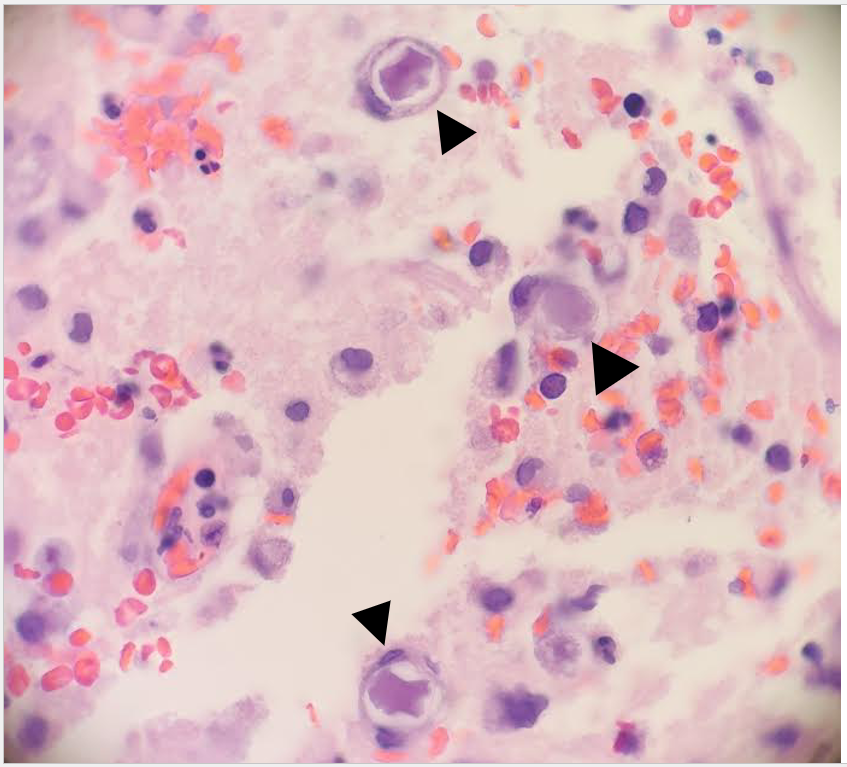
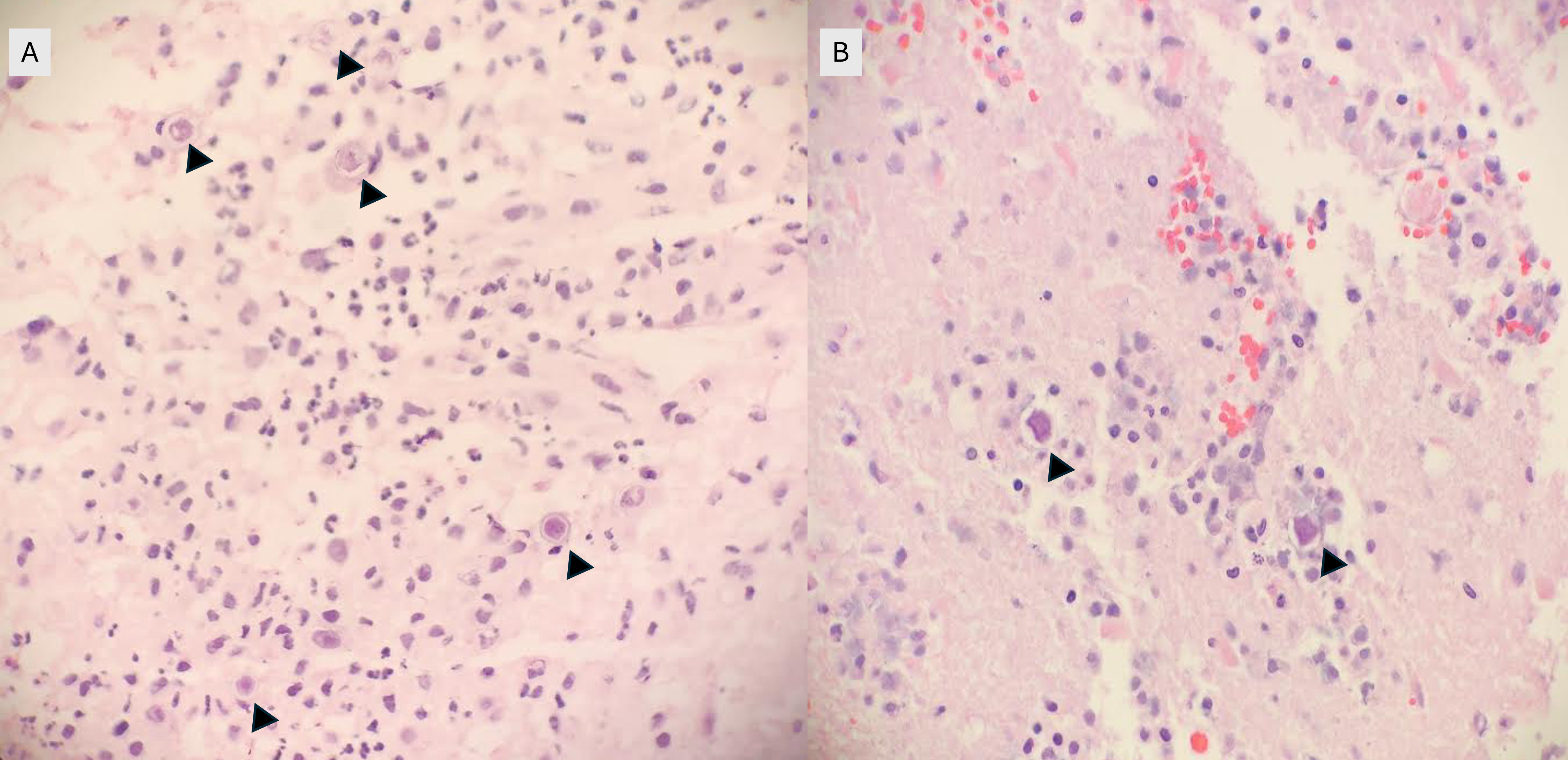
Frozen and permanent sections of a right temporal biopsy revealed frankly necrotic brain tissue with amoebic cysts and trophozoites, consistent with free-living amoeba (Figure 1 and 2). Cerebrospinal fluid (CSF) cytology was unremarkable. A specific immunohistochemistry (IHC) assay for Acanthamoeba species was performed at the Centers for Disease Control and Prevention (CDC; Atlanta, GA), confirming the diagnosis of granulomatous amoebic encephalitis from Acanthamoeba.

Figure 1. Frozen (A) and permanent (B) sections of a right temporal brain biopsy demonstrated amoebic cysts (arrowheads) in a background of necrosis, hemorrhage, and inflammation (H&E, 400x magnification).
Figure 2: Double-walled cysts (arrowheads) are observed in the brain biopsy  with admixed inflammation and hemorrhage (H&E, 1000x oil immersion magnification). 

Discussion

Acanthamoeba are free-living amoebae found worldwide in a variety of environmental sites, including soil, water, sewage, swimming pools, contaminated contact lens solution, and heating, ventilating, and air conditioning systems.1,2 The Acanthamoeba lifecycle consists of two stages: cysts and trophozoites. Although trophozoites represent the infective form, both cysts and trophozoites can enter the body through various means, including the eye, nasal passages, or broken skin.2,3. There are three distinct diseases that can be caused by Acanthamoeba: Acanthamoeba keratitis, disseminated infection, and Granulomatous Amebic Encephalitis (GAE).1

GAE is a parenchymal disease that occurs when Acanthamoeba enters the body through the respiratory system or broken skin, spreads hematogenously, and invades the central nervous system.2,3. Risk factors include immunocompromised status, such as HIV/AIDS, history of organ transplant, uncontrolled diabetes mellitus, liver cirrhosis, and malignancy.1,3 The clinical course tends to be subacute to chronic, with progressive neurological decompensation over weeks to months and eventual death. Imaging may reveal ring-enhancing lesions, arterial occlusions, infarctions, ventricular shifts, and areas of abnormal enhancement.3 CSF analyses may show a pleocytosis with lymphocyte predominance, increased protein, and decreased glucose; amoebae are typically not identified.3. While microscopic evidence of double-walled cysts and/or trophozoites demonstrates the presence of free-living amoeba in infected tissues, diagnosis of Acanthamoeba must be confirmed via specific IHC assays or PCR-based molecular techniques.4

There is currently no standardized recommended treatment, and no single agent has been shown to be universally effective.3. Rare successful cases have involved prolonged therapy using combinations of pentamidine isethionate, sulfadiazine, amphotericin D, azithromycin, flucytosine, and fluconazole or itraconazole.3,5

The patient was treated with miltefosine, fluconazole, pentamidine, flucytosine, and sulfadiazine, sulfamethoxazole/trimethoprim and azithromycin for HIV prophylaxis, and levetiracetam for seizure prophylaxis. Though repeat MRI of the brain/brain stem showed interval improvement of disease burden, he remained unresponsive to verbal, tactile, and painful stimuli, and his overall prognosis remained guarded. The patient was discharged to a long-term acute care facility, but returned to the emergency department one week later with recurrent seizures, hypotension, and fevers. Imaging revealed new areas of restricted diffusion in the right occipital and left parietal lobes. Despite continued treatment, the patient continued to decline and died approximately three months following his initial diagnosis.

References

1 Centers for Disease Control and Prevention. Parasites – Acanthamoeba – Granulomatous Amebic Encephalitis (GAE); Keratitis. https://www.cdc.gov/parasites/acanthamoeba/index.html. Accessed April 24, 2024.

2 Centers for Disease Control and Prevention. DPDx- Free Living Amebic Infections. https://www.cdc.gov/dpdx/freeLivingAmebic/index.html. Accessed April 24, 2024.

3 Siddiqui R, Khan NA. Biology and pathogenesis of Acanthamoeba. Parasit Vectors. 2012 Jan 10;5:6. doi: 10.1186/1756-3305-5-6. PMID: 22229971; PMCID: PMC3284432.

4 Haldar SN, Banerjee K, Modak D, Mondal A, Sharma C, Vasireddy T, Karad RK, Patel HB, Majumdar D, Bhattacharjee B, Khurana S, Ghosh T, Guha SK, Saha B. Case Report: A Series of Three Meningoencephalitis Cases Caused by Acanthamoeba spp. from Eastern India. Am J Trop Med Hyg. 2024 Jan 9;110(2):246-249. doi: 10.4269/ajtmh.23-0396. PMID: 38190743; PMCID: PMC10859797.

5 Visvesvara GS, Moura H, Schuster FL. Pathogenic and opportunistic free-living amoebae: Acanthamoeba spp., Balamuthia mandrillaris, Naegleria fowleri, and Sappinia diploidea. FEMS Immunol Med Microbiol. 2007 Jun;50(1):1-26. doi: 10.1111/j.1574-695X.2007.00232.x. Epub 2007 Apr 11. PMID: 17428307.

-Cristine Kahlow, MD, Pathology PGY-1 at UTSW Medical Center


-Clare McCormick-Baw, MD, PhD is an Assistant Professor of Clinical Microbiology at UT Southwestern in Dallas, Texas. She has a passion for teaching about laboratory medicine in general and the best uses of the microbiology lab in particular.

-Andrew Clark, PhD, D(ABMM) is an Assistant Professor at UT Southwestern Medical Center in the Department of Pathology, and Associate Director of the Clements University Hospital microbiology laboratory. He completed a CPEP-accredited postdoctoral fellowship in Medical and Public Health Microbiology at National Institutes of Health, and is interested in antimicrobial susceptibility and anaerobe pathophysiology

Waste Management Plus One

The latest Japanese Godzilla movie, Godzilla Minus One, is now available for home viewing or streaming, and as a life-long G-fan, I was excited to watch it again. The story begins in a ravaged Tokyo, right after the end of World War II, and everything is a mess. When Godzilla arrives, even more waste is created (hence the “minus one” designating another step backwards). The clean-up process would be tremendous, and it reminded me of the many waste types in the laboratory and how important it is to segregate it properly.

Proper lab waste segregation is not just about keeping the lab clean, it’s about minimizing the risk of contamination, protecting our environment, and adhering to legal requirements. Mismanaging waste can lead to high costs, serious health hazards, fines, and a tarnished reputation.

In a lab, waste can generally be classified into several categories. Biological waste is the most common. This includes any materials that have come into contact with biological specimens, such as cultures, stocks, and items contaminated with blood or other potentially infectious materials (OPIM). Sharps waste is a second type of biological waste. This includes needles, blades, and any other items that can puncture or cut. Sharps pose a high risk of injury and contamination if not disposed of correctly. Hazardous (chemical) waste is any discarded chemicals, whether they are reagents, solvents, or compounds. Proper handling is crucial to avoid dangerous reactions and to follow strict regulations. The lab may generate radioactive waste if it handles radioactive materials. Even small amounts of radioactive waste must be segregated and managed with utmost care due to their hazardous nature. Lastly, general waste includes items that don’t fall into the above categories, such as paper, packaging, and non-contaminated plastics.

One of the most effective ways to ensure proper waste segregation is through clear labeling and signage. Each waste container should be clearly marked with its category. Use color-coded bins (e.g., red for biological waste, yellow for chemical waste) and ensure the labels are large and legible. Place detailed posters near waste stations to remind staff of what goes where. Strategically place waste containers around the lab to make it easy for staff to dispose of waste correctly. For instance, have sharps containers readily available at workstations where needles or blades are used, and place chemical waste bins near areas where reagents are handled.

Training laboratory staff about proper waste segregation is key. All lab personnel should have this training during their onboarding process, and regular refresher courses and drills can help keep everyone up-to-date with any changes in protocols or regulations. Encourage immediate disposal of laboratory waste. Allowing waste to accumulate on benches or in undesignated areas increases the risk of accidents and contamination. Make it a rule that waste is disposed of in the correct container immediately after use.

Conduct regular audits of waste segregation practices. This can help identify any recurring issues or misunderstandings. Provide constructive feedback and take corrective actions as needed. Celebrating improvements can also motivate staff to maintain high standards. Lab leadership plays a crucial role in promoting a culture of safety and compliance. Provide the necessary resources, such as adequate waste containers, labeling supplies, and time for training. Discuss how mismanagement of waste can harm the environment, create regulatory fines, and increase lab costs. Tossing paper items into a sharps container, for example, is costly and wasteful. Extra money spent for container purchases and disposal could be better spent on new lab equipment and staff pay.

Proper waste segregation is truly a team effort. It requires the commitment and cooperation of every person in the lab. Review your lab’s waste management protocols today and make any necessary improvements. By following these guidelines, you not only protect yourself and your colleagues but also contribute to a safer, more sustainable world. It’s not a world with giant fire-breathing monsters wreaking messy destruction, but we need to do our best to keep it clean. That way labs can be designated a step ahead- or a “plus one” – for lab safety.

Dan Scungio, MT(ASCP), SLS, CQA (ASQ) has over 25 years experience as a certified medical technologist. Today he is the Laboratory Safety Officer for Sentara Healthcare, a system of seven hospitals and over 20 laboratories and draw sites in the Tidewater area of Virginia. He is also known as Dan the Lab Safety Man, a lab safety consultant, educator, and trainer.