Clinical Laboratory Science Education

At a young age, children have an idea of what they want to be when they grow up. From lawyers, to doctors, to scientists, children believe they can do it all. However, clinical laboratory science is not for everyone. In fact, Courtney Lower, who graduated from the University of Illinois-Springfield in 2014 with a Bachelor of Science degree in CLS, would attest to that. She believes that for someone to succeed in this field, one “must have patience, a high level of problem solving skills, and a compassion for helping others.” Possessing all of those skills is necessary when providing laboratory information and services that are required for the diagnosis and treatment of disease.

A clinical laboratory scientist not only performs laboratory tests, but he or she must also be able to explain the significance of these tests to physicians and other health professionals. A CLS must also be able to evaluate new methods and determine the effectiveness of new laboratory tests. This intense problem solving, along with her love for science, was what attracted Lower to the degree in the first place – which has in turn opened up the door to several possibilities.

Receiving a CLS degree has the potential to set one up for a multitude of exciting careers. A graduate can work in laboratories in several different settings: hospital, clinic, reference, government, or commercial. Within those laboratories, one could work in areas such as microbiology, chemistry, blood bank, hematology, and virology. Opportunities also exist in stem cell laboratories and veterinary clinics. Graduates can also use the degree to propel themselves into graduate or medical school.

Typically, CLS students take several science courses—typically chemistry and biology—before starting their degree-specific coursework. Most students take a similar route of three years of undergraduate schooling followed by a year in a laboratory setting to finish out their degree. Students enjoy this short schooling because it means that they can get into laboratories sooner. In particular, Lower remarked that, “My favorite program was rotations. It prepared me for transitioning from the classroom to the laboratory and I was able to gain more hands-on knowledge.”

Receiving a clinical laboratory degree has never been better when it comes to the job search. Graduates are basically guaranteed a job, partly because the degree is so versatile and partly because of abundant vacancies in the field. Hopefully this will be a degree that inspires young students let their love for science grow and partake in this field, allowing them to truly be able to do it all. Children can grow up knowing that they can serve a wide variety of employment opportunities and that their dreams can grow right along with them.

-Shannon Little is from Stillwater, Minnesota and is currently a journalism student at the University of Missouri. She is the fundraising chairman for Autism Speaks U. and is active in her sorority. In her free time, she enjoys watching U of M football.

Letters of Recommendation

Have you ever been asked to write a letter of recommendation? One of my favorite tasks is to write such a letter for someone who I believe is totally worthy of the honor for which he/she is being considered, or completely suited to the position or new career for which they are headed. Conversely, one of my least favorite tasks is to write such a letter for someone I’m unconvinced fits either of those categories.

Writing a letter of recommendation for someone you know well and believe in is a joy. It’s easy to write, easy to find examples, easy to express concepts. It almost writes itself. Writing a letter for someone you don’t know well, or aren’t sure fits the reason for the recommendation, can be a painful, tedious project.

A colleague once told me that if I can’t write a glowing recommendation for someone, I should decline to write one at all. That’s good advice because the recipient of the letter can often tell when you’re enthusiastic, and when you’re not. I have also received letters of recommendation for applicants from people who actually write a bad recommendation – why not to hire the person or admit him/her to the program. I’m appalled that people would agree to write a letter if they are going to write a bad recommendation. Yes, it is hard to say no to someone who comes asking, but it is far better to say no than to write a bad letter of recommendation.

Occasionally you may not have any options, and may need to write a letter of recommendation. For example a person may need a letter from their boss and have only worked in the job they currently have. Or they need a letter from their most recent instructor, and that’s you! These are especially hard to write because you may feel obligated to write a reference, but not have enough personal experience with the person to write a glowing one. In these cases, all you can do is write about as many positive aspects of the person as you are aware of and leave it at that. Sometimes I have talked to the person’s immediate supervisor or work colleagues to gain some insight before writing the letter.

I have declined to write a letter of recommendation on occasion. In general, I decline because I have not had enough direct contact with the individual asking me to provide them with a good recommendation. Once in a while I decline because I truly can’t recommend the person.

From the opposite perspective, when asking someone to write a letter of recommendation for you, always ask for a GOOD recommendation. Also, try to always ask people who know you well and know your work and work ethic well. You’ll be doing both them and yourself a favor.

-Patti Jones PhD, DABCC, FACB, is the Clinical Director of the Chemistry and Metabolic Disease Laboratories at Children’s Medical Center in Dallas, TX and a Professor of Pathology at University of Texas Southwestern Medical Center in Dallas.

There’s a Fungus Among Us

A 53 year old man with history of stroke, alcoholism, heart failure, hypertension, and atrophic right kidney presented to the ED with acute urinary retention and complained of dysuria and frequency. He was afebrile, denied nausea/vomiting or headaches. His labs at admission are listed below:

  • WBC: 21 k
  • Na: 122
  • Cr: 3 (baseline 1.2)

Urinalysis showed innumerable white blood cells, leukocyte esterase 3+ and negative nitrite.

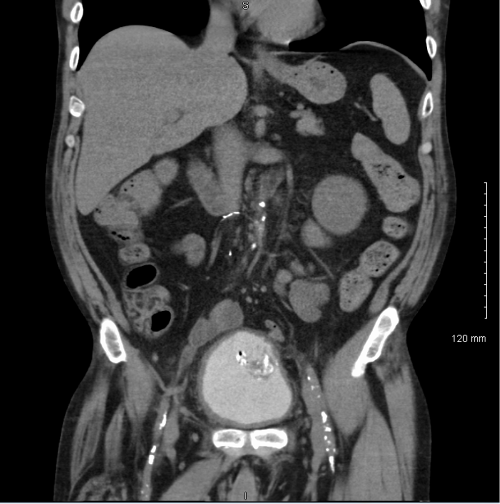
A catheter was placed and drained 1 L of yellow cloudy urine. The patient refused admission and he was prescribed ciprofloxacin 500 mg BID empirically and was sent home with a foley catheter in place with plans to follow up with Urology. He returned to the ED the following day because his foley catheter was not draining urine and he noted leaking around his catheter. CT scan was obtained and showed ill-defined areas of increased and decreased attenuation within the urinary bladder lumen and left hydroureteronephrosis.

fungusball1

Urine cultures obtained during his initial presentation grew >100,000 yeast and he was treated with fluconazole. The patient was taken to the operating room 11 days after first presentation to diagnose and treat the mass in the bladder. A tan-brown mass was removed and send to surgical pathology. Representative section (H&E stain) of the specimen is shown below:

fungusball2

Which of the following statements regarding Candiduria is true?

  1. Most patients with candiduria are asymptomatic and the yeasts merely represent colonization
  2. The presence of pseudohyphae in the urine or the number of colonies growing in culture help to distinguish colonization from infection
  3. The most commonly involved organ in disseminated candidiasis is the heart
  4. There is a higher propensity for fungal ball formation in adults than children

The correct answer is 1. Most patients with candiduria are asymptomatic and the yeast merely represent colonization. Infected patients may have symptoms (dysuria, frequency, suprapubic discomfort) while others might not. Pyuria is so common in patients with a chronic indwelling bladder catheter that it cannot be used to indicate infection.

Neither the presence of pseudohyphae in the urine nor the number of colonies growing in culture (unlike bacterial cultures) help to distinguish colonization from infection. Ascending infections are rare but usually subacute or chronic, unilateral and can cause perinephric abscesses.

Fungus balls in adults are uncommon with less than 10 adult cases reported in the literature. Risk factors include uncontrolled diabetes, prolonged use of antibiotics or steroids and immune compromise. Classic laboratory findings include marked leukocytosis, pyuria, hematuria and a concomitant bacterial urinary tract infection. Most cases are caused by Candida species although Aspergillus has been implicated in a few cases.

The kidneys are the most commonly involved organ in disseminated candidiasis and there is a higher propensity of fungus ball formation in neonates.

-Agnes Balla, MD is a 1st year anatomic and clinical pathology resident at the University of Vermont Medical Center.

Wojewoda-small

-Christi Wojewoda, MD, is the Director of Clinical Microbiology at the University of Vermont Medical Center and an Assistant Professor at the University of Vermont.