
Critical Update for Hispanic/Latinx Heritage Month and Indigenous Peoples’ Day

What is the data regarding the number of physicians- and pathologists-in-training who self-identify as Native American, Alaska Native, Hispanic/Latinx, or Native Hawaiian/Pacific Islander?

Among all resident physicians in ACGME-accredited and in combined specialty training programs on duty as of December 2022, there were a total of 154,231 individuals. The number of physicians in training in Pathology and its subspecialties totaled 2261 individuals.  Looking at the demographic data as self-identified, the following data are striking:
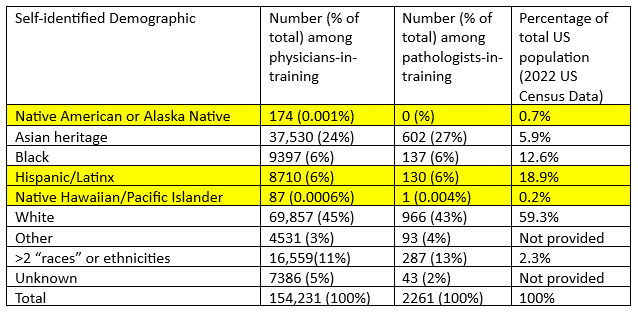
Reference: Data was derived from Table 8 from Brotherton SE, Etzel SI, Graduate Medical Education, 2022-2023, Appendix to JAMA 2023: 330(10):988-1011.

Clearly there is an enormous gap in training of people from Indigenous and Hispanic/LatinX background in both medical training generally and in pathology specifically.  The COVID19 pandemic disproportionately affected people from groups who are considered Under-Represented in Medicine (URIM), which include these groups, as well as individuals who self-identify as African American/Black, and who are also significantly under-represented in pathology and laboratory medicine. 

What about the numbers for the laboratory professions?

With respect to laboratory professionals in practice and in training, I searched unsuccessfully for rigorous data to compare to the data available for physicians in training; however, even from the numbers available, under-representation is a challenge in the laboratory professions.

Please also note that Asian heritage comprises over 50 different language and ethnic groups. Within the United States, some of these groups are disproportionately affected by poverty and adverse social determinants of health.  Therefore, for strategies to improve representation, future analyses should avoid simply lumping individuals into large buckets of self-identified demographic categories. 

To address the adverse health impacts of the social determinants of health for patients from ALL demographic backgrounds, it will be essential to recruit actively from groups who have been both URIM and also from communities grappling with the impact of low income; lack of access to health insurance; lack of access to clean water; lack of access to sanitation services; lack of access to high, quality fresh food; residence in historically redlined neighborhoods that have been zoned for hazardous industries; lack of access to air-conditioning and shade from trees; and over-representation in hazardous work conditions.

Even without addressing these subtleties within ethnic/demographic groups, the data presented in the table convey the obvious fact that we have work to do to increase the numbers of trainees in Pathology (and, by extension, in the laboratory professions) from populations who have been historically under-represented in our training programs and workplaces. ASCP has a great opportunity for focused efforts by our Career Ambassadors, our Pathology Ambassadors, and all members to increase awareness of career opportunities in laboratory medicine and pathology.   Recruitment is an important piece.  Equally important is building and sustaining climates in our training programs and workplaces where people feel welcomed, recognized, invited to participate in transforming our practices to serve our patients better and considered for opportunities to advance and to be considered for leadership positions.  Being hired is not enough. We all need to participate in continuous quality improvement, which means continuous engagement and active participation in decisions that will transform the ways we provide care so that we meet the needs of all our patients, now and in the future.

-Melissa P. Upton, MD.  Past-President of ASCP and Chair of the ASCP Diversity, Equity, and Inclusion Committee; Emeritus Professor of Pathology, Department of Laboratory Medicine and Pathology, University of Washington, Seattle, WA.

The Laboratory’s Role in Inclusion

“Where do we go from here…chaos or community?” is the question Dr. Martin Luther King, Jr. asked in 1967 before the civil rights riots in the hot summer of 1968.  The query was directed to the nation as it sought to address the racism and pain deeply felt in the daily lives of its African-American citizens.  Over 50 years later, that very same question is asked again as the nation is roiled with civil demonstrations, daily videos of racist behavior, and the seemingly senseless killings of African-American men and women. 

As American culture and the nation evolves, uncomfortable conversations are beginning to occur in healthcare and across the country.  Laboratory administrators and managers may want to reflect on the culture of their laboratory to ensure all voices are heard and that they are creating and supporting an inclusive work environment.

Diversity, inclusivity, and equity are goals healthcare organizations seek to incorporate into their culture to foster a healthy workplace environment and be reflective of the communities they serve.  As with most industries, the laboratory has found itself challenged to improve cross-cultural intelligence and eliminate implicit and unconscious bias.  The scientific community would like to believe it operates and makes decisions based solely on objectivity and facts.  However, everyone is human and prone to perceptions influenced by preconceived beliefs and life experiences. 

In the laboratory, questions involving race relations are pondered and discussed by workers of all creeds and colors.  Historically, laboratorians have viewed themselves as scientists focused strictly on the pursuit of facts, hard data, and helping patients.  However, one would err in thinking the lives of minority lab workers were encased in impenetrable bubbles of logic and reason. Instead, early on in their career (correction—their lives), many minority workers learned to compartmentalize and hide feelings of unfairness and helplessness in their effort to “fit in” and not make others feel uncomfortable.

Laboratory administrators should let employees know that their office is a “safe place” if an employee feels he or she needs to discuss issues affecting how they feel about their work environment. Many employees of color working in predominately white environments may avoid conversations involving race out of fear as being labeled as “one of those.”  However, avoiding difficult conversations does not make the problems go away; in fact, the lack of addressing an issue often creates a more significant problem later on, or the employee simply quits.  One thing managers should be prepared to hear if they are successful in creating a safe space and the employee chooses to talk, harsh truths.

Lab managers can be proactive and ask if the employee has encountered any barriers or obstacles to their success in the healthcare organization.  Minority employees frequently experience microaggressions, favoritism, and racial discrimination.  Discussing feelings may provide a release for the employee, allow the manager to begin to understand, and offer the opportunity for the manager to reflect on their behavior. 

 The diversity of today’s protest marchers provides evidence of the progress America has made toward vanquishing the problems of racism and discrimination.  All colors, creeds, and ethnicities are together expressing their desire to defeat the scourge of racial injustice.  Laboratories are a part of the social community, and minority employees are often reluctant to share anxiety and experiences they feel are race-based.  Lab managers should be reflective and reach out to their employees to let them know their office is a “safe place” to discuss issues openly, including those with racial overtones.  It is only through open and honest dialogue that we can avoid chaos and become the community we seek.

Darryl Elzie, PsyD, MHA, MT(ASCP), CQA(ASQ), has been an ASCP Medical Technologist for over 30 years and has been performing CAP inspections for 15+ years. Dr. Elzie provides laboratory quality oversight for four hospitals, one ambulatory care center, and supports laboratory quality initiatives throughout the Sentara Healthcare system.