
Death in Custody

When a person dies in police custody, forensic pathologists are responsible for performing an autopsy and determining cause and manner of death. While many people think “in custody” specifically means “in jail”, custody technically begins whenever the individual perceives that their freedom is being restricted. This leads to a broader timeline which can be divided into two main sections – the “pre-custody” and “custody” phases.

The “pre-custody” phase begins with the first interaction with law enforcement when the individual can no longer leave at will. Note that this does not necessarily mean they are under arrest, and it doesn’t necessarily involve physical contact. A wide variety of situations are therefore encompassed in this definition – it can mean a patrol office stopping (or “detaining”) someone on the street to ask questions, a police car putting on lights and sirens to pull someone over, or law enforcement arriving at a home with a lone person in crisis barricaded inside. This may seem like an excessively broad definition, but including this phase is necessary to capture deaths that occur during police pursuit and/or before apprehension. These are myriad and include deaths from blunt force injuries sustained in motor vehicle accidents, self-inflicted or other-inflicted gunshot wounds during a stand-off, or even a myocardial infarct (heart attack) while fleeing on foot. It isn’t hard to believe that amongst these many scenarios, some of these deaths could be preventable by policy changes or education. Without categorizing these deaths as in custody, we have no way of being able to review them and identify areas for potential improvement.

Once the individual is under physical control by law enforcement, the custody phase begins. This phase continues throughout incarceration until release (or, less commonly, judicial execution). Again, the types of deaths during this phase are widely variable and include natural diseases, accidental overdoses, suicidal hangings, and homicidal deaths from inflicted injuries. Because prisoners are a vulnerable population, unable to independently access medical care or report mistreatment, complete investigation and autopsy are needed. Even if prisoners are transported to the hospital for care and may be considered “discharged” from prison, they must be considered a custody death and reported to our office. After all, if the injury was sustained (or the disease began) while they were incarcerated, we need to make sure that foul play or neglect did not play a role.

During the autopsy, additional procedures are done to rule out occult trauma. The subcutaneous soft tissues of the wrists and ankles are examined, to identify injuries that may be associated with restraints. In situ examination of the muscles and cartilage of the neck can clarify whether pressure was placed on the neck (i.e. a chokehold). Given the degree of public interest, full transparency is of the utmost importance. Therefore, additional photographs (of both positive and negative findings) are performed to ensure reproducibility of the findings.

The public discourse around these deaths can be emotionally and politically heated, which is why it is so important that forensic pathologists and medical examiners are empowered to render scientific, unbiased opinions. In many areas of the United States, the death investigation system is run by a Coroner (an elected official). In some regions, the medical examiner is under the authority of the Sheriff. This problem was highlighted in 2017 in San Joaquin County, CA, when both the forensic pathologists resigned. Their resignation announcement informed the public that the Sheriff-Coroner was overruling their findings on death in custody. Subsequent legal changes were made to hopefully remedy the problem, but similar conflicts of interest exist in many other jurisdictions. If there is pressure from a politician or law enforcement, then forensic pathologists may not be able to fulfill their role of providing an impartial and scientific assessment of the facts.

It’s important to remember that our manner of death determination does not necessarily imply criminal actions. Most often, a ruling of homicide for an in-custody death doesn’t result in legal prosecution (think of the example of a person shot while pointing a gun at police). The autopsy can even help dispel concerns over excessive force or medical neglect. But without transparency and freedom from influence, the results will be viewed with suspicion. Deaths in custody therefore provide a crucial example of why forensic pathologist independence is a foundational element of death investigation.

References:

Prados MJ, Baker T, Beck AN, Burghart DB, Johnson RR, Klinger D, Thomas K, Finch BK. Do Sheriff-Coroners Underreport Officer-Involved Homicides? Acad Forensic Pathol. 2022 Dec;12(4):140-148. doi: 10.1177/19253621221142473.

Mitchell RA Jr, Diaz F, Goldfogel GA, Fajardo M, Fiore SE, Henson TV, Jorden MA, Kelly S, Luzi S, Quinn M, Wolf DA. National Association of Medical Examiners Position Paper: Recommendations for the Definition, Investigation, Postmortem Examination, and Reporting of Deaths in Custody. Acad Forensic Pathol. 2017 Dec;7(4):604-618. doi: 10.23907/2017.051.

-Alison Krywanczyk, MD, FASCP, is currently a Deputy Medical Examiner at the Cuyahoga County Medical Examiner’s Office.

Deep Dive into the Laboratory

This post is going to travel slightly off the beaten path by presenting a comparative analysis of my two favorite things – scuba diving and laboratory medicine. What in the world, you say? How can you possibly liken a recreational activity to an entire field of study? Easy. You just have to have a passion for both! I’ve been swimming and snorkeling since I was a wee little kid, always fascinated with being able to free dive down to the bottom of a body of water in one breath (you can blame my mermaid encounter for that). Around that same time, my parents gave me first microscope. The obsession with water was real, always examining wet mounts of everything that could fit between the slide and the coverslip. All throughout my grade school and undergrad years, I flourished in any science course that featured a microscope, finally acknowledging the fact that I had a knack for cells and tissues under the light microscope. During each summer break, I’d travel down to Florida with my parents and embrace the hidden gems of freshwater springs. It wasn’t until my junior year of college where I took a histology course during my summer break that I realized I wanted to make a career of this. During that summer, I began to research scuba diving; however, it wasn’t until after grad school and establishing a career as a cytologist that I finally committed to the idea. 10 years after graduating from a cytology program, I became the cytology supervisor at a renowned cancer center, and six years after my initial scuba diving certification, I became a dive professional, earning the title of divemaster.

Now, you should know that I like to dive deep into things – be it 112 feet down into a dark cavern or fully immersing myself in my work. Here, we’re going to dive into both scuba and the laboratory.

First and foremost, in both fields – diving and laboratory medicine, safety is paramount. There are rules and mechanisms in place to ensure that no one gets hurt. Policies and procedures are designed to keep you, your peers, and your “customers” (patients and students/certified divers) safe. Failure to follow a procedure can jeopardize lives. I’m certain you understand where I’m going with this. There are inherent risks in both fields, and we try to error-proof as best as we can. In diving, safety checks include checking you and your dive buddy’s equipment and configuration to make sure that gas cylinders are turned on and filled to an appropriate pressure, all hoses are connected and work as designed, releases and weights are secured, and that the divers have everything they need to perform the dive. Fortunately, in the laboratory, automation and barcoding has relieved the human eye of some of the burden of solely checking every patient detail, every order, and every equipment’s function. However, laboratory professionals must do their due diligence to double check. No piece of equipment is perfect, but following a procedure designed to avoid errors is the first step in verifying that the correct test has been ordered and the correct results will be delivered to the correct patient.

If you thought that preventative maintenance was necessary for lab equipment, scuba gear is the same way. Unlike a laboratory inspection, diving, for the most part, does not require evidence of gear maintenance to be “compliant” and therefore fit for use. The exception is visual inspection and hydrostatic testing of gas cylinders, but this is more a Department of Transportation rule. With that said, one of the top three reasons for dive accidents is equipment failure due lack of routine maintenance. That’s a risk I’m not willing to take. As much as I wish I had gills, I’m limited to the human form and the environment we are designed to live in. So whether it’s your own life or a family member’s test result, make sure that the relevant equipment is maintained per the manufacturer’s instructions or a more stringent policy or regulation.  

One of the many things I practice (while still ensuring a lean mindset) is redundancy. In diving, redundancy comes in the form of equipment. At a minimum, you should have two computers, two flashlights, two air sources, two regulators, two masks, two cutting implements, two people (buddy team), etc. If something goes wrong during a dive, there is a backup that can get you out of jam so that you can safely continue, or if necessary (and more likely the case), end that dive and formulate a plan for future dives. Think of needing to end the dive as a downtime procedure. In the laboratory, redundancy is having two centrifuges, two staining machines, two accessioning workstations, two analyzers (if that’s even in the budget), and other alternative, yet necessary procedures in the event of an electronic or equipment failure. The concept of redundancy is to maintain operations AND safety if something goes wrong.

Lastly, and something that I end my staff huddles or one-on-ones with is personal well-being. In diving, we disclose that it is okay to call a dive at any point for any reason, and a reason does not have to be provided. If you deem yourself physically, emotionally, or mentally unfit for a dive on any given day, call it. Do not muster through and pretend everything will be okay. That’s when divers neglect equipment checks, or fail to watch their gas consumption, depth limits, or time spent underwater. That’s when accidents happen. When you cannot be present for a dive, you cannot be present for your buddy or your students or divers that you are leading. In laboratory medicine, if you are not well, take the day off. I know we are dealing with staffing shortages across the country, I know that it might shift additional work onto a colleague, but you cannot risk jeopardizing patient care because you neglected yourself. Putting on a brave face for others in a world where it’s encouraged to be vulnerable is detrimental to more than just yourself, it’s detrimental to your passions. So take care of yourself and your (buddy) teams so that you can keep your passions safe and productive.

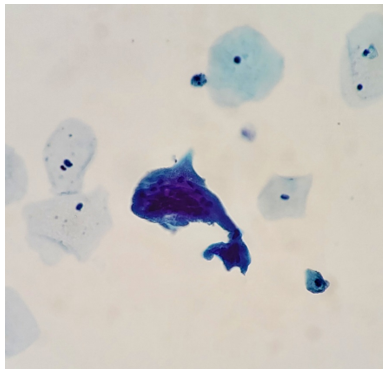
P.S. Sometimes diving and cytology overlap under the microscope, too!

-Taryn Waraksa-Deutsch, DHSc, SCT(ASCP)CM, CMIAC, LSSGB, is the Cytopathology Supervisor at Fox Chase Cancer Center, in Philadelphia, Pennsylvania. She earned her master’s degree from Thomas Jefferson University in 2014 and completed her Doctorate of Health Science from Bay Path University in 2023. Her research interests include change management and continuous improvement methodologies in laboratory medicine. She is an ASCP board-certified Specialist in Cytology with an additional certification by the International Academy of Cytology (IAC). She is also a 2020 ASCP 40 Under Forty Honoree. Outside of her work, Taryn is a certified Divemaster. Scuba diving in freshwater caverns is her favorite way to rest her eyes from the microscope.

Microbiology Case Study: Cough in a Female with B-cell Lymphoma

Case History

A 67 year old female presented to the emergency department with worsening chest pain and shortness of breath for several weeks. Her medical history was notable for diffuse large B cell lymphoma, for which she had started treatment with rituximab and tafastimab-cxix. Her complete blood count revealed severe leukopenia. A chest computed tomography scan showed focal consolidation in the right lower lobe, and broad-spectrum antibiotics and Filgrastim were started to treat her pneumonia. However, her symptoms did not improve. She underwent a bronchoalveolar lavage, which was sent to microbiology for culture. The initial Gram stain of the specimen was unrevealing. Twelve days later, a pathogen was isolated from cultures with acid-fast media and fungal media. On a Sheep’s blood agar plate, white, chalky colonies appeared. A Gram stain of the isolate showed gram-positive organisms growing as branching, beaded filaments. The organisms were further highlighted on a partial acid-fast stain. MALDI-TOF identified the organism as Nocardia farcinica. The patient was started on trimethoprim/sulfamethoxazole and imipenem, and was discharged following clinical improvement.

Images of Sheep’s blood agar plate showing white, dry colonies (left) and Gram stain highlighting beaded, branching filamentous bacteria after culture in MGIT broth (right).

Discussion

Once mistakenly classified as a fungus due to its filamentous, branching morphology, Nocardia spp. are actually gram-positive, aerobic bacteria that belong to the order Cornybacteriales1. Nocardia are normal inhabitants of the soil, where they digest decaying plant matter. However, they are a cause of human disease in susceptible hosts when they are inhaled or enter via the skin2,3 . The major risk factor for infection is an immunocompromised state, particularly defects in cell-mediated immunity. As such, patients with AIDS or lymphoma, those receiving allogeneic organ transplants, and those taking immunosuppressive drugs including high-dose steroids either are more susceptible to infection or suffer more severe disease2,4. Among persons with intact immune defenses, underlying lung diseases such as chronic obstructive pulmonary disease or cystic fibrosis, predispose to infection1.

The most common clinical manifestation of Nocardiosis, particularly in immunocompromised hosts, is a subacute to chronic pneumonia that can wax and wane, and abscesses are a characteristic pathologic feature4. Nocardia can spread via the blood to affect virtually all other organs, with the brain, eyes, and joints being common sites of dissemination1,5,6. Skin infections, more common in immunocompetent persons, include cellulitis and a lymphocutaneous disease that mimics Sporotrichosis4,5. Specifically for Nocardia farcinica, this species have been shown to be involved in disseminated diseases, with most patients being immunocompromised, but in immunocompetent individuals, cutaneous infections have been reported.

Often the first diagnostic clue comes from visualization of gram-positive beaded, thin, branching organisms on direct smears of specimens7. Of note, while the beaded, branching morphology is characteristic, this appearance is sensitive to several culture conditions including media and temperature. Given that Nocardia does not stain fully on Gram stain, it is recommended that a modified acid-fast stain be done as a reflex stain to confirm the suspicions. Organisms, aside from true Mycobacteria, that contain mycolic acids on the cell wall include Nocardia, Gordonia, Dietzia, Rhodococcus, Segmiliparus, Tsukamurella, and Williamsia.  However, in some cases, not all organisms can be seen on the direct smear, which warrants cultures to rule out infection but Nocardia spp. can be difficult to isolate in culture either due to low numbers in the initial specimen, or overgrowth by contaminating bacteria3. They grow slowly, usually over the course of weeks3,4. Nocardia can be isolated from most media used to culture bacteria, fungus and mycobacteria3,7. Colonies often appear white and dry but appearance of velvety, powdery, wrinkled, or being heaped are also not uncommon. On the reverse of the plate, the colors may vary and can be brown, tan, pink, orange, red, purple, gray, yellow, peach, or white. The partial acid-fastness of Nocardia spp. is an important corroborating piece of evidence7. Molecular and proteomic methods, including 16S rRNA sequencing and MALDI-TOF allow for definitive confirmation1,7.

A diagnosis of Nocardiosis aids in the selection of appropriate antibiotics and may raise suspicion for disseminated disease, such as brain abscesses. Trimethoprim/sulfamethoxazole remains the antibiotic of choice, and patients usually respond within weeks4. Adding another potent antibiotic such as imipenem helps treat more severe or disseminated disease6. Studies done in-vitro have shown that isolates with resistance to Trimethoprim/sulfamethoxazole are typically susceptible to carbapenems.

References

1.         Traxler RM, Bell ME, Lasker B, Headd B, Shieh WJ, McQuiston JR. Updated review on Nocardia species: 2006-2021. Clin Microbiol Rev. 2022;35(4).

2.         Steinbrink J, Leavens J, Kauffman CA, Miceli MH. Manifestations and outcomes of nocardia infections. Medicine (Baltimore). 2018;97(40).

3.         Lerner PI. Nocardiosis. Clin Infect Dis. 1996;22(6):891-903.

4.         Filice GA. Chapter 174: Nocardiosis. In: Harrison’s Principles of Internal Medicine. 21e ed. McGraw Hill; 2022. https://accessmedicine-mhmedical-com.proxygw.wrlc.org/content.aspx?bookid=3095&sectionid=263964309

5.         Mochon AB, Sussland D, Saubolle MA. Aerobic actinomycetes of clinical significance. Microbiiology Spectr. 2016;4(4).

6.         Langoya CO, Henderson NM, Sutherland RK. Nocardia and Actinomyces. Medicine (Baltimore). 2021;49(12):756-759.

7.         Tille PM. Chapter 18 Nocardia, Streptomyces, Rhodococcus and similar organisms. In: Bailey & Scott’s Diagnostic Microbiology. 15th ed. Elsevier; 2022.

-Stevephen Hung MD, PhD is currently a PGY-4 resident at George Washington University Hospital. He graduated from Case Western Reserve University School of Medicine in Cleveland, OH. His academic interests include transfusion medicine, informatics and molecular pathology.

-Rebecca Yee, PhD, D(ABMM), M(ASCP)CM is the Chief of Microbiology, Director of Clinical Microbiology and Molecular Microbiology Laboratory at the George Washington University Hospital. Her interests include bacteriology, antimicrobial resistance, and development of infectious disease diagnostics.