Dying in a Winter Wonderland: Staying Safe as the Temperature Drops

A 40 year old man was found deceased in a parking garage in a Midwest city. It was late October and had rained the previous evening. He was identified by his sister who was a tenant in the adjacent apartment building. Unknown to her, he had recently been discharged from the hospital after a one-week psychiatric admission. His sister stated he was homeless and would occasionally sleep in the parking garage for shelter.

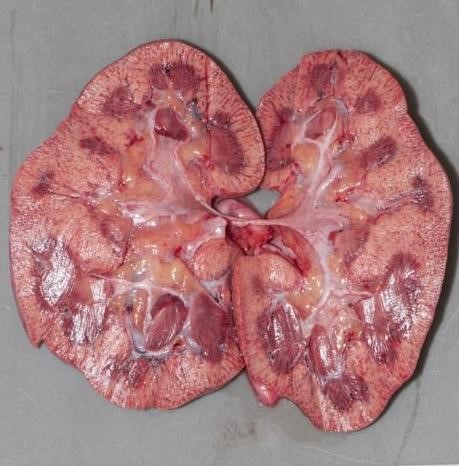
At the scene the decedent was prone on the ground, clad only in a pair of boxers. His water-soaked shoes, socks, sweatpants, and shirt were strewn about him. Autopsy revealed an atraumatic, thin adult man. Prominent pink discoloration was noted over the hips and knees. Internal examination showed only patchy black-brown discoloration of the gastric mucosa and pale kidneys. Histology was remarkable for subnuclear vacuolization of the renal tubular epithelium. The cause of death was certified as environmental hypothermia, and the manner of death accidental.

Hypothermia is defined as a core body temperature below 95℉ (35℃) and can result from endogenous illnesses like hypothyroidism or sepsis. The most common cause, though, is exposure to cold environments. On exposure, the hypothalamus initiates shivering and increases cellular metabolism to produce heat. Another crucial survival response is vasoconstriction, particularly of vessels in skin and skeletal muscle. If the overall loss of heat overtakes the body’s ability to produce or retain heat, hypothermia will result.

Developing hypothermia doesn’t require frigid weather – in dry air, temperatures of 50℉ can still result in hypothermia. Wind removes warmed air surrounding the body, and water conducts heat three times faster than air; therefore, with either of these factors present, people can develop hypothermia at even warmer temperatures,

The autopsy findings of hypothermia are not specific. External examination may show bright pink discoloration of the skin over joints (“frost erythema”). There may be black-brown spots on the gastric mucosa, (“Wischnewsky spots”), thought to result from terminal vasodilation of submucosal vessels. The kidneys may be pale with microscopic subnuclear vacuolization of the tubular epithelium (the “Armanni-Ebstein” lesion). Acute hemorrhagic pancreatitis has also been described. However, these findings require a period of survival to develop—many cases, particularly if the decedent succumbs quickly, show no findings at all. The diagnosis of hypothermia therefore relies heavily on scene investigation. “Paradoxical undressing” (demonstrated in this case), refers to the phenomenon of a terminally hypothermic person taking off their clothes. This is caused by a feeling of warmth resulting from failure of vasoconstriction in the skin, and contributed by altered mentation.

Those at greatest risk are people spending extended time outdoors, including the homeless and outdoor recreationalists. The elderly and very young have a lower ability to centrally regulate body temperature. Children’s increased body surface area also leads to more rapid heat loss. People who are intoxicated with alcohol or drugs may not sense the cold or lack judgment to seek shelter. Alcohol also acts as a vasodilator, impairing vasoconstrictive adaptation to cold.

As the weather cools down, be mindful of how easily hypothermia can develop. Temperatures can be above freezing, yet those who are vulnerable are still at risk of hypothermia. Prepare yourself well for any snowy excursions, and keep an eye on those in your community who may not be able to seek shelter.
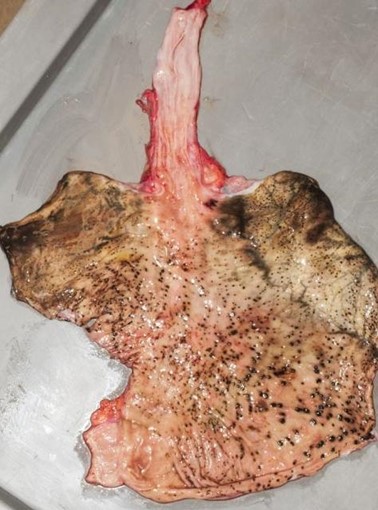
Stomach mucosa showing spots of black or dark brown discoloration
known as Wischnewsky spots. These are not specific to hypothermia and may just be an indicator of physiologic stress.
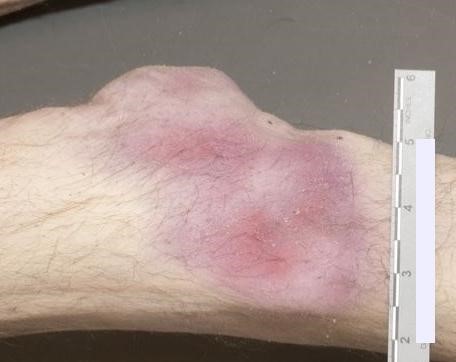
Bright pink discoloration over the knees, or “frost erythema”.
Pallor of the renal cortices corresponds to the microscopic “Armanni-Ebstein” lesion. This isn’t specific to hypothermia and can be seen in ketoacidosis from any cause.

-Alison Krywanczyk, MD, FASCP, is currently a Deputy Medical Examiner at the Cuyahoga County Medical Examiner’s Office.

Please Don’t Tell Me I Died of Cardiac Arrest

Ask any forensic pathologist what their professional pet peeve is and many of them will likely say “bad death certificates” (right after needing to scratch one’s nose in the middle of an autopsy). Despite the importance of death certificates to public health statistics, studies repeatedly demonstrate an unacceptably high error rate. Death certification isn’t taught in medical schools, and physicians usually learn on the fly. The media often perpetuates these errors, which is why you’ll see news headlines declaring a celebrity died of “cardiac arrest.” However, death certification is a relatively simple concept which can be easily grasped with a little instruction.

Cause of death is “that which in a continuous sequence, unbroken by an efficient intervening cause, results in death and without which death would not have occurred”. Put more simply, it is the etiologically specific disease or injury which triggers the chain of events leading to death. There’s no time limit; a cause can take years (as in breast cancer) or seconds (as in a gunshot wound). Conversely, mechanism of death describes the biochemical and biophysical processes by which the cause exerts its lethal effects. Mechanisms are non-specific and often happen in everyone who is dying (for example, hypoxia, metabolic acidosis, kidney failure). It’s easy to see why doctors list mechanisms on the death certificate—usually in a critically ill patient we’re focused on treating these mechanisms, by providing oxygen, replenishing electrolytes, and performing dialysis until kidney function has returned.

The most common example of this is “cardiac arrest.” Everyone who is dead is in cardiac arrest, by definition—what caused the cardiac arrest is what we really need to know. Putting only a mechanism on a death certificate doesn’t help families understand why their loved one died or inform them of their own potential medical risks, and it provides no useful information to public health prevention efforts.

Finally, manner of death describes the circumstances surrounding death. There are typically five options – natural, accidental, suicidal, homicidal, or undetermined. The most common manner of death error is ignoring fall-related injuries in the elderly or debilitated. A ground-level fall with femoral neck fracture can lead to death in a susceptible individual by blood loss, deconditioning, pneumonia, decubitus ulcers, or thromboembolism. Falls are not a “natural” event – they are potentially preventable, and especially in a vulnerable population may be a warning sign for neglect or abuse. For this reason, we categorize these deaths as accidental.

The nuances around death certification demonstrate one of my favorite roles as a forensic pathologist—public health informaticist. Accurate categorization of deaths allows us to track mortality data and intervene (for example, by notifying communities of a new potent fentanyl analog, or identifying trends in suicide). A death certificate of “cardiac arrest” is therefore frustratingly vague, and our patients and their families deserve a better answer. An academic autopsy program may find it worthwhile to do a quality assurance review of hospital death certificates to identify systemic errors or deficiencies. The CDC offers a free online tutorial (at https://www.cdc.gov/nchs/nvss/training.htm), which is an excellent resource for physicians or family members who want to learn more about this process.

Causes of DeathMechanisms of Death
Atherosclerotic cardiovascular diseaseCardiac ischemia
Type II Diabetes MellitusAcute renal failure
Blunt force injuriesExsanguination
Aspiration pneumonia due to cerebral infarctSepsis

Causes vs Mechanisms of Death: Notice that the causes are all etiologically specific diseases or injuries. The mechanisms are non-specific and lead the reader to ask “…due to what?”. For example, cardiac ischemia can be due to atherosclerosis, vasospasm, or blood loss from trauma.

-Alison Krywanczyk, MD, FASCP, is currently a Deputy Medical Examiner at the Cuyahoga County Medical Examiner’s Office.

Forensic Pathology: Getting to the Heart of the Matter

When I was about to complete residency in anatomic and clinical pathology, I was speaking with a colleague and mentioned I was pursuing dual fellowships in forensic and cardiovascular pathology. He furrowed his brow and asked, “What are you going to do with that?”

I was slightly surprised by this response, but he’s not the only person who would react that way. Many people (even pathologists) think of forensic pathology as gunshot wounds and motor vehicle accidents. While those deaths do come to our office, the majority of autopsies performed in the forensic setting are still due to natural causes, with heart disease making up a significant proportion. My interest in cardiovascular pathology was piqued when, as a medical student, I observed an autopsy on a healthy adolescent athlete who collapsed during a cross country race. The pathologist identified a congenital anomaly in his coronary arteries, in which the left coronary artery arose from the opposite cusp and traveled between the aortic and pulmonary arteries. This meant the coronary artery was susceptible to compression by the two surrounding, larger arteries, leading to ischemia and potential lethal arrhythmia whenever his heart rate became elevated. In another case, a relatively healthy young man had suddenly collapsed shortly after taking his first dose of prescribed azithromycin for a sinus infection. While the autopsy was macroscopically unremarkable, postmortem genetic testing revealed a likely pathogenic variant in a gene associated with long QT syndrome. In the context of the azithromycin (a drug known to prolong the QT interval), a lethal arrhythmia was triggered. His family was unaware of this heritable channelopathy, and they were urged to see a cardiologist themselves for a risk assessment.

These experiences made me see how our ability to detect and identify subtle cardiac disease at autopsy could have profound impacts on the emotional and physical well-being of families. It’s not news that pathology is facing a shortage of recruits, and both forensics and cardiovascular pathology are particularly feeling the squeeze. Unsurprisingly, these are both fields to which residents have very little exposure. Many residents don’t rotate through forensics until their 3rd year (after they’ve already chosen a specialty) and few academic centers have a specialized cardiovascular pathology service. The required number of autopsies to complete residency has now been decreased from 50 to 30, meaning residents see even less cardiovascular pathology during training. I can anecdotally add that myself and several other forensic pathologists I’ve met were occasionally discouraged from entering the field by academic mentors, who considered it a waste of potential. As a profession, we need to recognize the public health impact and academic worth of forensic autopsies and encourage residents’ exposure to the field. Not only is a well-trained forensic pathologist needed to accurately interpret injuries at autopsy, they are the front line in recognizing natural diseases that went undiagnosed prior to death. Additional cardiovascular training helps us to recognize potentially heritable cardiovascular disease; this not only helps families understand why and how their loved one died, but it also affords them the opportunity to obtain screening and interventional measures. It isn’t just natural deaths, either; people who died from any cause could have early signs of heritable disease, and overlooking them could mean disastrous consequences for the family. I would strongly encourage any pathology trainee with an interest in public and preventative health, molecular pathology, and non-neoplastic disease to consider combined training in forensics and cardiovascular pathology. The National Association of Medical Examiners offers free membership to trainees, and the Society for Cardiovascular Pathology offers a one-on-one mentorship program to introduce new members to the field – you will be a welcome addition to either or both groups! If you have specific questions you’d like to ask, I’m available at akrywanczyk@cuyahogacounty.us.

-Alison Krywanczyk, MD, FASCP, is currently a Deputy Medical Examiner at the Cuyahoga County Medical Examiner’s Office.